
Filter
675
Text search:
controlled
substances
Featured
90
136
Language
Document type
344
148
83
60
17
15
5
1
Countries
30
28
25
21
19
16
15
12
11
10
9
7
7
7
7
6
6
6
6
6
5
5
5
4
4
4
4
4
3
3
3
3
3
3
3
3
3
2
2
2
2
2
2
2
2
2
2
2
2
2
2
1
1
1
1
1
1
1
1
1
1
1
1
1
1
1
1
1
1
1
1
1
1
1
1
1
1
1
1
1
Authors & Publishers
Publication Years
Category
221
52
33
24
23
21
9
Toolboxes
138
61
29
26
26
22
21
21
19
18
14
12
11
11
10
7
7
5
5
3
2
2
2
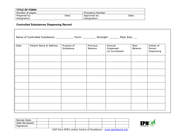
Last revised 2015.
Original Word document on: http://www.epnetwork.org/Resources/Standard%20Operating%20Procedure/Controlled%20substances%20dispensing%20record_Form.doc
Millennium Development Goal 8E aims for affordable access to essential medicines. Essential medicines, as defined by WHO, are those that “satisfy the health-care needs of the majority of the population” and that should therefore “be available at all times in adequate amounts”. However, there
...
The availability of controlled medicines is crucial for patients requiring palliative care, pain relief and symptom management. Many individuals worldwide, especially in low- and middle-income countries, continue to experience limited access to thes
...

GOVERNMENT NOTICE | No. 192 Promulgation of Medicines and Related Substances Control Act, 2003 (Act No. 13 of 2003), of the Parliament

Medicines and Allied Substances [No. 3 of 2013 47 | An Act to continue the existence of the Pharmaceutical Regulatory Authority and re-name it as the Zambia Medicines Regulatory Authority; provide for the functions and powers of the Authority; provi
...


Statutory Instrument 150 of 1991 | S.I. 150 of 1991 | Amended by S.I.’ s 298/93, 61/94, 319/94, 199/98, 256/98, 36/99, 24/2001 and 257/2002, 105 and 222 /2004

These guidelines have been developed in simple, user-friendly language and they explain the procedures for patients’ access to and the safe management of Schedule I and II drugs that are necessary for the treatment and relief of moderate to severe pain. They provide both procedures for acquisition
...

WHO guideline on balanced national controlled medicines policies to ensure medical access and safety
Access to medicines is essential for attainment of universal health coverage, which is central to achievement of the health-related Sustainable Development Goals. Controlled medicines include those such as opioids, benzodiazepines, barbiturates, amp
...
This publication provides information for identifying, classifying, marking, labelling, packaging, documenting and refrigerating infectious substances for transportation and ensuring their safe delivery.
The document provides practical guidance to
...
Constituting the fourth part of the World Drug Report 2022, this booklet focuses on the market dynamics of various stimulants – cocaine, amphetamines and “ecstasy” – and of NPS.
The first chapter contains an analysis of the global market for cocaine, starting with a review of cocaine supply
...
Access to controlled medicines. 3rd edition
The Access to Controlled Medications Programme identified the development of treatment guidelines that cover the treatment of all types of pain as one of the core areas of focus for improving access to opioid analgesics. Such guidelines are interes
...
Amphetamine-type stimulants, new psychoactive substances
-4-
World Drug Report 2017
Accessed: 14.03.2019

An Act to repeal the Dangerous Medicines Act of 1973,to ensure the availability of certain drugs for exclusive medical, scientific and related purposes, while preventing their abuse; to prevent the diversion from lawful trade of controlled chemicals
...

In 1998 the Swedish Veterinary Association decided to adopt a general policy for the use of antibiotics in animals. Since then specifi c policies for the use of antibiotics in dogs and cats have been adopted and in 2011 Guidelines for the use of Antibiotics in Production animals – Cattle and Pigs,
...
This user guide is designed to provide national malaria control programmes with general information on glucose-6-phosphate dehydrogenase (G6PD) deficiency. Individuals with this condition may be at risk of adverse effects from medicines commonly used to cure Plasmodium vivax malaria, as well as from
...
