
Filter
87
Text search:
International
Atomic
Energy
Agency
(IAEA)
Featured
11
19
Language
Document type
40
16
13
11
4
1
1
1
Countries / Regions
3
3
3
3
2
2
2
2
2
2
2
1
1
1
1
1
1
1
1
1
1
1
1
1
1
1
1
1
1
Authors & Publishers
Publication Years
Category
26
12
7
5
4
3
Toolboxes
22
10
6
4
4
3
3
2
2
2
1
1
1
1
1
1
1
Cancer centres are a major resource in ensuring a comprehensive approach to cancer treatment and its planning. As part of a new roadmap developed by WHO and IAEA to help countries design national cancer control programmes, this publication proposes
...
The aim of this publication is to provide a practical resource for emergency planning in the area of public communication in the development of a national radiation emergency communication plan (RECP). The term ‘public communication’ is defined as any activity that communicates info
...
These materials are designed for use at a training course on medical preparedness and response for a nuclear or radiological emergency. They contain a wide range of lectures and supporting materials, which cover the basic topics and more specific areas of medical preparedness
...
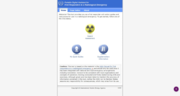
Welcome! This tool provides you as a first responder with action guides and instructions for use in a radiological emergency.
Also available in Russian: https://www-pub.iaea.org/MTCD/Publications/PDF/EPR-FirstRespondersPDA-2009/html/default.htm
The aim of this publication is to provide practical guidance for public information officers on the preparation for and response to a nuclear or radiological emergency, and to fulfil in part functions assigned to the IAEA in th
...
n view of the situation in Ukraine, IRSN has produced an information note presenting the nuclear facilities in Ukraine and an overview on the radiological monitoring of the country.
An increase of the radiological atmosphere around the Chernobyl site was reportedly observed on the stations nea
...
IAEA Safety Standards for protecting people and the environment
IAEA Safety Standards for protecting people and the environment
IAEA Safety Standards for protecting people and the environment
IAEA Safety Standards for protecting people and the environment
IAEA Safety Standards for protecting people and the environment

Types of radiotherapy equipment covered by the guide include external beam radiotherapy machines (both Cobalt-60 and linear accelerators), brachytherapy devices that apply radiation sources directly to tumours and complementary imaging devices such as conventional or computed tomography (CT) simulat
...
This Joint Emergency Management Plan of the International Organizations (Joint Plan) describes the
interagency framework of preparedness for and response to an actual, potential or perceived nuclear or
radiological emer
...
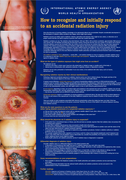
This leaflet is intended to inform physicians — mainly GPs — and medical students on how to recognize a possible radiation injury. It is important to note that radiation injury has no special signs and symptoms. However, the combination of some of them may be typical of radiation injury.
Arabic
...

Annex of Environmental Health in Emergencies and Disaster; page 245 - 252
Information in Tables 1–4 summarizes the actions of the World Health Organization,
the International Atomic
...

The Philippine Government, International Non-government Organizations (INGOs) and local NGOs are all making attempts to address the impact of disasters and climate change at various levels. The Philippine Government has made significant strides in t
...
Ghana's attempt to regulate health care waste management started in 2002 with the development of guidelines on health care waste manage-ment by the Environmental Protection Agency (EPA). In 2006, the Ghana Health Service (GHS) also developed the Hea
...
International health regulations (2005): state party self-assessment annual reporting tool, 2nd ed
Second edition.
AVailable in English, French, Spanish, Russian, Chinese and Portuguese
International Health Regulations (2005)
recommended
Third edition. The International Health Regulations (2005) (IHR) provide an overarching legal framework that defines countries’ rights and obligations in handling public health events and emergencies that have the potential to cross borders.
