
Filter
842
Text search:
Health
Cluster,
World
Health
Organization
(WHO)
Featured
Recommendations
87
New Publications
232
Language
Document type
No document type
450
Studies & Reports
138
Guidelines
113
Manuals
50
Strategic & Response Plan
50
Situation Updates
17
Training Material
9
Fact sheets
8
Resource Platforms
6
Infographics
1
Countries / Regions
Global
31
Sierra Leone
22
Syria
22
Malawi
21
Nepal
18
Kenya
18
Nigeria
17
India
16
Africa
16
Liberia
14
Ethiopia
14
Bangladesh
14
South Sudan
13
Rwanda
13
Myanmar / Burma
13
Uganda
12
Yemen
12
Zambia
11
Ukraine
11
Congo, Democratic Republic of
10
South Africa
10
Zimbabwe
9
Senegal
7
Mozambique
7
West and Central Africa
7
Guinea
6
Ghana
6
Haiti
6
Afghanistan
6
Mali
5
Cameroon
5
Cambodia
5
Russia
5
Niger
4
Philippines
4
Somalia
4
Pakistan
4
Tanzania
4
Brazil
4
Lesotho
4
East and Southern Africa
4
Western and Central Europe
4
Palestine
4
Burkina Faso
3
Lebanon
3
Thailand
3
Central African Republic
3
Colombia
3
Madagascar
3
Latin America and the Carribbean
3
Eastern Europe
3
Moldova
3
Indonesia
2
Sudan
2
Namibia
2
Eswatini/ Swaziland
2
Hungary
2
Libya
2
Mexico
2
South–East Asia Region
2
Venezuela
2
Morocco
1
Togo
1
Chad
1
Gambia
1
Mauritania
1
Papua New Guinea
1
Argentina
1
North Macedonia
1
Croatia
1
Sri Lanka
1
Middle East and North Africa
1
Western Pacific Region
1
Other region
1
Asia
1
Bhutan
1
Poland
1
Albania
1
Armenia
1
Laos
1
Tajikistan
1
Romania
1
Iran
1
Kyrgyzstan
1
Georgia
1
Vietnam
1
Jamaica
1
Denmark
1
Mauritius
1
Norway
1
Portugal
1
Azerbaijan
1
Belarus
1
Authors & Publishers
Publication Years
Category
Countries
294
Key Resources
84
Women & Child Health
73
Clinical Guidelines
67
Public Health
48
Capacity Building
10
Pharmacy & Technologies
6
Toolboxes
COVID-19
91
HIV
61
Conflict
57
Mental Health
49
Disability
30
Ebola & Marburg
26
NTDs
24
Rapid Response
23
TB
23
Natural Hazards
21
Planetary Health
19
AMR
18
Global Health Education
15
2.0 Rapid Response
15
Caregiver
13
Polio
11
Refugee
10
NCDs
9
Pharmacy
8
Cholera
6
Specific Hazards
6
Zika
5
Health Financing Toolbox
4
Typhoon
3
Malaria
3
Social Ethics
1
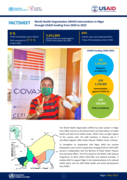
The World Health Organization (WHO) has been present in Niger since 1960, and acts as the Govern
...
South Sudan continues to struggle with a severe health crisis affecting 8.9 million people, primarily in flood- and conflict-affected regions with population movements (displacement and returns), and disease outbreaks. The nation's
...
The postpartum period is a critical time for mothers and newborns, who require essential hygiene and personal items, such as menstrual pads, clothes, and diapers, to ensure their well- being and health
...
Confronted with the important issue of patient safety, in 2002 the Fifty-fifth World Health Assembly adopted a resolution urging countries to pay the closest possible attention to the problem and to
...

The humanitarian crisis in Northeast Nigeria, driven by conflict, climate-related shocks, and food insecurity, has created immense challenges for the health sector in Borno, Adamawa, and Yobe (BAY) States. About 1.8 million people remain displaced(1
...
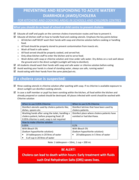
What you should do as head of school or child centre to prevent cholera:
Educate all staff and pupils on the common cholera transmission routes and how to prevent it.
Educate all kitchen staff on how to handle food and cooking utensils. Emphasis the key points below:
o All kitchen staff MUST wa
...
The war in Gaza has resulted in thousands of amputations, including early estimates of over 1000 children, all of whom have immediate and life-long needs. Surgical amputations performed under extremely difficult conditions are likely to be sub-optimal, meaning many of those amputated will require fu
...
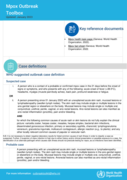
i. A person who is a contact of a probable or confirmed mpox case in the 21 days before the onset of signs or symptoms, and who presents with any of the following: acute onset of fever (>38.5°C), h
...
The document introduces a simple classification, minimums standards and a registration form for Foreign Medical Teams (FMTs) that may provide surgical and trauma care arriving within the aftermath of a sudden onset disaster. These can serve as tools to improve the coordination of the foreign medical
...

This report is one of the first major products of the newly established Precision Public Health Metrics unit of the UCN cluster of the WHO Regional
...
This guidance has been developed in line with the WHO corporate risk management framework, the WHO business continuity and contingency plans, as well as the Inter-Agency Emergency Response Preparedn
...
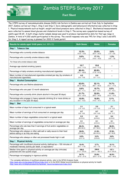
The STEPS survey of noncommunicable disease (NCD) risk factors in Zambia was carried out from July to September 2017. Zambia carried out Step 1, Step 2 and Step 3. Socio demographic and behavioural information was collected in Step 1. Physical measurements such as height, weight and blood pressure w
...
Available in Arabic, Chinese, English, French, Russian and Spanish. You can download a summary of the main report and background documents!
The report demonstrates that the current system—at both national and international levels— was not adequate to protect people from COVID-19. The time it t
...
The WHO Model List of Essential Medicines and Model List of Essential Medicines for Children are updated and published every two years, intended as a guide for countries or regional authorities to adopt or adapt in accordance with local priorities a
...
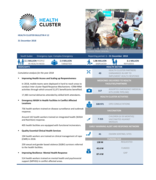
Emergency WASH in Health Facilities in Conflict Affected Locations 756 health workers trained on disease surveillance and outbreak response.
Around 142 h
...
The primary audience for the guideline is health programme managers, including governmental and non-governmental organizations, and policy makers who are responsible for designing maternal, newborn
...
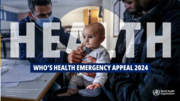
In 2024, we need US$1.5 billion to provide live-saving health care to millions of people in emergencies. An alarming combination of conflict, climate-related threats and increasing economic hardship mean an estimated 166 million people require
...

The World Health Organization (WHO) is releasing the second edition of its Global Accelerated Ac
...

The Millennium Development Goals (MDGs) showed
that global commitment and collective action
could significantly reduce the disease burdens of
three deadly communicable diseases: HIV/AIDS,
tuberculosis (TB) and malaria. The MDGs helped
focus efforts on these three deadly diseases
and leveraged
...
