Filter
1206
Text search:
Green,
R.
Featured
Recommendations
104
New Publications
239
Language
Document type
No document type
521
Studies & Reports
356
Guidelines
182
Manuals
72
Training Material
26
Strategic & Response Plan
22
Fact sheets
18
Situation Updates
3
Brochures
2
Resource Platforms
2
Infographics
2
Countries / Regions
Global
81
India
61
Western and Central Europe
30
South Africa
29
Kenya
24
Latin America and the Carribbean
21
Africa
21
Russia
17
Uganda
15
Eastern Europe
15
Nepal
14
Ghana
12
Bangladesh
12
Sierra Leone
10
Nigeria
10
Philippines
10
Tanzania
10
Rwanda
10
Ukraine
10
Myanmar / Burma
10
Zambia
9
Brazil
9
Ethiopia
8
Asia
8
Germany
7
Indonesia
7
South–East Asia Region
7
Eastern Europe and Central Asia
7
Liberia
6
Congo, Democratic Republic of
6
Cameroon
6
Pakistan
6
South Sudan
6
Afghanistan
6
Syria
6
China
6
Burkina Faso
5
Malawi
5
Mozambique
5
Chile
5
Middle East and North Africa
5
Senegal
4
Benin
4
Namibia
4
East and Southern Africa
4
West and Central Africa
4
Venezuela
4
North America
4
Guinea
3
USA
3
Zimbabwe
3
Haiti
3
Somalia
3
Chad
3
Cambodia
3
Thailand
3
Colombia
3
Angola
3
Madagascar
3
Lesotho
3
Paraguay
3
Belarus
3
Mali
2
Niger
2
Iraq
2
Jordan
2
Papua New Guinea
2
Sudan
2
Argentina
2
Peru
2
Eswatini/ Swaziland
2
North Macedonia
2
Ecuador
2
Mexico
2
Sri Lanka
2
Yemen
2
Western Pacific Region
2
Tajikistan
2
Kazakhstan
2
Georgia
2
Spain
2
Guinea-Bissau
1
Côte d’Ivoire / Ivory Coast
1
Morocco
1
Saudi Arabia
1
Lebanon
1
Turkey
1
Egypt
1
Malaysia
1
Mauritania
1
Dominican Republic
1
Cuba
1
Burundi
1
Honduras
1
Botswana
1
El Salvador
1
Bolivia
1
Libya
1
Guatemala
1
Nicaragua
1
Solomon Islands
1
Bhutan
1
Armenia
1
Mongolia
1
Congo-Brazzaville
1
Canada
1
Timor Leste/ East Timor
1
Qatar
1
Vietnam
1
Turkmenistan
1
Japan
1
Belgium
1
France
1
Tunisia
1
Portugal
1
Israel
1
Latvia
1
Authors & Publishers
Publication Years
Category
Countries
320
Clinical Guidelines
101
Public Health
84
Women & Child Health
71
Key Resources
57
Capacity Building
18
Pharmacy & Technologies
16
Toolboxes
Planetary Health
175
COVID-19
102
Mental Health
101
TB
73
HIV
62
NCDs
50
NTDs
45
Caregiver
43
Global Health Education
38
Pharmacy
31
Health Financing Toolbox
29
AMR
27
Disability
21
Ebola & Marburg
20
Natural Hazards
18
Refugee
15
Conflict
14
Social Ethics
9
Cholera
8
Malaria
8
Zika
6
Specific Hazards
6
Polio
5
2.0 Rapid Response
4
Rapid Response
3
South Sudan
1
Typhoon
1

The document emphasizes integrating environmental considerations into nutrition programs. It introduces a screening tool piloted across ten projects to identify environmental risks and opportunities, fostering sustainable practices in food systems. The tool promotes collaboration, co-learning, and a
...
People with asthma should be encouraged to take part in any sport they choose. If someone with asthma is having difficulty with sport, it means their asthma may not be under control. You will need to see your doctor to review your controller treatment and the way you use your medications in oder to
...
PlosOne https://doi.org/10.1371/journal.pone.0165797; Food production is a major driver of greenhouse gas (GHG) emissions, water and land use, and dietary risk factors are contributors to non-communicable diseases. Shifts in dietary patterns can therefore potentially provide benefits for both the en
...
BACKGROUND. Asthma is a heterogeneous condition characterised by chronic inflammation and variable expiratory airflow limitation, as well as airway reversibility. The burden of asthma in children is increasing in low- and middle-income countries and remains under-recognised and poorly managed.
OBJE
...

Lancet Planet Health 2019; 3: 469–77
The GCF aims to support developing countries in achieving a paradigm shift to low-emission and climate-resilient pathways. This is achieved by funding innovative and transformative lowemission (mitigation) and climate-resilient (adaptation) projects and programmes developed by the public and private
...
In line with the Climate and Environment Charter for Humanitarian Organisations which IFRC, ICRC and various Red Cross Red Crescent National Societies have endorsed, this short Guide aims to help practitioners integrate environmental and climate change considerations into their work. It has been dev
...
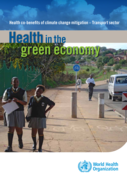
The threat climate change poses to health, equity, and development has been rigorously documented. However, in an era marked by economic crisis, regional conflicts, natural disasters and growing disparities between rich and poor, the joint global actions required to address climate change have been
...
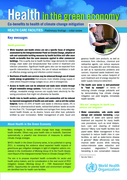
WHO's Health in the Green Economy sector briefings examine the health impacts of climate change mitigation strategies considered by the Intergovernmental Panel on Climate Change in their Fourth Assessment Report.
WHO's Health in the Green Economy sector briefings examine the health impacts of climate change mitigation strategies considered by the Intergovernmental Panel on Climate Change in their Fourth Assessment Report (Climate Change, 2007). Large, immedi
...
Burkina Faso remains one of the poorest countries in the world, with 44.5% of the population living below the poverty line. To promote the rights of persons with disabilities, the country has adopted almost all of the relevant initiatives and international legal texts on the rights of persons with d
...

Biodiversity and Health in the Face of Climate Change pp 47–66
This chapter reviews the emerging importance of pollen allergies in relation to ongoing climate change. Allergic diseases have been increasing in prevalence over the last decades, partly as the result of the impact of climate change.
...
Cervical intraepithelial neoplasia (CIN) is a premalignant lesion that may exist at any one of three stages: CIN1, CIN2, or CIN3. If left untreated, CIN2 or CIN3 (collectively referred to as CIN2+) can progress to cervical cancer. Instead of screening and diagnosis by the standard sequence of cytolo
...

To understand the mental health treatment gap in the Region of the Americas by examining the prevalence of mental health disorders, use of mental health services, and the global burden of disease.
In this era, grand challenges lies in biodiversity loss, climate change, and global noncommunicable diseases signify that planet and humanity are in crisis. Scholarly evidence from human and animal kingdom suggest that there is an optimism in planetary health which can provide a unique and novel con
...