
Filter
42
Topics:
Antimicrobial Resistance (AMR)
Featured
7
Language
Document type
17
6
5
4
3
2
1
1
1
Countries / Regions
3
2
2
1
1
1
1
Authors & Publishers
Publication Years
Category
3
2
1
1
1
1
1
1
1
Toolboxes
7
6
5
5
4
3
3
2
2
2
1
1
1
1
1
1
1
1
1
1
1
1
1
1
1
1
1
1
1
1
1
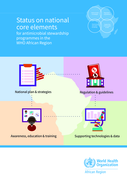
Antimicrobial resistance (AMR) is one of the world’s top 10 public health threats. The World Health Organization (WHO) in the African Region, using the Antimicrobial Stewardship assessment tool, has assessed Member States progress on strengthening national capacity need for effective implementatio
...

National action plans on antimicrobial resistance (AMR) often overlook the critical intersection of gender, despite evidence that exposure and susceptibility to infection, health-seeking behaviours, as well as antimicrobial prescribing and use patterns are all influenced by gender.
This dataset contains data from WHO's data portal covering the following categories:
Air pollution, Antimicrobial resistance (AMR), Assistive technology, Child mortality, Dementia diagnosis, treatment and care, Dementia policy and legislation, Environment and health, Foodborne Diseases Estimates,
...

Antimicrobials are medicines, including antibiotics, antivirals, antifungals, and antiparasitics, that are used to prevent and treat infections in humans, animals, and plants. Antimicrobial Resistance (AMR) arises when bacteria, viruses, fungi, and parasites no longer respond to these medicines, ren
...
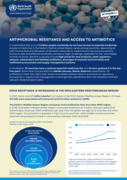
It is estimated that around 2 billion people worldwide do not have access to essential medicines. Access to medicines in the Eastern Mediterranean Region varies among countries, depending on their income level and allocation of domestic resources to medicine and vaccine procurement. Access to safe a
...
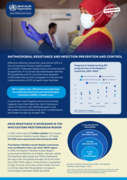
Effective infection prevention and control (IPC) is the cornerstone of every health system. As of 2023, 17 Member States have a functioning IPC programme; 19 countries have developed national IPC guidelines; and 13 countries have adopted multimodel intervention strategies to improve th
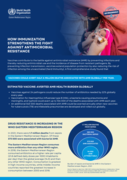
Vaccines contribute to the battle against antimicrobial resistance (AMR) by preventing infections and thereby reducing antimicrobial use and the incidence of disease from resistant pathogens. By preventing infection transmission, vaccines extend population protection by also reducing the risk of inf
...

Antimicrobial resistance (AMR) is a global public health crisis that resulted in 1.14 million deaths in 2021. According to the Institute for Health Metrics and Evaluation estimates, 96 416 of these deaths occurred in the World Health Organization (WHO) Eastern Mediterranean Region. All 22 countr
...
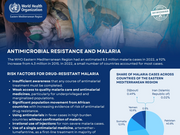
Antimicrobial resistance (AMR) and malaria remain significant public health challenges in the WHO Eastern Mediterranean Region (EMR). In 2021, the region reported 1.7 million sepsis-related deaths, with 373,000 associated with bacterial AMR. High antibiotic consumption, particularly in high-income c
...
La promotion du bon usage et l’utilisation appropriée des antimicrobiens sont à la base du quatrième objectif du Plan d’action mondial pour combattre la résistance aux antimicrobiens de l’Organisation mondiale de la Santé (OMS), adopté par les États Membres lors de la Soixante-Huitième
...

Video: Imaginez un monde dans lequel les infections et les maladies chez les animaux, les humains et les plantes ne pourraient pas être traitées. Ce scénario catastrophe pourrait devenir une réalité, car certains virus, champignons, parasites et certaines bactéries développent une résistance
...

En janvier 2021, un nourrisson atteint de tuberculose a été admis à l'hôpital dans l'État américain du Kansas. Les médecins ont rapidement découvert que la souche bactérienne à l'origine de l'infection était immunisée contre quatre traitements couramment utilisés, selon une étude réce
...
Au cours des trente dernières années, la mortalité des enfants de moins de cinq ans a chuté de près de 60 % au niveau mondial

The Strategy to respond to antimalarial drug resistance in Africa is a technical and advocacy document, grounded in the best available evidence to date and aimed at minimizing the threat and impact of antimalarial drug resistance of Plasmodium falciparum parasites in Africa. Its objectives are to: i
...
WHO’s sentinel surveys of acquired HIV resistance to dolutegravir among people receiving dolutegravir-containing antiretroviral therapy is intended for easy and frequent implementation. Results from sentinel surveys provide insight into the prevalence and year-over-year trends of dolutegravir resi
...
Esta guía rápida sobre la adaptación de los programas de resistencia a los antimicrobianos (TAP, por su sigla en inglés) se ha elaborado para ayudar los países a iniciar y ejecutar proyectos para enfrentar la propagación de la resistencia a los antimicrobianos en sus territorios. La resistenci
...

This document is a compilation of all questions, justifications, and sources used to determine the 2021 Global Health Security Index scores for Zambia. For a category and indicator-level summary, please see the Country Profile for Zambia.
La surveillance, par secteur, de la résistance aux antimicrobiens et de leur utilisation, ainsi que l’échange et la comparabilité des données entre les secteurs pour soutenir le principe « Une seule santé » sont essentiels. Cependant, il existe actuellement un nombre considérable de diffic
...
