
Filter
105
Featured
4
Language
Document type
63
26
9
2
2
2
1
Countries / Regions
79
10
3
2
1
1
1
1
1
1
1
1
1
1
1
1
1
1
1
1
1
Authors & Publishers
Publication Years
Category
1
Toolboxes
88
12
6
3
3
2
2
2
1
1
1
1
1
1
Over the past decade, countries in the African region experienced slow progress in mobilizing resources for health while facing continued challenges. In their revised estimates published in 2017, Stenberg et al., developed two costs scenarios, termed progress and ambitious, aimed at strengthening co
...
In 2021, global life expectancy at birth was 74 years whereas in sub-Saharan Africa it was 66 years. Yet in that same year, $92 per person was spent on health in sub- Saharan Africa, which is roughly one fifth of what the next lowest geographic region—North Africa and Middle East—spent ($379). T
...

One approach to development assistance for health, or health aid, emphasizes the ex ante selection of cost-effective health interventions, an approach that began with the World Development Report (1993) on Investing in Health and has since been adopted by the Effective Altruism community. But just h
...
The relative priority received by issues
in global health agendas is subjected to impressionistic
claims in the absence of objective methods of assessment
of priority. To build an approach for conducting structured
assessments of comparative priority health issues receive,
we expand the public
...
When we presented our analysis of Germany’s role in
global health in 2017 at an event in Berlin, Richard
Horton, the Editor-in-Chief of The Lancet, asked only
half-jokingly whether we could expect Germany to finally
shrug off the habitus of the “reluctant leader” and “step
up”. Back t
...
IHME’s Financing Global Health report provides an overview of health spending around the world, with a special focus on investments in health in low- and middle-income countries. The report examines how this funding for health is changing each year and forecasts how it may change in the future. Fi
...

As a recognized win–win-win approach to international debt relief, Debt-to-Health(D2H)has successfully translated debt repayments into investments in health-related projects. Although D2H has experienced modifications and periodic suspension, it has been playing an increasingly important role in r
...
Nearly 90 years after Simon Kuznets first introduced Gross Domestic Product (GDP) for the limited purpose of measuring economic growth (by measuring the monetary value of all local goods and services within a given period of time), calls continue to mount for decision-makers to stop using GDP and it
...
This paper presents a bibliometric analysis of the literature on private health aid and official health assistance between 2000 and 2022. It provides an overview of the sites and themes in the literature pertaining to development assistance in health, and collates the significant policy recommendati
...

Rising levels of inflation, debt and macrofiscal tightening are putting expenditures on the social sectors including health under immense scrutiny. Already, there are worrying signs of reductions in social sector investments. However, even before the pandemic, evidence showed the significant returns
...

The key tools and governance approaches for
international cooperation for sustainable development
(hereafter, international cooperation) were set up in a
markedly different time and age. International
cooperation – with official development assistance
(ODA) as the dominant means of implementa
...
The most packed schedule of cyclical replenishments in global health multilateral institutions has the potential to also clash with competing interests fuelled by a packed election calendar. But health imperatives are not a winner gets all scenario. The article provides a perspective on what needs t
...
Achieving universal health coverage (UHC) is a politicalambition in many low- and middle-income countries(LMICs). Public funding has been recognized as funda-mental to the two dimensions of UHC: expanding healthservice coverage and increasing protection against health-related financial hardship. Rel
...

Zambia is facing a severe economic crisis marked by high inflation, increasing poverty and a heavy debt burden that is straining both its fiscal stability and progress in health outcomes. By 2020, the country's external debt reached United States dollars (USD) 12.7 billion, representing 108% of the
...
Nigeria’s healthcare system faces significant challenges in financing and quality, impacting the delivery of services to its growing population. This study investigates healthcare workers’ perceptions of these challenges and their implications for healthcare policy and practice. A cross-sectiona
...

Covid-19 has reinforced health and economic cases for investing in pandemic preparedness and response (PPR). The World Bank and World Health Organization (WHO) propose that low- and middle-income
governments and donor countries should invest $31.1 billion each year for PPR. We analyse, based on the
...
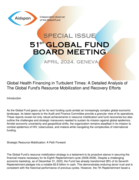
This article provides an in-depth analysis of the Global Fund's strategic initiatives in resource mobilization and recovery amid global economic fluctuations and geopolitical challenges. It highlights the Fund's successful conversion of pledges and innovative financing models that ensure sustainable
...

This comprehensive HPFM report thoroughly explores Kenya’s health financing landscape. It provides an in-depth analysis of the current state of affairs and sheds light on required strategic changes in health financing. The report points out the need to improve public financial management within th
...
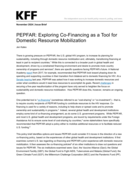
There is growing pressure on PEPFAR, the U.S. global HIV program, to increase its planning for sustainability, including through domestic resource mobilization and, ultimately, transitioning financing at
least in part to recipient countries. While this is connected to a broader push in global healt
...
This paper examines the implications of the IMF’s April 2024 macro-fiscal forecast updates on government health expenditure (GHE) across 170 economies through 2029, covering nearly all years remaining to achieve the Sustainable Development Goals (SDGs). The findings reveal wide disparities in gove
...
