
Filter
58
Breadcrumb:
Air pollution
Language
Document type
20
15
5
5
3
2
2
2
2
1
1
Countries
25
4
2
1
Authors & Publishers
Publication Years
Category
31
12
2
1
1
1
Toolboxes
21
12
9
8
6
3
2
2
1
1
1
1
1
1
More than a quarter of the global population still cook meals over open fires and/or on simple stoves fuelled by firewood, agricultural waste, dried dung, charcoal, and coal. This practice results in the emission of harmful and dangerously high levels of household air pollution.
Exposure to this h
...
Exposure to air pollution has significant adverse health effects, leading to nearly 1 in every 8 deaths globally. Air pollution affects all age groups, from unborn children to older people, in both high- and low-income nations.
A escala mundial, unos 2100 millones de personas siguen cocinando con combustibles sólidos (como leña, desechos agrícolas, carbón vegetal y mineral y excrementos de animales) y queroseno, en fuegos abiertos y fogones poco eficientes (1). En su mayor parte, se trata de personas en situación de p
...
La contaminación atmosférica proviene principalmente de cinco actividades humanas que emiten una gama de sustancias, tales como monóxido de carbono, dióxido de carbono, óxido de nitrógeno, dióxido de nitrógeno, dióxido de azufre, ozono troposférico o a nivel del suelo, material particulado
...

La contaminación atmosférica es una de las mayores amenazas para la salud infantil. El 99% de la población mundial vive en lugares donde el aire se considera nocivo. Respirar aire contaminado perjudica la salud de los niños y las niñas y pone en peligro su futuro.

Exposure to air pollution can affect everyone’s health. When we breathe in air pollutants, they can enter our bloodstream and contribute to coughing or itchy eyes and cause or worsen many breathing and lung diseases, leading to hospitalizations, cancer, or even premature death.
Minnesota’s ai
...
The Our World in Data webpage on air pollution provides an extensive overview of the global impact of air pollution on health and the environment. It presents data on sources of pollution, such as industry, vehicles, and domestic energy use, and highlights the associated health risks, including resp
...
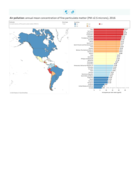
The webpage from the Pan American Health Organization (PAHO) focuses on the significant health impacts of air pollution in the Americas. It explains how exposure to air pollutants contributes to various health issues, including respiratory and cardiovascular diseases, leading to premature deaths. Th
...

The webpage from the Institute for Health Metrics and Evaluation (IHME) provides an analysis of air pollution as a significant global health risk. It details how air pollution contributes to severe health problems, including respiratory diseases and increased mortality rates. The site explains diffe
...

This dataset contains data from WHO's data portal covering the following categories:
Air pollution, Antimicrobial resistance (AMR), Assistive technology, Child mortality, Dementia diagnosis, treatment and care, Dementia policy and legislation, Environment and health, Foodborne Diseases Estimates,
...
La contaminación del aire exterior representa un importante riesgo medioambiental para la salud que afecta a todas las personas en los países de ingreso bajo, mediano y alto.
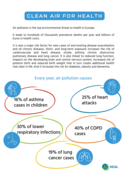
Air pollution is the top environmental threat to health in Europe. It leads to hundreds of thousands premature deaths per year and billions of Euros in health costs.
Air pollution is one of the leading causes of health complications and mortality worldwide, especially affecting lower-income groups, who tend to be more exposed and vulnerable. This study documents the relationship between ambient air pollution exposure and poverty in 211 countries and territories.
...
The World Health Organization (WHO) highlights the significant health risks associated with household air pollution, primarily resulting from the use of inefficient and polluting fuels and technologies for cooking, heating, and lighting. In 2020, approximately 2.1 billion people—about one-third of
...
Background: The impacts of air pollutants on health range from short-term health impairments to hospital admissions
and deaths. Climate change is leading to an increase in air pollution.

The WHO fact sheet on household air pollution highlights that around 2.1 billion people rely on solid fuels like wood and coal for cooking, using open fires or inefficient stoves. This leads to severe indoor air pollution, contributing to about 3.2 million premature deaths each year, including over
...

The WHO fact sheet on household air pollution highlights that around 2.1 billion people rely on solid fuels like wood and coal for cooking, using open fires or inefficient stoves. This leads to severe indoor air pollution, contributing to about 3.2 million premature deaths each year, including over
...

The WHO fact sheet on household air pollution highlights that around 2.1 billion people rely on solid fuels like wood and coal for cooking, using open fires or inefficient stoves. This leads to severe indoor air pollution, contributing to about 3.2 million premature deaths each year, including over
...
Worldwide, around 2.3 billion people still cook using solid fuels (such as wood, crop waste, charcoal, coal and dung) and kerosene in open fires and inefficient stoves. Most of these people are poor and live in low- and middle-income countries. There is a large discrepancy in access to cleaner cooki
...
The WHO fact sheet on household air pollution highlights that around 2.1 billion people rely on solid fuels like wood and coal for cooking, using open fires or inefficient stoves. This leads to severe indoor air pollution, contributing to about 3.2 million premature deaths each year, including over
...
