
Filter
274
Breadcrumb:
World Health Organization World Health Organization WHO
Featured
26
9
Language
Document type
86
43
37
28
25
12
12
9
8
7
4
2
1
Countries
65
6
4
2
1
1
1
1
1
1
1
1
1
1
1
1
1
1
1
1
1
1
1
1
1
1
1
1
1
1
1
1
1
1
1
Authors & Publishers
Publication Years
Category
7
6
4
4
4
3
3
3
3
3
3
2
2
2
2
2
1
1
1
1
1
1
1
1
1
1
1
1
1
1
1
1
1
1
1
1
1
1
1
1
1
Toolboxes
16
14
13
12
11
11
10
10
9
9
8
8
7
7
7
7
7
7
6
6
6
6
6
6
5
5
5
5
5
5
5
5
4
4
4
4
4
4
4
4
3
3
3
3
3
3
3
3
2
2
2
2
2
2
2
2
2
2
2
2
2
2
2
1
1
1
1
1
1
1
1
1
1
1
1
1
1
1
1
1
1
1
1
1
1
1
1
1
1
1
1
1
1
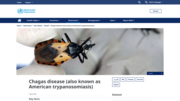
Chagas disease, also known as American trypanosomiasis, is a potentially life-threatening illness caused by the protozoan parasite Trypanosoma cruzi. About 6–7 million people worldwide are estimated to be infected with T. cruzi. The disease is found mainly in endemic areas of 21 continental Lati
...

The BeatChagas platform is a tool developed by the Technical Group of Information, Education, and Communication (IEC) for Chagas Disease (TG6-IEC Chagas), part of the Chagas Disease Control Program by the World Health Organization (WHO). The purpose of this platform is to share information about the
...
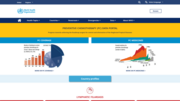
Progress towards achieving the Roadmap targets for control and elimination of the Neglected Tropical Diseases.
Chikungunya: WHO fact sheet on Chikungunya providing key facts and information on scope of the problem, who is at risk, prevention, WHO response.
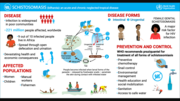
Infographic
Disease: Infection is widespread in poor communities, 221 million people affected worldwide...
Affected Populations: Women, Children...
Prevention and Control: WHO recommends praziquantel for treatment of all forms of schistosomiasis...

The development of this target product profile (TPP) was led by the WHO Department of Control of Neglected Tropical Diseases (NTD) following standard WHO guidance for TPP development. In order to identify and prioritize diagnostic needs, a WHO NTD Diagnostics Technical Advisory Group (DTAG) was form
...
Schistosomiasis is a public health problem in tropical and subtropical regions of Africa, Asia, the Caribbean and South America. It is one of the neglected tropical diseases (NTDs) - a group of diseases and conditions that affect particularly low-income populations, worldwide.
Last year, WHO laun
...
Localized cutaneous leishmaniasis and its evolving forms (diffuse cutaneous leishmaniasis, mucosal leishmaniasis and cutaneous leishmaniasis recidivans), together with the sequela of visceral leishmaniasis (post-kala-azar dermal leishmaniasis), account for about one million cases of dermal leishmani
...
About a year after infection, a painful blister forms – 90% of the time on the lower leg – and one or more worms emerge accompanied by a burning sensation. To soothe the burning pain, patients often immerse the infected part of the body in water. The worm(s) then releases thousands of larvae (ba
...
Course information
Yaws is targeted for eradication by WHO in the 2021-2030 NTD Roadmap. It is therefore crucial to know how to identify cases, design and implement activities to eradicate the disease at the community level.
In the context of integration of skin NTDs it is vital to learn to recogn
...
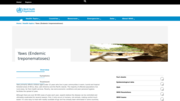
Yaws is a chronic skin infection characterized by papillomas (noncancerous lumps) and ulcers. It is caused by the bacterium Treponema pallidum subspecies pertenue, which belongs to the same group of bacteria that causes venereal syphilis.
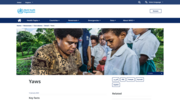
Yaws forms part of a group of chronic bacterial infections commonly known as the endemic treponematoses. These diseases are caused by spiral bacteria of the genus Treponema, which also includes endemic syphilis (bejel) and pinta. Yaws is the most common of these three infections.
Course information
Yaws is targeted for eradication by WHO in the 2021-2030 NTD Roadmap. It is therefore crucial to know how to identify cases, design and implement activities to eradicate the disease at the community level.
In the context of integration of skin NTDs it is vital to learn to recogn
...
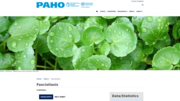
Fascioliasis is an animal parasitic disease (in cattle and sheep, but also pigs, donkeys, Llamas and alpacas that can be transmitted to humans. The infection is caught when aquatic or semi-aquatic plants with the larvae of the worm attached to their stem or leaves are ingested raw or poorly cooked.
...
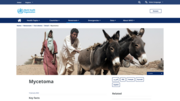
Mycetoma is a chronic disease usually of the foot but any part of the body can be affected. Infection is most probably acquired by traumatic inoculation of fungi or bacteria into the subcutaneous tissue. So far more than 70 different bacteria and fungi have been indicated as causative agents.
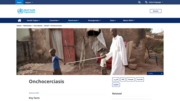
Onchocerciasis – or “river blindness” – is a parasitic disease caused by the filarial worm Onchocerca volvulus transmitted by repeated bites of infected blackflies (Simulium spp.). These blackflies breed along fast-flowing rivers and streams, close to remote villages located near fertile lan
...
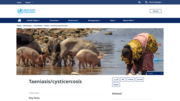
Humans can become infected with T. saginata or T. asiatica when they consume infected beef meat or pig liver tissue, respectively, which has not been adequately cooked, but taeniasis due to T. saginata or T. asiatica has no major impact on human health. Therefore, this fact sheet refers to the trans
...
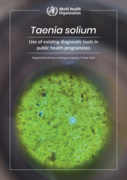
Taeniasis and cysticercosis caused by the parasite T. solium affect vulnerable populations,
mainly in Latin America, sub-Saharan Africa and Asia, where pigs (the intermediate host) roam
free and poor sanitation allows pigs access to human faeces.

Rabies is fatal, vaccine-preventable disease responsible for an estimated 59,000 human deaths each year. Most cases are transmitted by dogs, and most deaths occur in underserved populations in Africa and Asia. Approximately 40% of deaths occur in children.
Rabies is a vaccine-preventable viral disease which occurs in more than 150 countries and territories. Dogs are the source of the vast majority of human rabies deaths, contributing up to 99% of all rabies transmissions to humans.

