
Filter
22
Breadcrumb:
World Health Organization WHO, Regional Office for Europe
Featured
2
13
Language
Document type
11
3
2
2
2
1
1
Countries
12
2
2
1
Authors & Publishers
Publication Years
Category
2
1
1
1
1
1
1
1
Toolboxes
4
2
2
2
2
2
2
1
1
1
1
1
1
1
1
1
1
1
1
1
1
1
1
1
1
1
1
Coronavirus disease (COVID-19) outbreak, technical guidance - in Russian
Here you can download different guidelines and prevention & control preparedness documents
Здесь вы можете скачать различные руководящие принципы и документы по пр
...
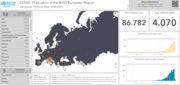
Daily interactive Dashboard
Available downloads in English, French, German, Russian, and various other languages including Arabic, Italian, Greek, Spanish and Turkish
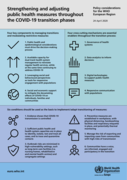
Policy considerations for the WHO European Region
24 April 2020
This analytical report reviews and discusses the potential role and influence of political commitment in implementing endorsements and conducting policy in the field of tuberculosis (TB) prevention and care. It promotes discussion by comparing and analysing the extent to which selected international
...
Mental health conditions affect one in 10 people at any one time and account for a large proportion of non-fatal disease burden. There is a high degree of comorbidity between mental health conditions such as depression and other noncommunicable diseases (NCDs), including cardiovascular disease, diab
...
Additional aims of the consultations included discussing achievements, identifying obstacles for implementation, and outlining the way forward. Areas with the lowest policy implementation were linked to pricing policies, marketing, availability of alcoholic beverages, reducing the negative consequen
...

An information package for school staff
This publication provides a practical tool to support countries in strengthening surveillance of WASH in schools. The findings will inform the development of supportive regulations and improvement planning to safeguard children’s health, well-being, dignity and cognitive performance. The tool also
...
One key aim of tuberculosis (TB) prevention and care is to render them more people-centred, which means further boosting and improving ambulatory care models across the countries of Eastern Europe and central Asia. This note is intended to remind interested parties of the evidence that shows that am
...
No Public Health without Refugee and Migrant health.
This report, the first of its kind, creates an evidence base with the aim of catalysing progress towards developing and promoting migrant-sensitive health systems in the 53 Member States of the WHO European Region and beyond. This report seeks to
...
Regional situation analysis, practices, experiences, lessons learned and ways forward.
COMPENDIUM of health system responses to large-scale migration in the WHO European Region
recommended
The scale of international migration in the WHO European Region has increased substantially in the last decade. The dynamics of large-scale migration pose specific challenges and opportunities to health systems, and responses will differ from country to country. Strengthening health system responses
...
Technical guidance.
This technical guidance aims to inform policy and practice development specifically related to improving the health of older refugees and migrants within the European Union and the larger WHO European Region. Both ageing and migration are in themselves complex multidimensional p
...

The European Mental Health Action Plan 2013–2020
recommended
Mental disorders are one of the top public health challenges in the WHO European Region, affecting about 25% of the population every year. In all countries, mental health problems are much more prevalent among the people who are most deprived. The WHO European Region therefore faces diverse challeng
...
