
Filter
68
Featured
14
30
Language
Document type
43
9
6
5
2
1
1
1
Countries
11
5
4
3
2
2
1
1
1
1
1
1
1
1
Authors & Publishers
Publication Years
Category
33
19
2
2
The compendium compiles practical case studies on the use of Geospatial Artificial Intelligence (GeoAI) to enhance disaster risk reduction and emergency response across diverse geographic and institutional contexts.
The compendium features selected case studies submitted by twenty-seven Regional Su
...
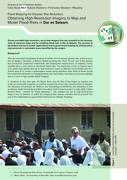
With an estimated population of about 5 million and an annual growth rate of 8 per cent, Dar es Salaam, Tanzania, is Africa’s fastest growing city.1 Over 70 per cent of the people live in informal, unplanned settlements with inadequate infrastructure. In addition, heavy rainfalls twice a year
...
Flood mapping in urban areas poses significant challenges for Synthetic Aperture Radar (SAR) sensors due to limitations in detecting water in regions characterized by dense vegetation, urban infrastructure, or complex surface conditions. These limitations include reduced sensitivity in vegetated or
...
Epi Info™ is a public domain suite of interoperable software tools designed for the global community of public health practitioners and researchers. It provides for easy data entry form and database construction, a customized data entry experience, and data analyses with epidemiologic statistics,
...

The Haiti Earthquake and Cholera Emergency appeal (MDRHT018) was implemented by the International Federation of Red Cross and Red Crescent Societies (IFRC) in collaboration with the Haitian Red Cross Society (HRCS) following the devastating earthquake on 14 August 2021, and the cholera outbreak on 2
...

This information can be used to assess the extent of the damage and the needs of affected communities. Information should be gathered on the extent of damage to infrastructure, housing, and public facilities such as hospitals, schools, and water systems. This information can be used to prioritize th
...
The Generic All-Hazards Risk Assessment and Planning Tool for Mass Gathering Events (“All-Hazards MG RA Tool”) aims to support Member States and mass gathering events organizers.
The tool is based on the principles of the World Health Organization’s Strategic Toolkit for Assessing Risk (STA
...

Thailand is exposed to flooding, landslides, drought, earthquakes, tsunamis, heat waves, forest fires, and epidemics. Thailand is also exposed to technological hazards such as chemical accidents. Flooding is the natural hazard with the most significant impact on human life, livelihoods, and the econ
...
Humanitarian Aid
recommended
In this category, you will find numerous guidelines on working in humanitarian aid, humanitarian standards, and health care for patients in fragile contexts
Earthquake Haiti: Guidelines and Resources
recommended
25 August 2021. The earthquake on August 14, 2021 was almost as strong as the severe quake in 2010, which killed about 300,000 people. The current number of victims is more than 2,200 people, and more than 12,000 people have been injured. More than 52,000 houses were destroyed and more than 77,000
...
Heat is the top killer among all types of weather hazards, including hurricanes and tornadoes. But hospitals and health care providers do not always report heat-related illnesses or heat as an underlying cause of a death, making it hard to measure the actual impact of extreme heat on health.
According to the International Science Council, the report focuses on identifying the scope of hazards that should be considered in risk reduction efforts, and provides scientifically robust and internationally agreed definitions of these hazards.
The Guidance Notes seek to help operationalize, simplify and standardize the collection and reporting of data through the application of common language and methods. They provide information on the key issues to take into account in the collection of health data and the types of data that should be
...
Consolidating Earthquake Safety Assessment Efforts in India. This document provides succinct instructions on how to perform rapid visual screening (RVS), a quick method of earthquake assessment of buildings. It covers a brief description of RVS and its role as a simplified qualitative assessment in
...
Enhancing disaster preparedness for effective response.
One of the most disaster-prone countries in the world, Bangladesh each year experiences a high degree of seasonal variety, including southwest monsoon and two cyclone seasons. With its long coastline on the Bay of Bengal and with a landscape
...
While the full extent of Cyclone Ida’s impact is still being assessed, early reports indicate significant damage to infrastructure and livelihoods, with an estimated 3,000km2 of land submerged. Preliminary government reports as of 24 March indicate that more than 58,600 houses have been damaged, i
...
Le manuel Sphère
recommended
WHO guidance for contingency planning
recommended
In this contingency planning guidance, a set of actions to prepare for emergencies from all hazards and to help minimize their impact, is proposed. These actions include the development, implementation, simulation, monitoring and regular update of risks-based contingency plans.
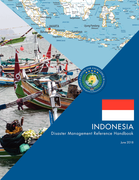
The Indonesian government has reformed its laws, policies, and institutions to better manage disaster risk since the significant 2004 Indian Ocean Tsunami. The Government of Indonesia now has contingency plans for every disaster-prone city which identifies its vulnerabilities, outlines the relief re
...
