
Filter
68
Featured
3
Language
Document type
56
4
2
2
2
1
1
Countries / Regions
5
5
5
5
3
1
1
1
1
1
1
Authors & Publishers
Publication Years
Category
14
2
1
Best practice guidelines are systematically developed statements designed to assist nurses working in partnership with persons and their families to make decisions about health care and services (Field & Lohr, 1990). This nursing Best Practice Guideline (BPG) is intended to replace the RNAO BPGs Scr
...
16-17 march 2015, Geneva, Switzerland
Meeting report
Session outline
•Introduction to dementia
•Assessment of dementia
•Management of dementia
•Follow-up
•Review
Материалы научно-практической конференции с международным участием «Достижения в нейробиологии и терапии болезни Альцгеймера», посвященной памяти профессора Э.Ð
...
Brochure à l’intention des professionnels des structures de
soins ambulatoires ou institutionnels et du travail social auprès des malades et de leurs proches.
Ein kompakter Ratgeber
23. aktualisierte Auflage
Bei der Bewältigung der Alzheimer-Krankheit und anderer Formen der Demenz müssen viele Personen zusammenwirken: der Patient selbst, seine Angehörigen, Freunde und Bekannte, der Hausarzt und spezialisierte Ärzte, oft auch die Mitarbeiter von Be
...
Bull World Health Organ 2013;91:773–783 | doi: http://dx.doi.org/10.2471/BLT.13.118422
(Submitted: 15 February 2013 – Revised version received: 21 June 2013 – Accepted: 22 June 2013 – Published online: 20 August 2013)

Доказательной базой для рекомендаций являются публикации, вошедшие в базы данных PubMed/MEDLINE, данные международных согласительных документов по болезни Альцгеймера:
...

Цель настоящего доклада — повысить осведомленность о деменции как
одной из приоритетных проблем общественного здравоохранения, сформу-
лировать подход к этой пÑ
...
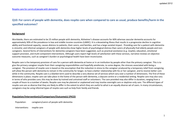
Q10: For carers of people with dementia, does respite care when compared to care as usual, produce benefits/harm in the specified outcomes?
Q9: For carers of people with dementia, do interventions (psychoeducational, cognitive-behavioural therapy counseling/case management, general support, training of caregivers, multi-component interventions and miscellaneous interventions) when compared to placebo/comparator, produce benefits/harm in
...
Q8: For people with dementia, what is the role of a medical review (including comorbid physical and mental conditions and medication use)?
Q4: For people with dementia with associated depression, do antidepressants when compared to placebo/comparator produce benefits/harm in the specified outcomes?
Q2: For people with dementia, does memantine, when compared to placebo/comparator, produce benefits/harm in the specified outcomes in non-specialist health settings?
Q5: For people with dementia, which cognitive/psychosocial interventions (such as cognitive stimulation, cognitive rehabilitation, reality orientation, reminiscence therapy) when compared to placebo/comparator produce benefits/harm in the specified outcomes?
Q6: Can dementia be diagnosed at first or second level care by non-specialist health care providers? What should be the assessment process for the diagnosis of dementia?
Q7: For people with dementia, who should be told of the diagnosis and how should the diagnosis be delivered?
Q3: For behavioural and psychological symptoms in people with dementia, do following drugs, when compared to placebo/comparator, produce benefits/harm in the specified outcomes?

The report “Dementia: a public health priority” has been jointly developed by WHO and Alzheimer's Disease International. The purpose of this report is to raise awareness of dementia as a public health priority, to articulate a public health approach and to advocate for action at international a
...
