
Filter
70
Featured
2
Language
Document type
51
14
2
2
1
Countries
35
2
2
1
1
1
1
1
1
1
1
1
1
1
1
1
Authors & Publishers
Publication Years
Category
5
3
Background and aims: Current coverage of mental health care in low- and middle-income countries is limited, not only in terms of access to services but also in terms of financial protection of persons in need of care and treatment. This is especially pertinent considering the established relationshi
...
Background: Primary health care (PHC) is a driving force for advancing towards universal health coverage (UHC). PHC-oriented health systems bring enormous benefits but require substantial financial investments. Here, we aim to present measures for PHC investments and project the associated resource
...
The majority of developing countries will fail to achieve their targets for Universal Health Coverage (UHC)1 and the health- and poverty-related Sustainable Development Goals (SDGs) unless they take urgent steps to strengthen their health financing. Just over a decade out from the SDG deadline of 20
...
Comprehensive and comparable estimates of health spending in each country are a key input for health
policy and planning, and are necessary to support the achievement of national and international health goals. Previous
studies have tracked past and projected future health spending until 2040 and
...
Corruption is embedded in health systems. Throughout my life—as a researcher, public health worker, and a Minister of Health—I have been able to see entrenched dishonesty and fraud. But despite being one of the most important barriers to implementing universal health coverage around the world, c
...
Between 2012 and 2016, development assistance for HIV/AIDS decreased by 20·0%; domestic financing is therefore critical to sustaining the response to HIV/AIDS. To understand whether domestic resources could fill the financing gaps created by declines in development assistance, we aimed to track spe
...
MOBILISIERUNG INLÄNDISCHER ÖFFENTLICHER RESSOURCEN FÜR GESUNDHEIT

This paper has been prepared to inform discussion at the conference “Beating the DRUM - Domestic Resource Use and Mobilization for accelerating progress towards SDG3,”. Many countries face critical shortfalls in domestic resource use and mobilization (DRUM) for health, threatening to push health
...
The 2018 global health financing report presents health spending data for all WHO Member States between 2000 and 2016 based on the SHA 2011 methodology. It shows a transformation trajectory for the global spending on health, with increasing domestic public funding and declining external financing. T
...
A System of Health Accounts 2011: Revised Edition provides an updated and systematic description of the financial flows related to the consumption of health care goods and services. As demands for information increase and more countries implement and institutionalise health accounts according to the
...
Background
The ambitious development agenda of the Sustainable Development Goals (SDGs) requires substantial investments across several sectors, including for SDG 3 (healthy lives and wellbeing). No estimates of the additional resources needed to strengthen comprehensive health service delivery to
...
Past quantitative research on health financing has focused mostly on the level and distribution of total expenditure, with little emphasis on the specific role of public funds, despite their known importance for universal health coverage (UHC). Health Accounts data do not disaggregate public expendi
...
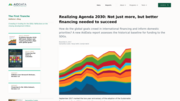
How do the global goals crowd in international financing and inform domestic priorities? A new AidData report assesses the historical baseline for funding to the SDGs.

Development assistance for health (DAH), the value of which peaked in 2013 and fell in 2015, is unlikely to rise substantially in the near future, increasing reliance on domestic and innovative financing sources to sustain health programmes in low-income and middle-income countries. We examined inno
...
Multiple pandemics, numerous outbreaks, thousands of lives lost and billions of dollars of national income wiped out—all since the turn of this century, in barely 17 years—and yet the world’s investments in pandemic preparedness and response remain woefully inadequate. We know by now that the
...
In 2015 around 15 million people living with HIV were receiving antiretroviral treatment (ART) in sub–Saharan Africa. Sustained provision of ART, though both prudent and necessary, creates substantial long–term fiscal obligations for countries affected by HIV/ AIDS. As donor assistance for healt
...
A general consensus exists that as a country develops economically, health spending per capita rises and the share of that spending that is prepaid through government or private mechanisms also rises. However, the speed and magnitude of these changes vary substantially across countries, even at simi
...
The final text of the outcome document adopted at the Third Internatinal Conference on Financing for Development (Addis Ababa, Ethiopia, 13–16 July 2015) and endorsed by the General Assembly in its resolution 69/313 of 27 July 2015.
Zero draft of the outcome document adopted at the Third Internatinal Conference on Financing for Development (Addis Ababa, Ethiopia, 13–16 July 2015) and endorsed by the General Assembly in its resolution 69/313 of 27 July 2015.
This important research emphasises that many governments are not meeting spending goals, and in many countries the financing gaps are so great that, even if they met the spending goals, expenditure would still fall short of what is needed (expenditure would cover only 64% of estimated future funding
...
