Filter
637
Filtered Results: 637
Text search:
Le
centre
Africain
de
prévention
et
de
lutte
contre
la
maladie
(CDC
Afrique)
Featured
Recommendations
39
New Publications
148
Language
Document type
No document type
291
Studies & Reports
136
Guidelines
83
Strategic & Response Plan
64
Manuals
19
Training Material
19
Fact sheets
13
Situation Updates
4
Infographics
4
Brochures
3
Resource Platforms
1
Countries / Regions
Senegal
73
Congo, Democratic Republic of
65
Benin
52
Burkina Faso
52
Central African Republic
30
Cameroon
28
Africa
23
Madagascar
22
Global
21
Guinea
20
West and Central Africa
15
Togo
13
Mali
11
Côte d’Ivoire / Ivory Coast
10
Rwanda
9
Haiti
8
East and Southern Africa
8
Niger
7
Ethiopia
4
Chad
4
Kenya
3
Burundi
3
Morocco
3
Latin America and the Carribbean
3
France
3
Sierra Leone
2
Malawi
2
Cambodia
2
Middle East and North Africa
2
Uganda
2
Liberia
2
Nigeria
1
Congo-Brazzaville
1
North America
1
Gabon
1
Argentina
1
South Africa
1
Angola
1
Zambia
1
Iraq
1
Somalia
1
Authors & Publishers
Publication Years
Category
Countries
339
Clinical Guidelines
54
Public Health
28
Women & Child Health
26
Key Resources
19
Pharmacy & Technologies
6
Capacity Building
5
Toolboxes
COVID-19
44
Ebola & Marburg
36
Malaria
35
HIV
27
NTDs
23
Mental Health
22
Rapid Response
21
TB
18
Disability
15
Planetary Health
12
AMR
12
Caregiver
11
Cholera
9
Pharmacy
8
2.0 Rapid Response
7
Polio
4
Refugee
3
Natural Hazards
3
Health Financing Toolbox
2
NCDs
2
Conflict
2
Zika
2

Senegal has adopted the World Health Organization–Joint United Nations Programme on HIV/AIDS recommended 90-90-90 targets.5 The adoption of this strategy means that the country is expected, by 2020, to have 90% of its population living with HIV diagnosed, 90% of all those diagnosed receiving susta...
The World Health Organization (WHO) has recommended a universal antiretroviral therapy (ART) for all HIVinfected children before the age of two since 2010, but this implies an early identification of these infants. We described the Prevention of Mother-to-Child HIV Transmission (PMTCT) cascade, the ...
Manuel de Référence Mali

Building on the 2021 Interim guidance, this second version and update, incorporates the lessons and feedback from the hepatitis pilots that successfully demonstrated the feasibility of measuring hepatitis B and C impact targets to demonstrate elimination, whilst highlighting challenges caused by hig...

Public Health is the science field dedicated to promoting health and well-being, and preventing disease within the human population to ultimately increase the quality of our livelihood and life span. Public Health does not focus on individual patients or diseases, but rather a given population and ...
Malaria remains a significant public health concern, particularly in sub-Saharan Africa, where the majority of cases and fatalities occur, especially among children under five. Although there was a significant decline in global mortality and incidence between 2000 and 2015, progress has stalled sinc...
3ieme Edition
Report of a WHO technical consultation meeting
Ouagadougou, Burkina Faso

Tsetse traps and targets (insecticide-impregnated screens) function by attracting the flies to a device that collects and/or kills them. Traps can be used for entomological surveillance, and also for control. Targets are simpler than traps, but are not used for surveillance. They are impregnated wit...
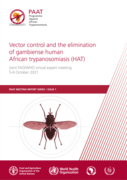
The main purpose of the meeting was to review tsetse control tools, activities and their contribution to the elimination of gHAT and the monitoring thereof. Seven endemic countries provided reports on recent and ongoing vector control interventions at the national level (Angola, Cameroon, Côte d’...

Cholera is a diarrhoeal disease that is usually contracted when drinking water contaminated with Vibrio cholerae bacteria. The fight against this disease requires a multidisciplinary approach that combines a water, hygiene and sanitation (WaSH) response with a monitoring system, improved water suppl...