
Filter
291
Text search:
groundwater
Featured
31
95
Language
Document type
124
61
38
30
13
9
8
3
2
2
1
Countries
17
13
11
8
7
5
5
4
4
4
4
4
3
3
2
2
2
2
2
2
2
2
2
2
2
2
1
1
1
1
1
1
1
1
1
1
1
1
1
1
1
1
1
1
1
1
1
1
1
1
1
1
Authors & Publishers
Publication Years
Category
96
87
12
8
5
2
2
Toolboxes
65
25
16
14
12
10
9
9
7
7
5
4
3
3
2
1
1
1
1
1
CDI 2 WASH Program
The “Field Level Arsenic Testing Guideline” provides guidance for testing arsenic in groundwater in simple and cost-effective way. The guideline covers different aspects like costing involved in a testing program, justifi ...
The “Field Level Arsenic Testing Guideline” provides guidance for testing arsenic in groundwater in simple and cost-effective way. The guideline covers different aspects like costing involved in a testing program, justifi ...
Due to Nepal’s difficult geographic structure, rapid urbanization, varied groundwater level, and increasing population the country is prone to earthquakes, floods, landslides, fires, lightning, hailstone, drought, epidemic, and other d
...
Since late August 2022, cases of severe acute watery diarrhoea have been increasingly reported across Syria, concentrated
particularly along the Euphrates river. These were later confirmed to be cholera cases.3 Cholera is a disease caused by
bacteria that can be found in faeces, and spreads throug
...
Adresssing climate change impacts on infrastructure: preparing for change. Fact sheet
The International Water Management Institute (IWMI) was commissioned to undertake a rapid review of access to and management of water resources in the Dry Zone, to assist LIFT and other potential donors and investors to identify the key issues and the priority actions for water management.
The ...
The ...
Survival, Health and Dignity for Refugees
Accessed March 13, 2019



A septic tank takes raw sewage in, allows the solids to settle (sludge) and allows the remaining liquid to flow into the surrounding soil by means of a soakaway. Scum on the surface is also prevented from leaving the tank. Microorganisms in the anaerobic environment in the tank digest the sludge and
...
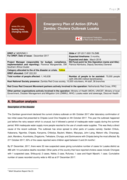
The document outlines the 2017 cholera outbreak in Zambia, mainly in Lusaka, due to poor sanitation and unsafe water. By December, 493 cases were reported, with risks increasing due to the rainy season. The Zambia Red Cross Society (ZRCS), in collaboration with the Ministry of Health, WHO, and UNICE
...
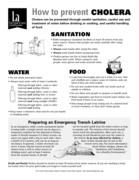
The Cholera Fact Sheet is available in English, Spanish, Arabic, French, and Haitian Kreyol. This heavily-illustrated, easy-to-read handout provides information for preventing, diagnosing and treating cholera with limited resources. It offers instructions for purifying drinking water and prepari
...
The National Institute for Transforming India (NITI) Aayog has developed the Composite Water Management Index (CWMI) to enable effective water management in Indian states in the face of extreme water stress. The Index and this associated report are expected to: (1) establish a clear baseline and ben
...
When setting national drinking-water quality regulations and standards, many countries consider the WHO Guidelines for drinking-water quality (GDWQ). To better understand the extent to which the GDWQ are used and reflected in these standards, this global review summarizes information from 104
...
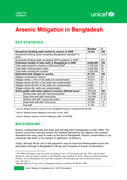
Arsenic contaminated tube well water was first detected in Bangladesh in early 1990s. The arsenic comes from naturally arsenic-rich material delivered by the region's river systems, deposited over many years to make up the land of Bangladesh. Arsenic contamination is not caused by tube wells, or by
...
