
Filter
2987
Text search:
country
profile
Featured
205
979
Language
2912
51
37
30
17
14
9
9
7
3
2
2
2
2
2
2
2
1
1
1
1
1
1
1
1
1
1
1
1
1
1
1
1
1
1
1
1
1
Document type
1803
481
282
120
111
68
54
38
13
10
5
2
Countries
156
97
94
84
76
72
72
68
67
62
61
57
56
54
53
51
48
46
45
40
39
37
35
33
31
31
31
29
29
27
26
26
24
23
20
20
18
18
15
14
14
13
13
13
12
11
11
10
10
9
9
8
8
7
7
6
6
6
5
5
5
5
5
4
4
4
4
4
4
4
4
4
4
4
3
3
3
3
3
3
3
3
3
3
3
3
3
2
2
2
2
2
2
2
2
2
2
2
2
2
2
2
2
2
2
1
1
1
1
1
1
1
1
1
1
1
1
1
1
1
1
1
1
1
1
1
1
1
1
1
1
Authors & Publishers
402
246
129
81
65
42
39
36
27
25
21
21
18
18
17
16
15
15
13
13
13
12
12
11
11
10
10
10
10
10
9
9
9
9
8
8
8
7
7
7
7
7
7
7
7
7
6
6
6
6
6
6
6
6
6
6
6
6
6
6
6
6
6
6
6
5
5
5
5
5
5
5
5
5
5
5
5
5
4
4
4
4
4
4
4
4
4
4
4
4
4
4
4
4
4
4
4
4
4
4
4
4
4
4
4
4
4
4
4
4
4
4
3
3
3
3
3
3
3
3
3
3
3
3
3
3
3
3
3
3
3
3
3
3
3
3
3
3
3
3
3
3
3
3
3
3
3
3
3
3
3
3
3
3
3
3
3
3
3
3
3
3
3
3
3
3
3
3
3
3
3
3
3
3
3
3
3
2
2
2
2
2
2
2
2
2
2
2
2
2
2
2
2
2
2
2
2
2
2
2
2
2
2
2
2
2
2
2
2
2
2
2
2
2
2
2
2
2
2
2
2
2
2
2
2
2
2
2
2
2
2
2
2
2
2
2
2
2
2
2
2
2
2
2
2
2
2
2
2
2
2
2
2
2
2
2
2
2
2
2
2
2
2
2
2
2
2
2
2
2
2
2
2
2
2
2
2
2
2
2
2
2
2
2
2
2
2
2
2
2
2
2
2
2
2
2
2
2
2
2
2
2
2
2
2
2
2
2
2
2
1
1
1
1
1
1
1
1
1
1
1
1
1
1
1
1
1
1
1
1
1
1
1
1
1
1
1
1
1
1
1
1
1
1
1
1
1
1
1
1
1
1
1
1
1
1
1
1
1
1
1
1
1
1
1
1
1
1
1
1
1
1
1
1
1
1
1
1
1
1
1
1
1
1
1
1
1
1
1
1
1
1
1
1
1
1
1
1
1
1
1
1
1
1
1
1
1
1
1
1
1
1
1
1
1
1
1
1
1
1
1
1
1
1
1
1
1
1
1
1
1
1
1
1
1
1
1
1
1
1
1
1
1
1
1
1
1
1
1
1
1
1
1
1
1
1
1
1
1
1
1
1
1
1
1
1
1
1
1
1
1
1
1
1
1
1
1
1
1
1
1
1
1
1
1
1
1
1
1
1
1
1
1
1
1
1
1
1
1
1
1
1
1
1
1
1
1
1
1
1
1
1
1
1
1
1
1
1
1
1
1
1
1
1
1
1
1
1
1
1
1
1
1
1
1
1
1
1
1
1
1
1
1
1
1
1
1
1
1
1
1
1
1
1
1
1
1
1
1
1
1
1
1
1
1
1
1
1
1
1
1
1
1
1
1
1
1
1
1
1
1
1
1
1
1
1
1
1
1
1
1
1
1
1
1
1
1
1
1
1
1
1
1
1
1
1
1
1
1
1
1
1
1
1
1
1
1
1
1
1
1
1
1
1
1
1
1
1
1
1
1
1
1
1
1
1
1
1
1
1
1
1
1
1
1
1
1
1
1
1
1
1
1
1
1
1
1
1
1
1
1
1
1
1
1
1
1
1
1
1
1
1
1
1
1
1
1
1
1
1
1
1
1
1
1
1
1
1
1
1
1
1
1
1
1
1
1
1
1
1
1
1
1
1
1
1
1
1
1
1
1
1
1
1
1
1
1
1
1
1
1
1
1
1
1
1
1
1
1
1
1
1
1
1
1
1
1
1
1
1
1
1
1
1
1
1
1
1
1
1
1
1
1
1
1
1
1
1
1
1
1
1
1
1
1
1
1
1
1
1
1
1
1
1
1
1
1
1
1
1
1
1
1
1
1
1
1
1
1
1
1
1
1
1
1
1
1
1
1
1
1
1
1
1
1
1
1
1
1
1
1
1
1
1
1
1
1
1
1
1
1
1
1
1
1
1
1
1
1
1
1
1
1
1
1
1
1
1
1
1
1
1
1
1
1
1
1
1
1
1
1
1
1
1
1
1
1
1
1
1
1
1
1
1
1
1
1
1
1
1
1
1
1
1
1
1
1
1
1
1
1
1
1
1
1
1
1
1
1
1
1
1
1
1
1
1
1
1
1
1
1
1
1
1
1
1
1
1
1
1
1
1
1
1
1
1
1
1
1
1
1
1
1
1
1
1
1
1
1
1
1
1
1
1
1
1
1
1
1
1
1
1
1
1
1
1
1
1
1
1
1
1
1
1
1
1
1
1
1
1
1
1
1
1
1
1
1
1
1
1
1
1
1
1
1
1
1
1
1
1
1
1
1
1
1
1
1
1
1
1
1
1
1
1
1
1
1
1
1
1
1
1
1
1
1
1
1
1
1
1
1
1
1
1
1
1
1
1
1
1
1
1
1
1
1
1
1
1
1
1
1
1
1
1
1
1
1
1
1
1
1
1
1
1
1
1
1
1
1
1
1
1
1
1
1
1
1
1
1
1
1
1
1
1
1
1
1
1
1
1
1
1
1
1
1
1
1
1
1
1
1
1
1
1
1
1
1
1
1
1
1
1
1
1
1
1
1
1
1
1
1
1
1
1
1
1
1
1
1
1
1
1
1
1
1
1
1
1
1
1
1
1
1
1
1
1
1
1
1
1
1
1
1
1
1
1
1
1
1
1
1
1
1
1
1
1
1
1
1
1
1
1
1
1
1
1
1
1
1
1
1
1
1
1
1
1
1
1
1
1
1
1
1
1
1
1
1
1
1
1
1
1
1
1
1
1
1
1
1
1
1
1
1
1
1
1
1
1
1
1
1
1
1
1
1
1
1
1
1
1
1
1
1
1
1
1
1
1
1
1
1
1
1
1
1
1
1
1
1
1
1
1
1
1
1
1
1
1
1
1
1
1
1
1
1
1
1
1
1
1
1
1
1
1
1
1
1
1
1
1
1
1
1
1
1
1
1
1
1
1
1
1
1
1
1
1
1
1
1
1
1
1
1
1
1
1
1
1
1
1
1
1
1
1
1
1
1
1
1
1
1
1
1
1
1
1
1
1
1
1
1
1
1
1
1
1
1
1
1
1
1
1
1
1
1
1
1
1
1
1
1
1
1
1
1
1
1
1
1
1
1
1
1
1
1
1
1
1
1
1
1
1
1
1
1
1
1
1
1
1
1
1
1
1
1
1
1
1
1
1
1
1
1
1
1
1
1
1
1
1
1
1
1
1
1
1
1
1
1
1
1
1
1
1
1
1
1
1
1
1
1
1
1
1
1
1
1
1
1
1
1
1
1
1
1
1
1
1
1
1
1
1
1
1
1
1
1
1
1
1
1
1
1
1
1
1
1
1
1
1
1
1
1
1
1
1
1
1
1
1
1
1
1
1
1
1
1
1
1
1
1
1
1
1
1
1
1
1
1
1
1
1
1
1
1
1
1
1
1
1
1
1
1
1
1
1
1
1
1
1
1
1
1
1
1
1
1
1
1
1
1
1
1
1
1
1
1
1
1
1
1
1
1
1
1
1
1
1
1
1
1
1
1
1
1
1
1
1
1
1
1
1
1
1
1
1
1
1
1
1
1
1
1
1
1
1
1
1
1
1
1
1
1
1
1
1
1
1
1
1
1
1
1
1
1
1
1
1
1
1
1
1
1
1
1
1
1
1
1
1
1
1
1
1
1
1
1
1
1
1
1
1
1
1
1
1
1
1
1
1
1
1
1
1
1
1
1
1
1
1
1
1
1
1
1
1
1
1
1
1
1
1
1
1
1
1
1
1
1
1
1
1
1
1
1
1
1
1
1
1
1
1
1
1
1
1
1
1
1
1
1
1
1
1
1
1
1
1
1
1
1
1
1
1
1
1
1
1
1
1
1
1
1
1
1
1
1
1
1
1
1
1
1
1
1
1
1
1
1
1
1
1
1
1
1
1
1
1
1
1
1
1
1
1
1
1
1
1
1
1
1
1
1
1
1
1
1
1
1
1
1
1
1
1
1
1
1
1
1
1
1
1
1
1
1
1
1
1
1
1
1
1
1
1
1
1
1
1
1
1
1
1
1
1
1
1
1
1
1
1
1
1
1
1
1
1
1
1
1
1
1
1
1
1
1
1
1
1
1
1
1
1
1
1
1
1
1
1
1
1
1
1
1
1
1
1
1
1
1
1
1
1
1
1
1
1
1
1
1
1
1
1
1
1
1
1
1
1
1
1
1
1
1
1
1
1
1
1
1
1
1
1
1
1
1
1
1
1
1
1
1
1
1
1
1
1
1
1
1
1
1
1
1
1
1
1
1
1
1
1
1
1
1
1
1
1
1
1
1
1
1
1
1
1
1
1
1
1
1
1
1
1
1
1
1
1
1
1
1
1
1
1
1
1
1
1
1
1
1
1
1
1
1
1
1
1
1
1
1
1
1
1
1
1
1
1
1
1
1
1
1
1
1
1
1
1
1
1
1
1
1
1
1
1
1
1
1
1
1
1
1
1
1
1
1
1
1
1
1
1
1
1
1
1
1
1
1
1
1
1
1
1
1
1
1
1
1
1
1
1
1
1
1
1
1
1
1
1
1
1
1
1
1
1
1
1
1
1
1
1
1
1
1
1
1
1
1
1
1
1
1
1
1
1
1
1
1
1
1
1
1
1
1
1
1
1
1
1
1
1
1
1
1
1
1
1
1
1
1
1
1
1
1
1
1
1
1
1
1
1
1
1
1
1
1
1
1
1
1
1
1
1
1
1
1
1
1
1
1
1
1
1
1
1
1
1
1
1
1
1
1
1
1
1
1
1
1
1
1
1
1
1
1
1
1
1
1
1
1
1
1
1
1
1
1
1
1
1
1
1
1
1
1
1
1
1
1
1
1
1
1
1
1
1
1
1
1
1
1
1
1
1
1
1
1
1
1
1
1
1
1
1
1
1
1
1
1
1
1
1
1
1
1
1
1
1
1
1
1
1
1
1
1
1
1
1
1
1
1
1
1
1
1
1
1
1
1
1
1
1
1
1
1
1
1
1
1
1
1
1
1
1
1
1
1
1
1
1
1
1
1
1
1
1
1
1
1
1
1
1
1
1
1
1
1
1
1
1
1
1
1
1
1
1
1
1
1
1
1
1
1
1
1
1
1
1
1
1
1
1
1
1
1
1
1
1
1
1
1
1
1
1
1
1
1
1
1
1
1
1
1
1
1
1
1
1
1
1
1
1
Publication Years
1
771
1982
223
10
Category
1592
171
166
148
103
43
26
Toolboxes
184
173
138
102
94
84
72
66
60
51
50
50
48
46
46
44
39
35
27
25
20
17
12
9
6
To support the achievement of health equity in the Region, the regional inter-agency movement Every Woman Every Child Latin America and the Caribbean (EWEC-LAC) advocates for and supports the use of equity and evidence-based policies, strategies and interventions to accelerate equitable progress in
...
the health of women, children and adolescents. Although progress has been made, great inequities persist. Women from the LAC region’s poorest countries are almost four times more likely to die due to complications during childbirth than those living in the wealthiest countries. Through the years, several tools, instruments and methods (TIMs) have been developed by global, regional and country partners that can be used to conduct systematic equity-based analyses and/or re-designs of health systems, programs, strategies and interventions. The main purpose of this document is to present an overview of existing TIMs that can be used by policymakers, program managers, development partners, nongovernmental organizations, academia and civil society partners to strengthen systematic identification, analysis and responding to social inequities in the health of women, children and adolescents in LAC. The TIMs included were identified through a systematic search process
more
The aim of this guidance manual is to introduce the user to project/programme plan- ning in a Red Cross Red Crescent environment. It describes the different stages of the planning phase of the “project/programme cycle” within the context of Results-Based Management (RBM). It also gives an overvi
...
ew of the various components of RBM and explains how to integrate and apply this approach in practice. In addition, the manual summarizes briefly the other key phases of the cycle (assessment, imple- mentation and monitoring, evaluation) and provides references to the key Federation manuals on these phases.
The manual has been developed primarily for use by people managing projects and programmes either in a National Society or the secretariat of the International Federation of Red Cross and Red Crescent Societies (International Federation). Although it is mainly designed for use at the country level, the basic principles can be applied to project and programme planning at any level. The manual draws on two International Red Cross and Red Crescent Movement publications – the International Federation’s Project Planning Process (2002) and the ICRC Economic Security Unit’s Programme/ Project Management: The Results-Based Approach (2008) – reflecting the significant similarity of approach. The International Federation has developed the manual internally to suit the particular needs and uses of project/programme management within the organization.
more

Sharing successful strategies from the Eastern Mediterranean Region in mitigating noncommunicable diseases and mentalhealth disorders during the COVID-19pandemic and beyond
World Health Organization (WHO) Regional Office for the Eastern Mediterranean
World Health Organization (WHO) Regional Office for the Eastern Mediterranean
(2023)
C_WHO
The "Stories from the field" document by the WHO Regional Office for the Eastern Mediterranean shares effective strategies from the Eastern Mediterranean Region for addressing noncommunicable diseases (NCDs) and mental health challenges, particularly during the COVID-19 pandemic. It highlights regio
...
nal success stories in mitigating NCDs and mental health conditions through innovative, country-specific interventions. The report emphasizes multisectoral collaboration, community engagement, and resilience in public health responses. It aims to inspire further action and knowledge-sharing to enhance health outcomes in challenging settings across the region.
more

Health system resilience is not an inevitable byproduct of any investment in health but must be intentionally programmed and developed with necessary input, investment and contextualization. This technical product aims to guide national, subnational, and global health actors to operationalize the co
...
ncept of health system resilience for advancement of universal health coverage, health security and ultimately better health for all. It supports the translation of relevant conceptual guidance and high-level recommendations into practical actions.
The specific objectives are to:
present a concise overview of the concept of health system resilience;
provide a roadmap outlining practical and foundational steps for building health system resilience to be adapted to different contexts;
share examples of actions and tools, including stakeholder roles, to support country application of the roadmap.
The target audience for this work is the various stakeholders involved in strengthening health systems and public health including management of emergencies (from prevention and preparedness to response and recovery) and other public health challenges in countries. This ranges from the donors, policy-makers and decision-makers at global, national and subnational levels to the implementing institutions and line managers of health system functions and services across the health system building blocks.
more

The Polio Transition1
Monitoring and Evaluation (M&E) Framework was designed to monitor progress towards achieving the strategic and operational outcomes of the post-2023 Strategic Action Plan on Polio Transition (2018– 2023), as outlined in the Global Vision to use polio investments to build st
...
rong, resilient and equitable health systems (the Global Vision), and regional strategic plans for the WHO African, Eastern Mediterranean and SouthEast Asia Regions. It aims to support an efficient and effective polio transition process through both process and outcome-based monitoring. The M&E Framework promotes accountability and strives for a harmonized approach to monitoring and evaluating the polio transition at the country, regional and global levels
more
The Global Health Expenditure Report delves into the intricate landscape of global economies and health systems. This year, it focuses on health spending in 2022, the third year of the COVID-19 pandemic. It shows how countries around the world responded to the health and economic shocks of the pande
...
mic from a financial perspective. It also considers what the future may hold as countries emerge from the pandemic. Although it is still too early to gauge whether the COVID-19 pandemic has altered long-term trends in health spending, spending appears to have peaked and is now at or below its long-term rising trend in most country income groups. Additionally, to mark the 25th anniversary of the World Health Organization’s (WHO) Health Expenditure Tracking Program, the report reviews the program’s achievements and envisions a path forward. As the program’s lead technical agency, WHO is committed to working closely with partners to support countries in tracking health spending and sustaining the Global Health Expenditure Database and the Global Health Expenditure Report as global public goods.
more
One approach to development assistance for health, or health aid, emphasizes the ex ante selection of cost-effective health interventions, an approach that began with the World Development Report (1993) on Investing in Health and has since been adopted by the Effective Altruism community. But just h
...
ow much of health aid is cost-effective? In this paper, we examine projects in the Organisation for Economic Co-operation and Development (OECD) Creditor Reporting System, the standard dataset that measures and characterizes development assistance for health, for the
years 2019 to 2021, and count the number of projects that refer to interventions from a list of highly cost-effective interventions as defined by the Disease Control Priorities Project, third edition. This exploratory quantitative analysis indicates that 61% of projects used a key word/phrase of a costeffective intervention. There were 11.9 interventions mapped per project on average. There is little evidence that donors tailor the set of interventions to country income levels by cost-effectiveness.
Policymakers may benefit from reviewing the full portfolio of interventions covered by domestic and external resources.
more
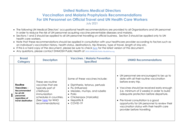
This document, issued by the United Nations Medical Directors in July 2021, outlines vaccination and malaria prophylaxis recommendations for UN personnel travelling on official business and UN healthcare workers. The guidance aims to minimise the risk of vaccine-preventable diseases and malaria by f
...
ocusing on three key areas:(1) routine vaccines, such as those for influenza, measles, polio, hepatitis B, varicella and SARS-CoV-2 (the virus that causes the disease known as 'Covid-19'), which are recommended for all staff regardless of their destination;
(2) destination-based measures, including mandatory vaccines (e.g. yellow fever, meningitis and polio), recommended vaccines depending on regional risks (e.g. cholera, typhoid, hepatitis A and rabies) and WHO-advised malaria prevention through mosquito protection and chemoprophylaxis. The third area covers vaccines for healthcare workers with direct patient or laboratory exposure, including hepatitis B, influenza, diphtheria, pertussis and others. The recommendations emphasise the importance of pre-travel medical consultations, adherence to host country requirements, and individualised risk assessments.
more

Populations affected by emergencies are continually at risk of outbreaks of epidemic-prone diseases and other public health hazards. This operational guidance aims to guide decision-making on when and how to implement and strengthen Early Warning Alert and Response (EWAR) in preparation for and resp
...
onse to emergencies. Each module aims to provide updated operational guidance for EWAR practices, which may be more easily understood and applied during emergencies. Through its application, this operational guidance aims to contribute to:
- earlier detection of acute public health events
- earlier and more effective response
- reduced impact of emergencies on health
- increased trust of the population in the (public) health system
- fulfilling our collective commitments to the International Health Regulations (IHR,
2005).
This guidance was developed jointly by 69 experts from more than 20 organizations from global level to country level.
more

Medical evacuation in emergencies
recommended
A guidance for medical teams and specialized care teams.
This guidance aims to provide a comprehensive framework for the safe and context-adapted coordination, clinical care, operations support and logistics relevant to governments, national authorities, including ministries of health, civil protec
...
tion and civil defence, national and international Emergency Medical Teams (EMTs), nongovernmental organizations (NGOs), Emergency Medical Services (EMS) and other key stakeholders operating in the medevac space, or wishing to build this kind of capacity. It defines minimum standards and recommendations for the development and classification of respective specialized care teams (SCTs). This is particularly relevant for contexts without pre-existing or functional prehospital or medevac systems, and can support country-level capacity building, regional and sub-regional planning, and the development of SCTs.
more

The WHO Global Antimicrobial Resistance and Use Surveillance System (GLASS) was launched in 2015 to foster AMR surveillance and inform strategies to contain AMR. The system started with surveillance of AMR in bacteria causing common human infections and has expanded its scope to include surveillance
...
of antimicrobial consumption (AMC), invasive fungal infections, and a One Health surveillance model relevant to human health. To meet future challenges, it is in continuous evolution to enhance the quality and representativeness of data to inform the AMR burden accurately. As of the end of 2022, 127 countries, territories and areas participate in GLASS.
The fifth GLASS report, produced in collaboration with Member States, summarizes 2020 data on AMR rates in common bacteria from countries, territories, and areas. The report brings new features, including analyses of population testing coverage or AMR trends. For the first time, the report presents 2020 data on AMC at the national level. A new interactive dashboard allow users to explore AMR and AMC global data, country profiles and download the data.
This report marks the end of the early implementation phase of GLASS. In addition to presenting data collected through the latest data call, this report provides a summary of five years of national AMR surveillance data contributed to GLASS from its initiation, presents AMR findings in the context of progress of country participation in GLASS and in global AMR surveillance coverage and laboratory quality assurance systems at (sub)national level.
Patterns of antimicrobial consumption are presented by country with a particular focus on antibacterials. The report also presents the antimicrobial consumption according to the WHO AWaRe antibiotic classification, for penicillins and cephalosporines. From a One Health perspective, the report presents antimicrobial consumption data in the human sector expressed in tons to allow a comparison with antimicrobial consumption from other sectors (not included in this report).
more

In 2015, the United Nations set important targets to reduce premature
cardiovascular disease (CVD) deaths by 33% by 2030. Africa disproportionately
bears the brunt of CVD burden and has one of the highest risks of dying
from non-communicable diseases (NCDs) worldwide. There is currently
an epide
...
miological transition on the continent, where NCDs is projected
to outpace communicable diseases within the current decade. Unchecked
increases in CVD risk factors have contributed to the growing burden of three
major CVDs—hypertension, cardiomyopathies, and atherosclerotic diseasesleading to devastating rates of stroke and heart failure. The highest age
standardized disability-adjusted life years (DALYs) due to hypertensive heart
disease (HHD) were recorded in Africa. The contributory causes of heart failure
are changing—whilst HHD and cardiomyopathies still dominate, ischemic
heart disease is rapidly becoming a significant contributor, whilst rheumatic
heart disease (RHD) has shown a gradual decline. In a continent where health
systems are traditionally geared toward addressing communicable diseases,
several gaps exist to adequately meet the growing demand imposed by CVDs.
Among these, high-quality research to inform interventions, underfunded
health systems with high out-of-pocket costs, limited accessibility and
affordability of essential medicines, CVD preventive services, and skill
shortages. Overall, the African continent progress toward a third reduction
in premature mortality come 2030 is lagging behind. More can be done in
the arena of effective policy implementation for risk factor reduction and
CVD prevention, increasing health financing and focusing on strengthening
primary health care services for prevention and treatment of CVDs, whilst
ensuring availability and affordability of quality medicines. Further, investing
in systematic country data collection and research outputs will improve the accuracy of the burden of disease data and inform policy adoption on
interventions. This review summarizes the current CVD burden, important
gaps in cardiovascular medicine in Africa, and further highlights priority
areas where efforts could be intensified in the next decade with potential
to improve the current rate of progress toward achieving a 33% reduction
in CVD mortality.
more
Indonesia Health Profile 2015
Follow up to the Maseru Declaration. ZIMBABWE COUNTRY REPORT
Reporting Period: January 2013 - December 2013
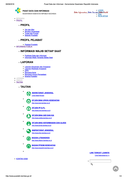
Screenshot of statistic data websites.
Follow the link and find Country Profiles in indonesian language on TB, Reproductive Health, Malaria, Lymphoma, Pneumonia, Hypertension and much more.
Alternative websites:
http://www.promkes.depkes.go.id/
...
or http://www.kemkes.go.id/
more
Indonesia's Health Profile 2012
Papua Province Health Profile 2012
Profile of Children Dissabilities in Indonesia
Management of substance abuse - Country profiles 2014
Global Food and Nutrition Security Dashboard
recommended
Interactive maps; country profiles and Studies
The Dashboard is designed to consolidate and present up-to-date data on food crisis severity, track global food security financing, and make available global and
...
country-level research and analysis to improve coordination of the policy and financial response to the crisis.
It will bring together disparate and vast information on food security into one place, to help reduce transaction costs, improve transparency, and strengthen analysis. It can also help speed up financing by highlighting funding needs and gaps. The goal is to inform a coordinated global food crisis response while also helping to advance medium to long-term food security interventions.
more
