
Filter
625
Featured
44
76
Language
Document type
183
145
76
41
34
30
19
18
18
17
15
13
11
2
Countries
21
20
18
10
10
9
8
5
5
4
4
3
3
3
3
3
3
3
3
3
3
3
3
3
3
3
3
3
3
3
3
2
2
2
2
2
2
2
2
2
2
2
2
2
2
1
1
1
1
1
1
1
1
1
1
1
1
1
1
1
1
1
1
1
1
1
1
1
1
1
1
1
1
1
1
1
1
1
1
1
1
1
1
1
1
1
1
1
1
1
1
1
1
1
1
1
1
1
1
1
Authors & Publishers
Publication Years
Category
79
32
8
4
2
2

Antibiotics and other antimicrobial agents are invaluable life savers, particularly in resource-limited countries where infectious diseases are abundant. Both uncomplicated and severe infections are potentially curable as long as the aetiological agents are susceptible to the
...
WHO would like to express its gratitude and appreciation to all Member States that provided information to the WHO survey on policies and activities at the national level in the area of antimicrobial resistance. The contribution of staff in WHO Regional and Country Offices has been invaluable: in ga
...

The Transatlantic Task Force on Antimicrobial Resistance (TATFAR) fosters cooperation between the European Union (EU) andthe United States (US) on the issue of antimicrobial resistance. The first TATFAR recommendation refers to appropriate use of antimicrobials in human medicine through hospital Ant
...

The Global Antibiotic Resistance Partnership (GARP)-Mozambique team, in partnership with the Center for Disease Dynamics, Economics & Policy (CDDEP), has produced this report as part of a solid com-mitment to develop actionable policy proposals to tackle antibiotic resistance and improve appropriate
...
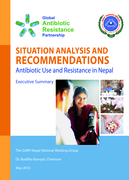
Antibiotic resistance is no longer a concern for the distant future but is a pressing issue, both globally and in Nepal. As part of global effort to preserve the effectiveness of antibiotics, the Global Antibiotic Resistance Partnership (GARP)-Nepal was established to doc
...

You don't always need antibiotics when you're sick—only for infections caused by bacteria. And overuse is causing a global health problem.

At the Society's 2014 Annual Conference, Professor Laura Piddock was awarded the Society's Marjory Stephenson Prize. Her is her prize lecture, in which she talks about the mechanisms underlying antimicrobial resistance

Antimicrobial resistance (AMR) represents a major threat to human health with significant global economic and security implications. In 2015, WHO Member States unanimously approved a Global Action Plan to tackle AMR (GAP-AMR). The goal of GAP-AMR is “to ensure, for as long as possible, continuity
...
The report focuses on antibacterial resistance (ABR) in common bacterial pathogens. There is a major gap in knowledge about the magnitude of this problem. Antimicrobial resistance (AMR) threatens the effective revention and treatment of an ever-increasing range of infections caused by bacteria, para
...
The following checklist is a companion to Core Elements of Hospital Antibiotic Stewardship Programs. This checklist should be used to systematically assess key elements and actions to ensure optimal antibiotic prescribing and limit overuse and misuse of antibiotics in hospitals. CDC recommends that
...
Curriculum reform efforts to enhance training on rational medicine use (RMU) and AMR should pay particular attention to ensuring that the right topics are integrated and the right teaching-learning methodologies are adopted.
This is the first national Policy to combat AMR in Cambodia. It was developed based on conclusions and recommendations of a country situaytion analysis.
Antibiotic resistance is a natural occurrence caused by mutations in bacteria’s genes. However, inappropriate use of antibiotics accelerates the emergence and spread of antibiotic-resistant bacteria. When exposed to antibiotics, susceptible bacteria are killed; while excessive antibiotic use or th
...

Antimicrobial resistance represents a big threat to public health. The Centers for Disease Control and Prevention (CDC) estimate that every year two million Americans are infected with a (multi-)drug resistant bacterium, resulting in 23,000 deaths. The WHO has repeatedly drawn attention to this majo
...
Antimicrobials are used in veterinary medicine to treat infectious diseases in animals caused or complicated by microorganisms, mainly bacteria, or to prevent the development or spread of infection in healthy animals.
Nosocomial infections, or hospital-acquired infec-tions (HAI), are among the most significant causesof morbidity and mortality in healthcare settingsthroughout the world.Prevention of HAIs iscentral to providing high quality and safe health-care, even in settings with limited resources.Transmi
...
El informe anual de la vigilancia de la resistencia a los antibióticos de los países participantes de la Región de las Américas se discute y analiza con el fin de tomar medidas para el perfeccionamiento continuo de la calidad de los datos, y su utilidad en la orientación a los clínicos para el
...
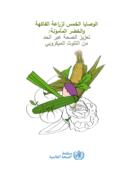
إن أهمية الفواكه والخضروات في النظم الغذائية الصحية والمغذية معروفة جيدًا ، وفي السنوات الأخيرة تم تشجيع المستهلكين على تناول المزيد من هذه المنتجات. بالنسبة للعدي
...

The National Department of Health and Department of Agriculture, Forestry and Fisheries have collectively engaged to determine the key interventions that will form the basis for this strategy taking into account the recommendations from the WHO and OIE.
The development and implementation of a Natio
...
