Filter
466
Text search:
rumours
Featured
77
114
Language
Document type
186
97
51
50
31
15
14
11
5
4
2
Countries
34
28
19
18
13
13
12
11
11
10
9
8
7
7
7
7
6
6
6
6
5
4
4
4
4
4
4
3
3
3
3
3
3
3
3
3
3
3
3
2
2
2
2
2
2
2
2
2
2
2
2
2
2
2
2
2
2
1
1
1
1
1
1
1
1
1
1
1
1
1
1
1
1
1
1
1
1
1
1
1
1
Authors & Publishers
Publication Years
Category
132
45
27
18
16
7
Toolboxes
132
78
34
26
22
16
15
15
15
9
9
7
5
4
4
3
3
3
2
2
2
2
1
1
This What Matters? edition focuses on Covid-19 rumours circulating in the Rohingya camps of Cox’s Bazar. It explores some of the more common rumours, discusses sources and formats of information,
...

The CDAC Network commissioned a practice guide to draw both on their experiences and many others’ in order to document approaches, practices and tools to working with rumors. It is aimed primarily at humanitarian programme managers and field staff to provide them with practical tips on how to work
...

This practice guide offers approaches, practices and tools to working with rumours and misinformation. It is aimed primarily at humanitarian programme managers and field staff to provide them with practical tips on how to work with
...
A toolkit containing links to videos which use clay figures to address topics relating to COVID-19, such as stigma and rumours, as well as issues surrounding migration, including social inclusion.
A toolkit containing links to videos which use clay figures to address topics relating to COVID-19, such as stigma and rumours, as well as issues surrounding migration, including social inclusion.
Overview: Risk communication and community engagement are essential for any disease outbreak response. This is particularly critical during outbreaks of Ebola which may create fear in the public and frontline responders alike due to severe presentation of symptoms, misunderstanding of the causes of
...
EPI-WIN WHO Information Network for Epidemics
recommended
A key component of epidemic and pandemic preparedness is ensuring systems are in place for real-time information to flow from a trusted source to the people at risk.
In the absence of such information rumours can spread rapidly through social media
...
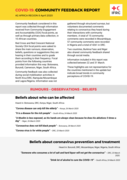
Community feedback considered in this report was collected through information received from Community Engagement and Accountability (CEA) focal points,as well as through primary data collection,in 10 African countries.Red Cross and Red Crescent National Society CEA focal points were asked to share
...

There is an overabundance of information circulating about the new coronavirusdisease(COVID-19), which can make it hard for people to identify which information is reliable and trustworthy. Rumours and misinformation travel fast–especially through
...

Guidance Note: Mental health and Psychosocial Support Implications of Mpox Outbreaks, September 2024
recommended
The IFRC Psychosocial Centre has published a guidance note providing an overview of the psychosocial consequences of virus outbreaks, with a focus on mpox, and outlines key considerations for MHPSS programming.
The current mpox outbreaks present numerous challenges for responding National Societi
...
Plusieurs membres du réseau CDAC (Communicating with Disaster Affected Communities, Communication avec les communautés sinistrées) ont reconnu le besoin de gérer les rumeurs durant leurs missions afin de prévenir la perte de vies et d’alléger les souffrances. En particulier, Internews avec l
...

Introduction The novel Coronavirus (nCoV) epidemic in 2019 -2020 has recently emerged. The route of transmission is not totally known, although it is known that it can spread from person to person, and local health care systems may be ill-equipped to handle a large-scale outbreak. Furthermore, misco
...


Brazilian media and science communicators must understand the main characteristics of misinformation in social media about COVID-19, so that they can develop attractive, up-to-date and evidence-based content that helps to increase health literacy and counteract the spread of false information.
Cholera Outbreak Response
recommended
The document provides comprehensive guidelines for managing cholera outbreaks, including detection, confirmation, response, treatment, and prevention. It emphasizes the importance of rehydration, water sanitation, hygiene promotion, and community mobilization to limit the spread. This guide is desig
...
Briefing note prepared by the IFRC Reference Centre for Psychosocial Support, August 2014
Risk of spill-over of EVD to Uganda has been categorised as very high. On 28 September 2018, WHO elevated the risk at the regional level which includes Uganda from ‘high’ to ‘very high’. Uganda has a very long and largely porous border with the DRC. High population movements across the borde
...