Filter
370
Text search:
conflict-affected
persons
Featured
34
110
Language
Document type
202
83
24
23
23
9
3
1
1
1
Countries
35
30
21
21
16
14
9
8
8
7
6
5
5
5
4
4
4
4
4
3
3
3
3
3
2
2
2
2
2
2
2
2
2
2
2
2
1
1
1
1
1
1
1
1
1
1
1
1
1
1
1
1
1
1
1
1
1
1
1
1
1
1
1
1
1
Authors & Publishers
Publication Years
Category
117
53
25
16
7
3
Toolboxes
76
43
39
38
25
11
10
8
7
5
5
4
3
3
3
2
2
2
1
1
1

This operational guidance on MHPSS provides a practical orientation and tools for UNHCR country operations. It covers specific points of good practice to consider when developing MHPSS programming and offers advice on priority issues and practical difficulties, while also providing some background i
...

Today, more children than ever before are displaced within their own countries. Their harrowing stories of displacement are unfolding every day, and with increasing frequency. At the end of 2019, approximately 45.7 million people were internally displaced by conflict and violence (Fig. 1.1). Nearly
...
This report shows that frontier agriculture is a viable complement to conventional agriculture, particularly in Africa and countries affected by fragility, conflict, and violence (FCV).
Development assistance for health (DAH) has grown substantially, totaling more than $31.3 billion in 2013. However, the degree that countries with high concentrations of armed conflict, ethnic violence, inequality, debt, and corruption have received this health aid and how that assistance might be d
...
The following Emergency Response Plan for the COVID-19 pandemic seeks to set out activities that will be undertaken by humanitarian actors in Ukraine over the course of 2020 to respond to the public health impact of the epidemic – as well as the indirect, socio-economic impact on people’s well-b
...
Census Report Volume 4-K
The results of the 2014 Census collected only relates to four of the six types of disability domains recommended by the Washington Group on Disability Statistics, namely: seeing, hearing, walking, and remembering or concentrating.
Out of a total of 50.3 million ...
The results of the 2014 Census collected only relates to four of the six types of disability domains recommended by the Washington Group on Disability Statistics, namely: seeing, hearing, walking, and remembering or concentrating.
Out of a total of 50.3 million ...

Nearly 800 women die every day from preventable maternal causes, and in 2022 alone, an estimated 2.3 million newborns died. For every maternal death, countless more women endure life-altering injuries, infections, and disabilities related to childbirth.
Maternal deaths are concentrated in the poo
...

The arrival of COVID-19 in Afghanistan has brought heartache to millions of people who are now battling a deadly pandemic while simultaneously fighting for their survival amid poverty, disaster and war. Over my three years as Humanitarian Coordinator, I have marvelled at the resilience of the people
...
The escalation of the war in Ukraine began on 24 February 2022, causing thousands of civilian
casualties; destroying civilian infrastructure, including hospitals, and triggering the fastest-
growing displacement crisis in Europe since World War II. The demographic profile of Ukraine,
combined wit
...

The key actions, activities, and approaches in this document are organized within each of the 5Cs (see Table 1 in the PDF) and those of the Strategic preparedness and response plan (SPRP) pillars as follows:
National action plan key activities, prioritized for the current context and the current
...

Mental health problems are common and cause great suffering to individuals and communities around the world. They have a significant impact not only on the physical and mental health of those affected but also on their families and the communities they live in. At the same time, all communities have
...
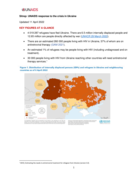
As the war in Ukraine enters its fifth year, the humanitarian crisis continues to deepen, with profound consequences for access to essential services, including health care. Modern warfare tactics, including the widespread use of drones and repeated attacks on critical infrastructure, are increasing
...
Emergency Medical Teams 2030 strategy
recommended
The Emergency Medical Teams (EMT) initiative plays a vital role in building this stronger and
more resilient global health emergency architecture, both by driving its formation and by
contributing to a rapidly deployable global health emergency corps. The Initiative and EMTs
bring something uniqu
...

Since February 24th, 2022, the beginning of Russia’s aggression against Ukraine, more than 80,000 women were expected to give birth. Therefore, understanding the impact of war on the perinatal health of women is an important requisite to improve perinatal care. This narrative synthesis has two mai
...

Almost two years after the signing of the Political Accord for Peace and Reconciliation (APPR), the Central African population is still hostage to an unstable and unpredictable security environment. Continuing conflicts in several areas of the country, structural weaknesses combined with the socio-e
...
A broad range of UNHCR’s key priorities overlap with MHPSS issues – for example, child protection and sexual and gender-based violence [SGBV] prevention and response.
Despite all these existent synergies, UNHCR’s current policies and guidelines do not sufficiently link with MHPSS principles.
...