
Filter
1117
Text search:
Act
Alliance
Featured
Recommendations
85
New Publications
300
Language
Document type
No document type
589
Studies & Reports
254
Guidelines
83
Strategic & Response Plan
67
Manuals
65
Training Material
27
Fact sheets
11
Situation Updates
9
Resource Platforms
5
Infographics
3
Brochures
2
App
1
Online Courses
1
Countries / Regions
Global
90
India
39
Kenya
39
Uganda
30
Myanmar / Burma
24
South Africa
23
Nigeria
22
Liberia
19
Zambia
19
Sierra Leone
18
Ghana
18
Syria
16
Bangladesh
16
Malawi
16
Africa
16
Nepal
15
Namibia
12
Lesotho
12
Tanzania
11
Western and Central Europe
11
Asia
11
Ethiopia
10
Senegal
9
Philippines
9
South Sudan
9
Ukraine
9
South–East Asia Region
9
Congo, Democratic Republic of
7
Cambodia
7
Thailand
7
Yemen
7
Latin America and the Carribbean
6
Vietnam
6
Zimbabwe
5
Indonesia
5
Central African Republic
5
East and Southern Africa
5
West and Central Africa
5
Eastern Europe
5
USA
4
Haiti
4
Germany
4
Lebanon
4
China
4
Laos
4
Guinea
3
Iraq
3
Afghanistan
3
Rwanda
3
Papua New Guinea
3
Sri Lanka
3
Western Pacific Region
3
Venezuela
3
Burkina Faso
2
Pakistan
2
Jordan
2
Mozambique
2
Eswatini/ Swaziland
2
Botswana
2
Palestine
2
Canada
2
Timor Leste/ East Timor
2
Iran
2
Georgia
2
Mali
1
Cameroon
1
Niger
1
Togo
1
Somalia
1
Egypt
1
Malaysia
1
Ireland
1
Peru
1
Brazil
1
Switzerland
1
Serbia
1
Colombia
1
Greece
1
Mexico
1
Middle East and North Africa
1
Eastern Europe and Central Asia
1
Albania
1
Southern Africa
1
Tajikistan
1
Russia
1
Estonia
1
North America
1
Japan
1
Authors & Publishers
Publication Years
Category
Countries
353
Public Health
82
Key Resources
73
Women & Child Health
70
Clinical Guidelines
49
Capacity Building
19
Pharmacy & Technologies
7
Toolboxes
HIV
102
Mental Health
92
COVID-19
77
Disability
67
Planetary Health
67
Global Health Education
40
Health Financing Toolbox
38
Conflict
37
TB
33
AMR
32
Caregiver
27
NCDs
25
NTDs
24
Refugee
22
Malaria
21
Ebola & Marburg
20
Pharmacy
16
Natural Hazards
7
Rapid Response
7
2.0 Rapid Response
6
Social Ethics
5
Polio
4
Cholera
3
South Sudan
1
Zika
1
SADF POLICY BRIEF
31 October 2018 Issue n° 8
ISSN: 2406-5625
Self-care interventions are among the most promising and exciting new approaches to improve health and well-being, both from a health systems perspective and for people who use these interventions. The World Health Organization (WHO) uses the following working definition of self-care: Self-care is t
...
The present report, which covers the period from January to December 2018, is submitted pursuant to Security Council resolution 2427 (2018). The preparation of the report involved broad consultations within the United Nations, in the field and at Headquarters, and with relevant Member States. It hig
...
Letter of the holy father
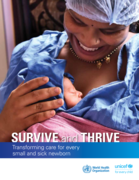
Just about everyone has experienced the joy that a healthy newborn child brings to parents, families and communities. But the arrival of a newborn who is small or sick often results in immediate worry and sadness. When the infant is at high risk of death or disability, these concerns can be a tremen
...
This fourth annual report monitors global progress towards the 2023 target for global elimination of industrially produced trans-fatty acids (TFA), highlighting achievements during the past year (October 2021 – September 2022). Countries are responding to the World Health Organization (WHO) call t
...
UNAIDS Report 2013

South Africa has faced many challenges over the past two decades, accomplishing profound positive changes in the social structure and government of the nation. This has not yet fully translated into better health for the population, however, particularly the poorest segment. In fact, the p
...

This field study to measure access to and use of medicines was undertaken in GHANA in May-June 2008. The study assessed information on the socio-economic level of households, and access to and use of medicines for acute and chronic conditions as well as opinions and perceptio
...
Guidelines for social mobilization
TB and poverty; TB and children; TB and women; TB, migrants and refugees; TB and prisons
WHO/CDS/STB/2001.9
Original: English; Distribution: Limited
Rabies is a global public health problem with important socioeconomic impacts. Human rabies is preventable; almost all cases are transmitted through the bite of a rabid dog. Elimination of human rabies is possible. Technical support and tools are available. This report covers:
- Why investment ...
- Why investment ...
SDG Factsheet: Health-focused urban design can roll back the epidemic of noncommunicable diseases (NCDs), making cities a bedrock for healthy lifestyles – as well as climate-friendly and resilient. WHO’s new Urban Health Initiative provides a model for the health sector to contribute to healthy
...
Antimicrobial resistance (AMR) is an important public health concern shared by developed and developing countries. In developing countries the burden of infectious diseases is greater and exacerbated by limited access to, and availability and affordability of, antimicrobials required to treat infect
...
In 1964 medical mission was challenged and called to define its distinctiveness and its special role in the context of that particular time. The consultation "Tuebingen I" clearly stated: "The Christian church has a specific task in the field of health and healing"1, and developed a conce
...

Int. J. Environ. Res. Public Health 2018, 15(12), 2626; https://doi.org/10.3390/ijerph15122626
Climate change is increasing risks to human health and to the health systems that seek to protect the safety and well-being of populations. Health authorities require information about current associatio
...

The content of these guidelines goes beyond the technicalities of medical needs with additional insights into community empowerment, possible access to welfare and economic opportunities and similar issues. If these are adequately explored, the health and quality of life of people affected and their
...
There are indigenous communities at high risk in every country of the region. At stake are the lives of 45 million people who belong to more than 800 indigenous peoples. Of these, some 100 are spread across several countries, around 200 maintain voluntary isolation or are in initial contact, and nea
...
