
Filter
969
Text search:
disaster
law
Featured
105
317
Language
Document type
563
157
82
80
54
14
9
6
2
1
1
Countries
57
45
29
29
27
22
22
20
17
15
14
13
12
12
11
10
10
10
9
9
9
9
9
9
8
8
7
7
6
5
5
5
5
5
4
4
4
4
4
4
4
4
3
3
3
3
3
3
3
3
3
2
2
2
2
2
2
2
2
2
2
2
1
1
1
1
1
1
1
1
1
1
1
1
1
1
1
1
1
1
1
1
1
1
1
1
1
Authors & Publishers
Publication Years
Category
348
177
49
38
20
14
1
Toolboxes
96
82
75
73
58
51
39
36
26
24
23
21
14
12
6
6
6
5
5
2
2
2
1
1
1
1
Shaping Health programme on Learning from international experience on approaches to community power, participation and decision-making in health,AMHF, TARSC
Maternal Mental Health and child health and development in low and middle income countries
recommended
The impact of maternal mental health problems on infants in high income countries has been identified mostly in terms of psychosocial and emotional development, thanks to the groundbreaking early work of Spitz (2) and of Bowlby (3), who studied the emotional needs of infants and mother-child attachm
...
These guidelines are informed by evidence of ‘what works’ and lessons learned in the field. They are designed to accelerate UNICEF regional and country offices’ programming on social service workforce strengthening, and support work to better plan, develop and support the social services workf
...
As of June 2019, the number of Venezuelans leaving their country reached 4 million, with Colombia, Peru, Chile, Ecuador and Brazil hosting the vast majority of Venezuelans in Latin America. The end of the first half of the year was marked by the announcement of tighter immigration measures in Peru
...
Sexual and gender-based violence (SGBV) threatens displaced women and girls, as well as men and boys, in all regions of the world. Creating safe environments and mitigating the risk of SGBV can only be achieved by addressing gender inequality and discrimination. While the scourge of SGBV is receivin
...
The Call to Action on Protection from GBV in Emergencies, formally launched in 2013 by the United Kingdom and Sweden, aims to fundamentally transform the way GBV is addressed in humanitarian operations via the collective action of numerous partners, each bringing our various strengths and capacities
...
At least half of the world’s population does not have full coverage of essential health services. Health expenses push more than 100 million people into extreme poverty each and every year, forcing them into terrible choices that no one should ever have to make: Buy medicine or food? Education or
...
Germany has become a visible actor in global health in the past 10 years. In this Series paper, we describe how this development complements a broad change in perspective in German foreign policy.
A multidisciplinary and multisectoral collaboration, through a One Health approach is required to effectively prepare for, detect, assess, and respond to emerging and endemic zoonotic diseases. However, external and internal health system evaluations continue to identify major gaps in capacity
...
This report considers how to integrate health into urban planning, investments, and policy decisions, so as to support the implementation and achievement of the goals and objectives of the New Urban Agenda.

Thirty years ago, the United Nations General Assembly adopted the Convention on the Rights of the Child at a moment of rapid global change marked by the end of apartheid, the fall of the Berlin Wall and the birth of the World Wide Web. These developments and more brought momentous and lasting evolut
...
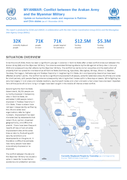
Since the end of 2018, there has been a significant upsurge in violence in Rakhine State after armed conflict broke out between the Arakan Army (AA) and the Myanmar Military. The violence escalated following attacks by the AA against military sites in January 2019 and subsequent counter-attacks by t
...
Unstable settings present challenges for the effective provision of antiretroviral treatment (ART). In this paper, we summarize the experience and results of providing ART and implementing contingency plans during acute instability in the Central African Republic (CAR) and Yemen.
Over the reporting period, economic actors continued to carry out their activities with little regard for their impacts on the livelihoods of the communities living in the surrounding areas. In Doo Tha Htoo (Thaton) District, cold dust from a Tatmadaw-run cement factory contaminated nearby waterways
...

This second edition of the “living paper” contributes to the global knowledge on how countries are responding to the pandemic by documenting real-time actions in a key area of response – that is, social protection measures planned or implemented by governments.
For the purpose of this revie
...
Last update: 2 April 2020
Productive and Inclusive Cities for an Emerging Democratic Republic of Congo
March – June 2020
This update: 3 April 2020
