Filter
274
Text search:
здоровье
ребенка
Featured
Recommendations
9
New Publications
105
Language
Document type
No document type
169
Studies & Reports
41
Guidelines
17
Fact sheets
16
Manuals
8
Situation Updates
7
Strategic & Response Plan
6
Infographics
4
Training Material
3
Brochures
1
Resource Platforms
1
Videos
1
Countries / Regions
India
26
Nepal
16
Senegal
15
Ethiopia
15
Kenya
15
Malawi
15
Uganda
13
Sierra Leone
12
Tanzania
11
Congo, Democratic Republic of
10
South Africa
10
Nigeria
9
Syria
7
Rwanda
7
Indonesia
7
Bangladesh
7
Benin
6
Ghana
5
Haiti
5
Latin America and the Carribbean
5
Paraguay
5
Burkina Faso
4
Philippines
4
Mozambique
4
Argentina
4
Namibia
4
Ukraine
4
Madagascar
4
Lesotho
4
Germany
3
Lebanon
3
Zambia
3
Cambodia
3
Brazil
3
Venezuela
3
Global
3
Zimbabwe
2
Somalia
2
Afghanistan
2
Myanmar / Burma
2
Liberia
1
Mali
1
Niger
1
Togo
1
South Sudan
1
Iraq
1
Jordan
1
Turkey
1
Sudan
1
Central African Republic
1
Ecuador
1
Bolivia
1
Guatemala
1
Yemen
1
Middle East and North Africa
1
South–East Asia Region
1
Eastern Europe and Central Asia
1
Western and Central Europe
1
Russia
1
Authors & Publishers
Publication Years
Category
Countries
269
Women & Child Health
22
Clinical Guidelines
6
Capacity Building
1
Toolboxes
Caregiver
14
COVID-19
12
Conflict
10
Mental Health
5
Refugee
3
Cholera
2
Polio
2
HIV
2
Ebola & Marburg
1
Natural Hazards
1
Global Health Education
1
NTDs
1
Health Financing Toolbox
1
NCDs
1
EVALUATION REPORT. This report is a synthesis of the evaluation of UNICEF's response to the 2004 Indian Ocean tsunami in Indonesia that was undertaken in August 2008 to July 2009. The evaluation assessed UNICEF's response in four sectors where it had major involvement: child protection; basic educat
...
750,000 people are estimated to be food insecure. This number may magnify as households continue to recover from impacts of COVID-19.
Over 63% of household surveys were responded to by female heads and 37.5% of the Key informant respondents were women. Women and children continue to be more dispr
...
Accessed on 02.02.2020
Selon la Conférence Internationale sur la Population et le Développement (CIPD, Caire, 94, paragraphe 7.2), « la santé de la reproduction ou santé génésique est un état de complet bien-être physique, mental et social et pas seulement l’absence de maladie ou d’inf
...
Accessed on 20.10.2020
L͛analyse des tendances récentes montre que le Burkina Faso a enregistré une réduction significative de la mortalité infanto-juvénile. Même si aucune des cibles des OMD 4 et 5 n͛a été atteinte par le pays, le taux de mortalité infanto-juvénile est passé de 129
...
The coronavirus disease 2019 (COVID-19) pandemic has created a global and gendered crisis that is compounding existing inequalities and disproportionately affecting girls and women. Emerging evidence from the COVID-19 crisis in 2020 shows school closures, disruptions in essential services and rising
...
From 2000 to 2010, Rwanda implemented comprehensive health sector reforms to strengthen the public health system, with the aim of reducing maternal and newborn deaths in line with Millennium Development Goal 5, among many other improvements in national health. Based on a systematic review of the lit
...
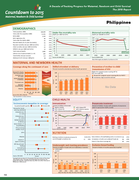
The Countdown country profile presents in one place the best and latest evidence to enable an assessment of a country’s progress in improving reproductive, maternal, newborn, and child health (RMNCH)
O Subsídio de Primeira Infância (SPI) é uma transferência monetária incondicional, dirigida a crianças até aos 2 anos de idade que vivam em agregados familiares pobres ou vulneráveis, com o objectivo de promover a redução da desnutrição crónica e de melhorar o acesso das crianças aos s
...
Acessed on 20.10.2020
Dans sa lutte contre la mortalité maternelle, le gouvernement du Burkina Faso est soutenu par les bailleurs de fonds qui contribuent au budget de la santé et financent également des projets spécifiques visant à améliorer l’accès aux soins. Le présent rapport reconna
...
Au Sénégal, près de deux millions de filles et de femmes ont subi des MGF. Au total, 25 % des filles et des femmes ont subi cette pratique, allant de plus de 90 % dans la région de Kédougou à un peu moins de 1 % dans celle de Diourbel
PLoS ONE 13(8): e0202499. https://doi.org/10.1371/journal.pone.0202499
This was a school-based cross-sectional study conducted in 2015 among 305 school children aged 7–16 years from two primary schools located in Ilemela and Magu Districts, north-western Tanzania. Single stool and urine samples w
...
Cuadro de Procedimientos, Módulo de Capacitación
recommended
Large File: 45 MB!!