
Filter
4965
Text search:
Clinical
Staff
Featured
604
1267
Language
4835
125
87
65
49
33
25
10
10
7
5
5
4
4
4
3
3
3
3
3
3
3
3
2
2
2
2
2
2
2
2
2
1
1
1
1
1
1
1
1
1
1
1
1
1
1
1
1
1
1
1
1
1
1
1
1
Document type
2517
916
671
376
202
125
85
39
12
8
8
5
1
Countries
276
179
155
144
125
114
113
111
106
93
82
81
80
75
66
63
60
60
49
48
47
46
41
36
36
36
36
33
33
32
30
29
29
29
24
24
23
21
20
19
19
18
17
16
14
14
14
13
12
11
11
9
9
9
9
9
9
8
8
7
7
7
7
7
7
7
6
6
6
6
6
5
5
5
5
5
5
4
4
4
4
4
4
3
3
3
3
3
3
3
3
3
3
3
3
3
3
2
2
2
2
2
2
2
2
2
2
2
2
2
2
2
2
2
2
2
2
1
1
1
1
1
1
1
1
1
1
1
1
1
1
1
1
1
1
1
1
1
1
1
1
1
1
1
1
1
1
Authors & Publishers
900
273
146
125
123
104
77
65
52
42
34
34
31
30
28
28
27
27
26
25
25
25
21
20
20
19
19
19
18
18
18
18
18
18
17
17
17
17
16
16
15
14
14
13
12
12
11
11
11
11
11
10
10
10
10
10
9
9
9
9
9
9
9
9
9
9
9
9
9
9
9
9
9
8
8
8
8
8
8
8
8
8
8
8
7
7
7
7
7
7
7
7
7
7
7
7
7
7
7
6
6
6
6
6
6
6
6
6
6
6
6
6
6
6
6
6
6
5
5
5
5
5
5
5
5
5
5
5
5
5
5
5
5
5
5
5
5
5
5
5
5
5
5
5
5
5
5
5
5
5
5
5
4
4
4
4
4
4
4
4
4
4
4
4
4
4
4
4
4
4
4
4
4
4
4
4
4
4
4
4
4
4
4
4
4
4
4
4
4
4
4
4
4
4
3
3
3
3
3
3
3
3
3
3
3
3
3
3
3
3
3
3
3
3
3
3
3
3
3
3
3
3
3
3
3
3
3
3
3
3
3
3
3
3
3
3
3
3
3
3
3
3
3
3
3
3
3
3
3
3
3
3
3
3
3
3
3
3
3
3
3
3
3
3
3
3
3
3
3
3
3
3
3
3
3
3
3
3
3
3
3
3
3
3
3
2
2
2
2
2
2
2
2
2
2
2
2
2
2
2
2
2
2
2
2
2
2
2
2
2
2
2
2
2
2
2
2
2
2
2
2
2
2
2
2
2
2
2
2
2
2
2
2
2
2
2
2
2
2
2
2
2
2
2
2
2
2
2
2
2
2
2
2
2
2
2
2
2
2
2
2
2
2
2
2
2
2
2
2
2
2
2
2
2
2
2
2
2
2
2
2
2
2
2
2
2
2
2
2
2
2
2
2
2
2
2
2
2
2
2
2
2
2
2
2
2
2
2
2
2
2
2
2
2
2
2
2
2
2
2
2
2
2
2
2
2
2
2
2
2
2
2
2
2
2
2
2
2
2
2
2
2
2
2
2
2
2
2
2
2
2
2
2
2
2
2
2
2
2
2
2
2
2
2
2
2
2
2
2
2
2
2
2
2
2
2
2
2
2
2
2
2
2
2
2
2
2
2
2
2
2
2
2
2
2
2
2
2
2
2
2
2
2
2
2
2
2
2
2
2
2
2
2
2
2
2
2
2
2
2
2
2
2
2
2
2
2
1
1
1
1
1
1
1
1
1
1
1
1
1
1
1
1
1
1
1
1
1
1
1
1
1
1
1
1
1
1
1
1
1
1
1
1
1
1
1
1
1
1
1
1
1
1
1
1
1
1
1
1
1
1
1
1
1
1
1
1
1
1
1
1
1
1
1
1
1
1
1
1
1
1
1
1
1
1
1
1
1
1
1
1
1
1
1
1
1
1
1
1
1
1
1
1
1
1
1
1
1
1
1
1
1
1
1
1
1
1
1
1
1
1
1
1
1
1
1
1
1
1
1
1
1
1
1
1
1
1
1
1
1
1
1
1
1
1
1
1
1
1
1
1
1
1
1
1
1
1
1
1
1
1
1
1
1
1
1
1
1
1
1
1
1
1
1
1
1
1
1
1
1
1
1
1
1
1
1
1
1
1
1
1
1
1
1
1
1
1
1
1
1
1
1
1
1
1
1
1
1
1
1
1
1
1
1
1
1
1
1
1
1
1
1
1
1
1
1
1
1
1
1
1
1
1
1
1
1
1
1
1
1
1
1
1
1
1
1
1
1
1
1
1
1
1
1
1
1
1
1
1
1
1
1
1
1
1
1
1
1
1
1
1
1
1
1
1
1
1
1
1
1
1
1
1
1
1
1
1
1
1
1
1
1
1
1
1
1
1
1
1
1
1
1
1
1
1
1
1
1
1
1
1
1
1
1
1
1
1
1
1
1
1
1
1
1
1
1
1
1
1
1
1
1
1
1
1
1
1
1
1
1
1
1
1
1
1
1
1
1
1
1
1
1
1
1
1
1
1
1
1
1
1
1
1
1
1
1
1
1
1
1
1
1
1
1
1
1
1
1
1
1
1
1
1
1
1
1
1
1
1
1
1
1
1
1
1
1
1
1
1
1
1
1
1
1
1
1
1
1
1
1
1
1
1
1
1
1
1
1
1
1
1
1
1
1
1
1
1
1
1
1
1
1
1
1
1
1
1
1
1
1
1
1
1
1
1
1
1
1
1
1
1
1
1
1
1
1
1
1
1
1
1
1
1
1
1
1
1
1
1
1
1
1
1
1
1
1
1
1
1
1
1
1
1
1
1
1
1
1
1
1
1
1
1
1
1
1
1
1
1
1
1
1
1
1
1
1
1
1
1
1
1
1
1
1
1
1
1
1
1
1
1
1
1
1
1
1
1
1
1
1
1
1
1
1
1
1
1
1
1
1
1
1
1
1
1
1
1
1
1
1
1
1
1
1
1
1
1
1
1
1
1
1
1
1
1
1
1
1
1
1
1
1
1
1
1
1
1
1
1
1
1
1
1
1
1
1
1
1
1
1
1
1
1
1
1
1
1
1
1
1
1
1
1
1
1
1
1
1
1
1
1
1
1
1
1
1
1
1
1
1
1
1
1
1
1
1
1
1
1
1
1
1
1
1
1
1
1
1
1
1
1
1
1
1
1
1
1
1
1
1
1
1
1
1
1
1
1
1
1
1
1
1
1
1
1
1
1
1
1
1
1
1
1
1
1
1
1
1
1
1
1
1
1
1
1
1
1
1
1
1
1
1
1
1
1
1
1
1
1
1
1
1
1
1
1
1
1
1
1
1
1
1
1
1
1
1
1
1
1
1
1
1
1
1
1
1
1
1
1
1
1
1
1
1
1
1
1
1
1
1
1
1
1
1
1
1
1
1
1
1
1
1
1
1
1
1
1
1
1
1
1
1
1
1
1
1
1
1
1
1
1
1
1
1
1
1
1
1
1
1
1
1
1
1
1
1
1
1
1
1
1
1
1
1
1
1
1
1
1
1
1
1
1
1
1
1
1
1
1
1
1
1
1
1
1
1
1
1
1
1
1
1
1
1
1
1
1
1
1
1
1
1
1
1
1
1
1
1
1
1
1
1
1
1
1
1
1
1
1
1
1
1
1
1
1
1
1
1
1
1
1
1
1
1
1
1
1
1
1
1
1
1
1
1
1
1
1
1
1
1
1
1
1
1
1
1
1
1
1
1
1
1
1
1
1
1
1
1
1
1
1
1
1
1
1
1
1
1
1
1
1
1
1
1
1
1
1
1
1
1
1
1
1
1
1
1
1
1
1
1
1
1
1
1
1
1
1
1
1
1
1
1
1
1
1
1
1
1
1
1
1
1
1
1
1
1
1
1
1
1
1
1
1
1
1
1
1
1
1
1
1
1
1
1
1
1
1
1
1
1
1
1
1
1
1
1
1
1
1
1
1
1
1
1
1
1
1
1
1
1
1
1
1
1
1
1
1
1
1
1
1
1
1
1
1
1
1
1
1
1
1
1
1
1
1
1
1
1
1
1
1
1
1
1
1
1
1
1
1
1
1
1
1
1
1
1
1
1
1
1
1
1
1
1
1
1
1
1
1
1
1
1
1
1
1
1
1
1
1
1
1
1
1
1
1
1
1
1
1
1
1
1
1
1
1
1
1
1
1
1
1
1
1
1
1
1
1
1
1
1
1
1
1
1
1
1
1
1
1
1
1
1
1
1
1
1
1
1
1
1
1
1
1
1
1
1
1
1
1
1
1
1
1
1
1
1
1
1
1
1
1
1
1
1
1
1
1
1
1
1
1
1
1
1
1
1
1
1
1
1
1
1
1
1
1
1
1
1
1
1
1
1
1
1
1
1
1
1
1
1
1
1
1
1
1
1
1
1
1
1
1
1
1
1
1
1
1
1
1
1
1
1
1
1
1
1
1
1
1
1
1
1
1
1
1
1
1
1
1
1
1
1
1
1
1
1
1
1
1
1
1
1
1
1
1
1
1
1
1
1
1
1
1
1
1
1
1
1
1
1
1
1
1
1
1
1
1
1
1
1
1
1
1
1
1
1
1
1
1
1
1
1
1
1
1
1
1
1
1
1
1
1
1
1
1
1
1
1
1
1
1
1
1
1
1
1
1
1
1
1
1
1
1
1
1
1
1
1
1
1
1
1
1
1
1
1
1
1
1
1
1
1
1
1
1
1
1
1
1
1
1
1
1
1
1
1
1
1
1
1
1
1
1
1
1
1
1
1
1
1
1
1
1
1
1
1
1
1
1
1
1
1
1
1
1
1
1
1
1
1
1
1
1
1
1
1
1
1
1
1
1
1
1
1
1
1
1
1
1
1
1
1
1
1
1
1
1
1
1
1
1
1
1
1
1
1
1
1
1
1
1
1
1
1
1
1
1
1
1
1
1
1
1
1
1
1
1
1
1
1
1
1
1
1
1
1
1
1
1
1
1
1
1
1
1
1
1
1
1
1
1
1
1
1
1
1
1
1
1
1
1
1
1
1
1
1
1
1
1
1
1
1
1
1
1
1
1
1
1
1
1
1
1
1
1
1
1
1
1
1
1
1
1
1
1
1
1
1
1
1
1
1
1
1
1
1
1
1
1
1
1
1
1
1
1
1
1
1
1
1
1
1
1
1
1
1
1
1
1
1
1
1
1
1
1
1
1
1
1
1
1
1
1
1
1
1
1
1
1
1
1
1
1
1
1
1
1
1
1
1
1
1
1
1
1
1
1
1
1
1
1
1
1
1
1
1
1
1
1
1
1
1
1
1
1
1
1
1
1
1
1
1
1
1
1
1
1
1
1
1
1
1
1
1
1
1
1
1
1
1
1
1
1
1
1
1
1
1
1
1
1
1
1
1
1
1
1
1
1
1
1
1
1
1
1
1
1
1
1
1
1
1
1
1
1
1
1
1
1
1
1
1
1
1
1
1
1
1
1
1
1
1
1
1
1
1
1
1
1
1
1
1
1
1
1
1
1
1
1
1
1
1
1
1
1
1
1
1
1
1
1
1
1
1
1
1
1
1
1
1
1
1
1
1
1
1
1
1
1
1
1
1
1
1
1
1
1
1
1
1
1
1
1
1
1
1
1
1
1
1
1
1
1
1
1
1
1
1
1
1
1
1
1
1
1
1
1
1
1
1
1
1
1
1
1
1
1
1
1
1
1
1
1
1
1
1
1
1
1
1
1
1
1
1
1
1
1
1
1
1
1
1
1
1
1
1
1
1
1
1
1
1
1
1
1
1
1
1
1
1
1
1
1
1
1
1
1
1
1
1
1
1
1
1
1
1
1
1
1
1
1
1
1
1
1
1
1
1
1
1
1
1
1
1
1
1
1
1
1
1
1
1
1
1
1
1
1
1
1
1
1
1
1
1
1
1
1
1
1
1
1
1
1
1
1
1
1
1
1
1
1
1
1
1
1
1
1
1
1
1
1
1
1
1
1
1
1
1
1
1
1
1
1
1
1
1
1
1
1
1
1
1
1
1
1
1
1
1
1
1
1
1
1
1
1
1
1
1
1
1
1
1
1
1
1
1
1
1
1
1
1
1
1
1
1
1
1
1
1
1
1
1
1
1
1
1
1
1
1
1
1
1
1
1
1
1
1
1
1
1
1
1
1
1
1
1
1
1
1
1
1
1
1
1
1
1
1
1
1
1
1
1
1
1
1
1
1
1
1
1
1
1
1
1
1
1
1
1
1
1
1
1
1
1
1
1
1
1
1
1
1
1
1
1
1
1
1
1
1
1
1
1
1
1
1
1
1
1
1
1
1
1
1
1
1
1
1
1
1
1
1
1
1
1
1
1
1
1
1
1
1
1
1
1
1
1
1
1
1
1
1
1
1
1
1
1
1
1
1
1
1
1
1
1
1
1
1
1
1
1
1
1
1
1
1
1
1
1
1
1
1
1
1
1
1
1
1
1
1
1
1
1
1
1
1
1
1
1
1
1
1
1
1
1
1
1
1
1
1
1
1
1
1
1
1
1
1
1
1
1
1
1
1
1
1
1
1
1
1
1
1
1
1
1
1
1
1
1
1
1
1
1
1
1
1
1
1
1
1
1
1
1
1
1
1
1
1
1
1
1
1
1
1
1
1
1
1
1
1
1
1
1
1
1
1
1
1
1
1
1
1
1
1
1
1
1
1
1
1
1
1
1
1
1
1
1
1
1
1
1
1
1
1
1
1
1
1
1
1
1
1
1
1
1
1
1
1
1
1
1
1
1
1
1
1
1
1
1
1
1
1
1
1
1
1
1
1
1
1
1
1
1
1
1
1
1
1
1
1
1
1
1
1
1
1
1
1
1
1
1
1
1
1
1
1
1
1
1
1
1
1
1
1
1
1
1
1
1
1
1
1
1
1
1
1
1
1
1
1
1
1
1
1
1
1
1
1
1
1
1
1
1
1
1
1
1
1
1
1
1
1
1
1
1
1
1
1
1
1
1
1
1
1
1
1
1
1
1
1
1
1
1
1
1
1
1
1
1
1
1
1
1
1
1
1
1
1
1
1
1
1
1
1
1
1
1
1
1
1
1
1
1
1
1
1
1
1
1
1
1
1
1
1
1
1
1
1
1
1
1
1
1
1
1
1
1
1
1
1
1
1
1
1
1
1
1
1
1
1
1
1
1
1
1
1
1
1
1
1
1
1
1
1
1
1
1
1
1
1
1
1
1
1
1
1
1
1
1
1
1
1
1
1
1
1
1
1
1
1
1
1
1
1
1
1
1
1
1
1
1
1
1
1
1
1
1
1
1
1
1
1
1
1
1
1
1
1
1
1
1
1
1
1
1
1
1
1
1
1
1
1
1
1
1
1
1
1
1
1
1
1
1
1
1
1
1
1
1
1
1
1
1
1
1
1
1
1
1
1
1
1
1
1
1
1
1
1
1
1
1
1
1
1
1
1
1
1
1
1
1
1
1
1
1
1
1
1
1
1
1
1
1
1
1
1
1
1
1
1
1
1
1
1
1
1
1
1
1
1
1
1
1
1
1
1
1
1
1
1
1
1
1
1
1
1
1
1
1
1
1
1
1
1
1
1
1
1
1
1
1
1
1
1
1
1
1
1
1
1
1
1
1
1
1
1
1
1
1
1
1
1
1
1
1
1
1
1
1
1
1
1
1
1
1
1
1
1
1
1
1
1
1
1
1
1
1
1
1
1
1
1
1
1
1
1
1
1
1
1
1
1
1
1
1
1
1
1
1
1
1
1
1
1
1
1
1
1
1
1
1
1
1
1
1
1
1
1
1
1
1
1
1
1
1
1
1
1
1
1
1
1
1
1
1
1
1
1
1
1
1
1
1
1
1
1
1
1
1
1
1
1
1
1
1
1
1
1
1
1
1
1
1
1
1
1
1
1
1
1
1
1
1
1
1
1
1
1
1
1
1
1
1
1
1
1
1
1
1
1
1
1
1
1
1
1
1
1
1
1
1
1
1
1
1
1
1
1
1
1
1
1
1
1
1
1
1
1
1
1
1
1
1
1
1
1
1
1
1
1
1
1
1
1
1
1
1
1
1
1
1
1
1
1
1
1
1
1
1
1
1
1
1
1
1
1
1
1
1
1
1
1
1
1
1
1
1
1
1
1
1
1
1
1
1
1
1
1
1
1
1
1
1
1
1
1
1
1
1
1
1
1
1
1
1
1
1
1
1
1
1
1
1
1
1
1
1
1
1
1
1
1
1
1
1
1
1
1
1
1
1
1
1
1
1
1
1
1
1
1
1
1
1
1
1
1
1
1
1
1
1
1
1
1
1
1
1
1
1
1
1
1
1
1
1
1
1
1
1
1
1
1
1
1
1
1
1
1
1
1
1
1
1
1
1
1
1
1
1
1
1
1
1
1
1
1
1
1
Publication Years
1558
2881
494
29
3
Category
1932
502
330
270
261
171
72
2
Toolboxes
482
405
309
247
202
180
175
148
116
108
105
101
99
81
67
66
56
55
41
36
35
28
27
26
20
1
Interim guidance, 6 October 2021
Direct detection of SARS-CoV-2 viral proteins (antigens) in nasal swabs and other respiratory secretions using lateral flow immunoassays (also known as rapid diagnostic tests, RDTs) offers a faster and less expensive method to test for SARS-CoV-2 than the reference
...
method, nucleic acid amplification tests (NAATs). This interim guidance offers recommendations on the priority uses of antigen-detecting rapid diagnostic tests (Ag-RDTs) in specific populations and settings, including (i) for primary case detection in symptomatic individuals suspected to be infected and asymptomatic individuals at high risk of COVID-19, (ii) for contact tracing, (iii) during outbreak investigations and (iv) to monitor trends of disease incidence in communities. Ag-RDTs meeting minimum performance requirements can be used outside of clinical and laboratory settings, including in communities, by trained operators in accordance with instructions. The guidance additionally provides recommendations on implementation, product selection and storage.
more
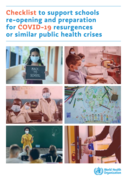
The checklist is aligned with, and builds upon, existing COVID-19-related WHO guidelines and is structured around protective measures related to: 1) hand hygiene and respiratory etiquette; 2) physical distancing; 3) use of masks in schools; 4) environmental cleaning and ventilation; and 5) respectin
...
g procedures for isolation of all people with symptoms. The checklist is designed to support policy-makers, staff and officials from the education and health sectors, local authorities, school principals/leaders and administrators, teachers’ unions, community leaders, school staff, teachers, parents and caregivers.
more
WHO labour care guide: user’s manual
recommended
The WHO Labour Care Guide is a tool that aims to support good-quality, evidence-based, respectful care during labour and childbirth, irrespective of the setting or level of health care. This manual has been developed to help skilled health personnel to successfully use the WHO Labour Care Guide. The
...
manual will also be of interest to staff involved in training health care personnel, health-care facility managers, and implementers and managers of maternal and child health services.
more
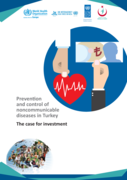
Noncommunicable diseases (NCDs) such as cancer, cardiovascular diseases, diabetes and chronic respiratory diseases and their risk factors are an increasing public health and development challenge in Turkey. This report provides evidence through three analyses that NCDs reduce economic output, and di
...
scusses potential options in response, outlining details of their relative returns on investment. An economic burden analysis shows that economic losses from NCDs are equivalent to 3.6% of gross domestic product. An intervention costing analysis provides an estimate of the funding required to implement a set of policy interventions for prevention and clinical interventions. A cost–benefit analysis compares these implementation costs with the estimated health gains and identifies which policy packages would give the greatest returns on investment.
more

Quality of care in fragile, conflict-affected and vulnerable settings: tools and resources compendium
recommended
This compendium represents a curated, pragmatic and non-prescriptive collection of tools and resources to support the implementation of interventions to improve quality of care in such contexts. Relevant tools and resources are listed under five areas: Ensuring access and basic infrastructure for qu
...
ality; shaping the system environment; reducing harm; improving clinical care; and engaging and empowering patients, families and communities.
more
This brief summarizes current evidence and guidance for maintaining safe and effective care across the spectrum of maternal, newborn and infant care while protecting mother and child and health care providers during COVID-19. Furthermore, implications of the principle of “do no harm” are reviewe
...
d for maternal, newborn and infant care delivery during COVID-19, so that this information is conveniently and readily available to clinical and health system policy leaders and stakeholders in countries and communities. Additionally, considerations for safe oxygen delivery as well as key Infection Prevention and Control (IPC) measures at home and in healthcare facilities for pregnant women, newborns and children are described in detail in the brief.
more

The EAPC White Paper addresses the issue of spiritual care education for all palliative care
professionals. It is to guide health care professionals involved in teaching or training of palliative care and spiritual care; stakeholders, leaders and decision makers responsible for training and educati
...
on; as well as national and local curricula development groups.
The EAPC white paper points out the importance of spiritual care as an integral part of palliative care and suggests incorporating it accordingly into educational activities and training models in palliative care. The revised spiritual care education competencies for all palliative care providers are accompanied by the best practice models and research evidence, at the same time being sensitive towards different develop-ment stages of the palliative care services across the European region.
Conclusions: Better education can help the healthcare practitioner to avoid being distracted by their own fears, prejudices, and restraints and attend to the patient and his/her family. This EAPC white paper encourages and facilitates high quality, multi-disciplinary, academically and financially accessible spiritual care education to all
palliative care staff.
more
Noncommunicable diseases (NCDs) such as cancer, cardiovascular diseases, diabetes and chronic respiratory diseases and their risk factors are an increasing public health and development challenge in Kyrgyzstan. This report provides evidence through three analyses that NCDs reduce economic outp
...
ut and discusses potential options in response, outlining details of their relative returns on investment. An economic burden analysis shows that economic losses from NCDs are equivalent to 3.9% of gross domestic product. An intervention costing analysis provides an estimate of the funding required to implement a set of policy interventions for prevention and clinical interventions. A cost–benefit analysis compares these implementation costs with the estimated health gains and identifies which policy packages would give the greatest returns on investment.
more
Evidence shows that FGM can cause several physical, mental and sexual health complications in girls and women, and in newborns. Health-care providers play an important role in supporting girls and women living with FGM, and improving their health and well-being. They are in a unique position to infl
...
uence and change the attitudes of their patients about FGM.
WHO is committed to scaling up the health-sector response to address FGM prevention and care. One aspect is to strengthen the quality of FGM prevention and care services by building the capacity of health-care providers. Several guidance materials have been produced to target health-care providers. These include FGM content for training curricula, clinical guidelines and a clinical handbook.
This training manual complements previous publications by building person-centred communication skills specifically for FGM prevention.
more
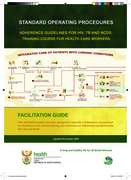
The target audience for this training course is non-clinicians such as Home Based Carers, Community Caregivers, Youth Care Workers, Peer educators, Community Health Workers etc. primarily those who will be providing adherence counselling to clients with HIV, TB, Hypertension and Diabetes. This group
...
of non-clinicians play a vital role in helping to reduce the workload of nursing staff. Amongst others, non- clinicians educate clients and provide emotional support in a manner that makes each client feel like they are receiving focused, individual attention. Non-clinicians are often in close contact with communities and, therefore, able to understand and play a role in alleviating health service barriers in the community.
Facility managers may also be part of the target audience in order to ensure that they understand the components of the minimum package of interventions to support linkage, adherence and retention in care.
Further, their attendance seeks to ensure that non-clinicians receive necessary assistance and support when they have to implement what they have learned back into their workplaces.
more
The Committee discussed the implications for preparedness for smallpox-like events reflected by the ongoing COVID-19 pandemic. The Committee noted how quickly diagnostics and vaccines could be developed and deployed when resources and political will were abundant. This rapidity was also due to the f
...
act that the genetic sequence of the severe acute respiratory syndrome coronavirus 2 (SARS-CoV-2) had been shared worldwide. It was noted that in one country SARS-CoV-2 had been reconstructed in a laboratory from the viral genome sequence before the first case of COVID-19 had been reported, highlighting the benefits of synthetic biology technologies for accelerated development of diagnostics as well as the oft-described potential risks. Lessons learned about clinical care during the COVID-19 pandemic were also discussed.
more
The primary audience for these recommendations includes health professionals who are responsible for developing national and local health-care guidelines and protocols and health workers involved in the provision of care to women and their newborns during pregnancy, labour and childbirth; this inclu
...
des midwives, nurses, general medical practitioners and obstetricians. The primary audience also includes managers of maternal and child health programmes, and relevant staff in ministries of health and educational and training institutions, in all settings.
more
The primary audience for these recommendations includes health professionals who are responsible for developing national and local health-care guidelines and protocols and health workers involved in the provision of care to women and their newborns during pregnancy, labour and childbirth; this inclu
...
des midwives, nurses, general medical practitioners and obstetricians. The primary audience also includes managers of maternal and child health programmes, and relevant staff in ministries of health and educational and training institutions, in all settings.
more
The primary audience for these recommendations includes health professionals who are responsible for developing national and local health-care guidelines and protocols and health workers involved in the provision of care to women and their newborns during pregnancy, labour and childbirth; this inclu
...
des midwives, nurses, general medical practitioners and obstetricians. The primary audience also includes managers of maternal and child health programmes, and relevant staff in ministries of health and educational and training institutions, in all settings.
more
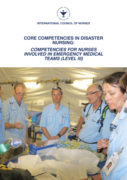
Over the last decade, there have been numerous disasters and major emergencies that have profoundly impacted the lives of millions of people worldwide. To support these crises, national and international emergency medical teams (EMTs) are often deployed to assist disaster affected populations. EMTs
...
are teams of healthcare professionals composed most frequently of doctors, nurses, psychologists and others to provide direct clinical care to people affected by disasters and conflicts and to support local health systems. In agreement with the World Health Organization’s (WHO) Global Health Emergency Health Workforce programme, any health professional coming from another country to practice health care in a disaster setting must be part of a team that is qualified, trained, equipped, resourced, and meets minimum acceptable standards to practice.
more

As countries aim to progress towards the Sustainable Development Goals (SDGs) and achieving universal health coverage, health inequities driven by racial discrimination and intersecting factors remain pervasive. Inequities experienced by indigenous peoples as well as people of African descent, Roma
...
and other ethnic minorities are of concern globally; they are unjust, preventable and remediable.
Health systems themselves are important determinants of health and health equity. They can perpetuate health inequities by reflecting structural racism and discriminatory practices of wider society. For instance, systemic racism, implicit bias, misinformed clinical practice, or discrimination by health professionals contributes to health inequities. However, health systems can also be a leading force for tackling the inequities faced by populations experiencing racial discrimination.
Primary health care (PHC) is the essential strategy for reorientating health systems and societies to become healthier, equitable, effective and sustainable. In 2018, on the 40th anniversary of the Declaration of Alma-Ata, the World Health Organization (WHO) and the United Nations Children’s Fund (UNICEF) renewed the emphasis on PHC with their strategy,
WHO outlines 14 strategic and operational levers for policy-makers to strengthen PHC. Within each lever, there are multiple potential entry points for targeted actions to address racial discrimination, foster intercultural care, and reduce health inequities experienced by indigenous peoples as well as people of African descent, Roma and other ethnic minorities.
more

An interregional meeting on leishmaniasis among neighbouring endemic
countries in the Eastern Mediterranean, African and European regions was organized by the World Health Organization (WHO) Regional Office for the Eastern
Mediterranean in Amman, Jordan, from 23 to 25 September 2018. The meeting w
...
as attended by representatives from the health ministries of Albania, Georgia, Greece, Iran (Islamic Republic of), Iraq, Jordan, Lebanon, Morocco, Pakistan, Saudi Arabia, Sudan, Syrian Arab Republic and Tunisia. Representatives from Afghanistan, Algeria and Libya were unable to attend. The Secretariat comprised staff from WHO headquarters, WHO regional offices in the Eastern Mediterranean, Africa and Europe, WHO country offices in Iraq, Pakistan, Syrian Arab Republic and Yemen, and WHO temporary advisors from Spain and Tunisia.
more
Snakebite envenoming is a serious public health problem in Central America, where approximately 5,500 cases occur every year. Panama has the highest incidence and El Salvador the lowest. The majority, and most severe, cases are inflicted by the pit viper Bothrops asper (family Viperidae), locally kn
...
own as ‘terciopelo’, ‘barba amarilla’ or ‘equis’. About 1% of the bites are caused by coral snakes of the genus Micrurus (family Elapidae). Despite significant and successful efforts in Central America regarding snakebite envenomings in the areas of research, antivenom manufacture and quality control, training of health professionals in the diagnosis and clinical management of bites, and prevention of snakebites, much remains to be done in order to further reduce the impact of this medical condition. This essay presents seven challenges for improving the confrontation of snakebite envenoming in Central America. Overcoming these challenges demands a coordinated partnership of highly diverse stakeholders though inter-sectorial and inter-programmatic interventions.
more

Medical care for people caught up in armed conflict and other insecure environments saves lives and alleviates suffering. It is one of the most immediate and high priority needs of an affected population and is often the first type of response activated and/or requested by authorities and affected c
...
ommunities. Medical teams working in armed conflict and other insecure environments
frequently face serious threats to their security and safety, challenges to patient access, and at times limited acceptance by affected communities in which they work and parties to the conflict. Such difficulties are likely to increase (6) and
thereby creating a critical need to establish contact and trust with all sides in conflicts and in other insecure environments to ensure operational continuity. This trust can best be achieved when all sides perceive the medical teams to be neutral, impartial, and independent, and specifically not aiding (or being perceived to aid) any one party to achieve a military, political or economic
advantage. For medical teams that are deploying increasingly closer to the frontlines, the implications of and consequences for both staff and patients of teams not being fully prepared, and/or not fully comprehending the context in which they work, can be severe. Medical response can easily be hindered or compromised by intentional or unintentional acts and the behaviour and
conduct of the teams themselves
more
Violence against women and girls is widespread in the Region of the Americas, resulting in enormous consequences for the health and wellbeing of women and girls, their families and communities. These costs are unacceptable and they can be prevented through evidence-based action, including the health
...
sector through its policies and protocols, as well as in collaboration with other sectors. This report remains the first of its kind and is a major milestone for the Region. It is specifically informed by the commitments of Member States in the regional Strategy and Plan of Action on Strengthening the Health System to Address Violence against Women. The report provides an analysis of efforts to advance the prevention of violence against women through health policies, clinical protocols, multisectoral plans and related approaches across the Americas. Attention to this topic is timely, as the COVID-19 pandemic has created new visibility for this area of work. This report offers critical information on efforts in the Region that can be learned from and used to build upon in the future to prevent and respond to violence against all women and girls everywhere.
more
