
Filter
303
Text search:
Womens
Refugee
Commission
Featured
Recommendations
35
New Publications
86
Language
Document type
No document type
179
Studies & Reports
73
Manuals
21
Guidelines
15
Strategic & Response Plan
7
Training Material
3
Situation Updates
2
Fact sheets
2
Online Courses
1
Countries / Regions
Syria
22
Myanmar / Burma
16
Global
15
South Sudan
14
Bangladesh
11
Western and Central Europe
10
Uganda
9
Ethiopia
7
Lebanon
7
Kenya
7
Indonesia
6
Liberia
5
Philippines
5
India
5
Rwanda
5
Africa
5
Nepal
4
Afghanistan
4
Zambia
4
Thailand
4
Yemen
4
Nigeria
3
Congo, Democratic Republic of
3
Malawi
3
Ukraine
3
Ghana
2
Germany
2
Cambodia
2
Mozambique
2
Sudan
2
Central African Republic
2
Mexico
2
Middle East and North Africa
2
Latin America and the Carribbean
2
Venezuela
2
Eastern Europe
2
Russia
2
Burkina Faso
1
Sierra Leone
1
Senegal
1
Cameroon
1
Haiti
1
Somalia
1
Pakistan
1
Jordan
1
Turkey
1
China
1
Malaysia
1
South Africa
1
Singapore
1
Namibia
1
Brazil
1
Burundi
1
Colombia
1
Libya
1
Sri Lanka
1
East and Southern Africa
1
West and Central Africa
1
South–East Asia Region
1
Eastern Europe and Central Asia
1
Asia
1
Palestine
1
Laos
1
Tajikistan
1
Bulgaria
1
Iran
1
Vietnam
1
Authors & Publishers
Publication Years
Category
Countries
94
Women & Child Health
36
Key Resources
36
Public Health
11
Capacity Building
9
Clinical Guidelines
5
Toolboxes
Disability
45
Conflict
43
Mental Health
25
Refugee
23
HIV
23
COVID-19
22
Health Financing Toolbox
9
Global Health Education
8
TB
5
Caregiver
4
Planetary Health
3
Natural Hazards
2
Ebola & Marburg
1
Zika
1
Specific Hazards
1


Guidance on Disability Inclusion for GBV Partners in Lebanon
The guide summarizes an assessment of War Child Canada’s three-pronged legal protection model as implemented with South Sudanese refugees in Northern Uganda and uses it to identify the most important lessons for ensuring legal protection mechanisms are in place at the onset of an emergency
Globally, it is estimated that 128.6 million people are currently in need of humanitarian assistance. Of these individuals, approximately one-fourth are women and girls of reproductive age. Although family planning is one of the most life-saving, empowering, and cost-effective interventions for wome
...
As the Burundi refugee crisis enters its fourth year, some 430,000 Burundian refugees are being hosted across the region by the governments and people of Tanzania, Rwanda, the Democratic Republic of the Congo, and Uganda. Although the spectre of mas
...
Since the beginning of the Ukraine crisis on 24 February 2022, WHO has supported Government-led efforts and initiatives alongside key partners on the ground. Building on efforts to date, and working alongside Bulgaria’s health authorities to bring added value to existing mechanisms, the WHO Countr
...

Sudan has a long history of hosting refugees and asylum seekers with 991,787 individuals, 51 per cent female and 53 per cent children, expected to live in Sudan by the end of 2020.
The new Global Strategy aims to achieve the highest attainable standard of health for all women, children and adolescents, transform the future and ensure that every newborn, mother and child not only survives, but thrives.
White Paper from the National Child Traumatic Stress Network Refugee Trauma Task Force

The main objective of this guidance is to provide scientific advice on public health principles and considerations for infection and prevention control of COVID-19 in migrant and refugee reception and detention centres in the European Union and Euro
...
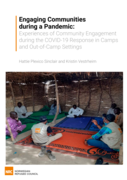
This report presents examples from different agencies on how they approached community engagement in their Covid-19 responses, the tools and methodologies used, as well as the challenges they encountered and how they attempted to overcome these. It discusses what community engagement means to the va
...
Giving Myanmar's displaced their land back
The Norwegian Refugee Council and Displacement Solutions have produced the report "Addressing Myanmar's Unsettled Restitution Gap" to advocate and help find ways for displaced people in Myanmar to be abl
...
According to 2014 Census data, almost a third of the population in Myanmar do not have adequate identity and civil documentation. Of these, 54 percent are women.
Women who live in remote or conflict affected areas, who are displaced or belong to stateless ethnic and religious minorities face the ...
Women who live in remote or conflict affected areas, who are displaced or belong to stateless ethnic and religious minorities face the ...
This manual outlines proposals for the insertion of housing, land and property restitution rights simultaneously within the context of the ongoing peace process and within broader national legal reform efforts, including work towards a national land law. The paper begins by emphasising that many cou
...
