
Filter
906
Text search:
World
Health
Organization
Eastern
Mediterranean
Featured
Recommendations
126
New Publications
180
Language
Document type
No document type
312
Studies & Reports
247
Guidelines
143
Manuals
65
Strategic & Response Plan
53
Fact sheets
25
Situation Updates
19
Training Material
16
Resource Platforms
15
Infographics
7
Brochures
1
App
1
Online Courses
1
Videos
1
Countries / Regions
Global
92
Syria
31
Africa
29
Middle East and North Africa
22
Western and Central Europe
18
Somalia
12
Yemen
11
Latin America and the Carribbean
10
Pakistan
9
Sudan
9
Nigeria
8
South–East Asia Region
8
Eastern Europe
8
Congo, Democratic Republic of
6
Afghanistan
6
Lebanon
6
Sierra Leone
5
Liberia
5
Ethiopia
5
India
5
Jordan
5
Kenya
5
Myanmar / Burma
5
West and Central Africa
5
Asia
5
Saudi Arabia
4
Nepal
4
Iraq
4
Rwanda
4
East and Southern Africa
4
Iran
4
Ghana
3
Uganda
3
South Sudan
3
Turkey
3
Egypt
3
China
3
Ukraine
3
Russia
3
Senegal
2
Cambodia
2
Thailand
2
South Africa
2
Benin
2
Greece
2
Madagascar
2
Western Pacific Region
2
Eastern Europe and Central Asia
2
Venezuela
2
Albania
2
Djibouti
2
Guinea
1
Morocco
1
USA
1
Cameroon
1
Niger
1
Philippines
1
Tanzania
1
Indonesia
1
Bangladesh
1
Malawi
1
Brazil
1
North Macedonia
1
Serbia
1
Croatia
1
Colombia
1
Ecuador
1
Libya
1
Sri Lanka
1
Palestine
1
Qatar
1
Georgia
1
Tunisia
1
Authors & Publishers
Publication Years
Category
Countries
127
Clinical Guidelines
119
Public Health
111
Women & Child Health
72
Key Resources
57
Capacity Building
26
Pharmacy & Technologies
19
Toolboxes
Mental Health
107
COVID-19
76
Planetary Health
59
TB
49
NTDs
47
NCDs
44
HIV
42
Global Health Education
38
Conflict
35
AMR
34
Refugee
30
Caregiver
30
Rapid Response
26
Malaria
26
Disability
24
Pharmacy
20
2.0 Rapid Response
19
Ebola & Marburg
17
Polio
16
Cholera
13
Natural Hazards
12
Zika
10
Health Financing Toolbox
8
Specific Hazards
4
Typhoon
1
Social Ethics
1
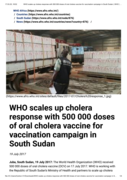
This article describes WHO's efforts to combat a cholera outbreak in South Sudan in July 2017. The organization received 500,000 doses of oral cholera vaccine (OCV) and was working with South Sudan's Ministry of
...

Anopheles stephensi is an invasive mosquito species which has been found spreading across Africa. While this species presents a new challenge for malaria control on the continent, its surveillance and management have been ongoing in Asia for many years. This document aims to summarize key lessons fr
...
The brief on key findings from the 2025 edition of the WHO anaemia estimates provides a snapshot of the current status of anaemia among women aged 15–49 years at the country, regional, and global levels, along with progress toward achieving the global anaemia target by 2030, in alignment with the
...

Adolescents and young adults aged 10-24 remain underserved in the global response against HIV. Combination prevention, treatment and care programmes use a mix of evidence-based interventions to meet the current HIV prevention needs of adolescents and young adults. However, there needs to be a focus
...
9 June 2021
Since its launch, GLASS has expanded in scope and coverage and as of May 2021, 109 countries and territories worldwide have enrolled in GLASS. A key new component in GLASS is the inclusion of antimicrobial consumption (AMC) surveillance at the national level highlighted in this fourth G
...
As of October 2017, the global database comprised almost 30 000 records, including results from bioassays to measure phenotypic resistance, and biochemical and molecular tests for resistance mechanisms. The current report presents an overview of data on malaria vector resistance for 2010 to 2016. It
...

This adaptation and implementation guide is part of a five-part Caregiver skills training for families of children with developmental delays or disabilities (CST) package providing guidance on caregiver skills training for families of children aged 2–9 years with developmental delays or disabiliti
...

This guide is part of a five-part Caregiver skills training for families of children with developmental delays or disabilities (CST) package providing guidance on caregiver skills training for families of children aged 2–9 years with developmental delays or disabilities.
This guide for facilita
...

WHO guideline on contact tracing
recommended
This practical guideline establishes definitions for “contact”, “contact person”, “contact tracing” and other associated concepts. It allows for improvement of contact tracing strategies and provides recommendations attempting to answer some, though not all, questions that arose during t
...
This analytical report reviews and discusses the potential role and influence of political commitment in implementing endorsements and conducting policy in the field of tuberculosis (TB) prevention and care. It promotes discussion by comparing and analysing the extent to which selected international
...
Manual for Early Implementation
The "Assessing National Capacity for the Prevention and Control of Noncommunicable Diseases: Report of the 2021 Global Survey" by WHO examines the global state of readiness and infrastructure for managing noncommunicable diseases (NCDs) across countries. Based on the 2021 survey, it analyzes nationa
...
IPCAT2 will assist countries to determine the core components already in place, that is, existing strengths, and to identify gaps or weaknesses to guide action planning. IPCAT2 corresponds to the six core component recommendations of the guidelines targeted at the national level.
It is very impor
...
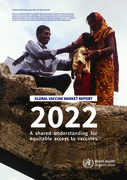
The report aims to capture lessons from the COVID-19 pandemic and to highlight the opportunity for more ambitious global action: expanding sustainable access to vaccines for all towards
the Immunization Agenda 2030 and pandemic prevention, preparedness and response efforts. The report is organized
...

Meeting report, Kampala, Uganda,
7–8 November 2023
