
Filter
1258
Text search:
Antimicrobial
resistance
Featured
155
238
Language
Document type
320
284
275
94
80
77
30
23
22
16
13
12
9
1
Countries
58
41
34
30
29
25
24
20
14
12
11
11
10
10
10
9
8
8
7
7
7
6
6
6
6
6
6
6
5
5
5
5
4
4
4
4
4
3
3
3
3
3
3
3
3
3
3
2
2
2
2
2
2
2
2
2
2
2
2
2
2
2
2
2
1
1
1
1
1
1
1
1
1
1
1
1
1
1
1
1
1
1
1
1
1
1
1
1
1
1
1
1
1
1
1
1
1
1
1
1
1
1
1
1
1
1
1
1
1
1
1
Authors & Publishers
Publication Years
Category
298
91
86
48
36
20
16
3
Toolboxes
554
80
75
58
48
46
33
32
31
27
25
22
18
16
16
14
11
8
6
4
3
1
1
Pathogen genomic surveillance has become a priority for public health systems in recent years. Genomic sequencing is increasingly being used to characterize pathogens and monitor important public health priorities (e.g. poliovirus, influenza virus, Mycobacterium tuberculosis and Vibrio cholerae,
...

The Infection Prevention and Control (IPC) Guidelines aim to support healthcare workers improve quality and safety health care. The Guidelines further aim to promote and facilitate the overall goal of IPC by providing evidence-based recommendations on the critical aspects of IPC, focusing on the fun
...

Access to safe, effective and quality-assured health products and technologies is crucial for achieving universal health coverage and primary health care goals. The continued growth of the aging population; increasing burden of noncommunicable diseases; growing burden of mental health issues; climat
...
PNAS 119 (8) e2113947119 | https://doi.org/10.1073/pnas.2113947119
Environmental exposure to active pharmaceutical ingredients (APIs) can have negative effects on the health of ecosystems and humans. While numerous studies have monitored APIs in rivers, these employ different analytical methods, m
...
The Strategy to respond to antimalarial drug resistance in Africa is a technical and advocacy document, grounded in the best available evidence to date and aimed at minimizing the threat and impact of antimalarial drug
...
WHO’s sentinel surveys of acquired HIV resistance to dolutegravir among people receiving dolutegravir-containing antiretroviral therapy is intended for easy and frequent implementation. Results from sentinel surveys provide insight into the preval
...
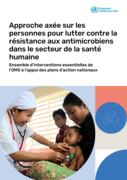
La résistance aux antimicrobiens (RAM) est une réponse
évolutive naturelle à l’exposition aux antimicrobiens, qui
a été aggravée par des comportements humains, tels que
l’utilisation abusive et excessive d’antimicrobiens, l’utilisa
...
Efficacious antimalarial medicines are critical to malaria control and elimination. Continuous monitoring of their efficacy is needed to inform treatment policies in malaria-endemic countries, and to ensure early detection of, and response to, drug resista
...
Pour combattre et éliminer le paludisme, il est essentiel de disposer de médicaments antipaludiques efficaces. Un suivi régulier de l’efficacité des médicaments s’impose pour orienter les politiques de traitement dans les pays d’endémie palustre et assurer la détection précoce de la ph
...

Video: Imaginez un monde dans lequel les infections et les maladies chez les animaux, les humains et les plantes ne pourraient pas être traitées. Ce scénario catastrophe pourrait devenir une réalité, car certains virus, champignons, parasites et certaines bactéries développent une
...
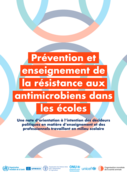
La résistance aux antimicrobiens (RAM) constitue une menace pour la santé mondiale, la sécurité alimentaire et la réalisation des Objectifs de développement durable (ODD) à l'horizon 2030. Il est essentiel de s'attaquer à la RAM pour préser
...

En janvier 2021, un nourrisson atteint de tuberculose a été admis à l'hôpital dans l'État américain du Kansas. Les médecins ont rapidement découvert que la souche bactérienne à l'origine de l'infection était immunisée contre quatre traitements couramment utilisés, selon une étude réce
...
La surveillance, par secteur, de la résistance aux antimicrobiens et de leur utilisation, ainsi que l’échange et la comparabilité des données entre les secteurs pour soutenir le principe « Une seule santé » sont essentiels. Cependant, il ex
...
In November 2022, WHO launched a strategy to address antimalarial drug resistance in Africa, emphasizing the need for stronger surveillance. While regional monitoring networks have been active in other regions, most in Africa have not convened since
...
La promotion du bon usage et l’utilisation appropriée des antimicrobiens sont à la base du quatrième objectif du Plan d’action mondial pour combattre la résistance aux antimicrobiens de l’Organisation mondiale de la Santé (OMS), adopté p
...
WHO Antibiotic Categorization AWaRE
recommended
Online Database: Provides recommendations for 21 common infectious diseases; Classifies antibiotics into three groups based on the potential to induce and propagate resistance; Identifies antibiotics that are priorities for monitoring and surveillan
...

World malaria report 2025
recommended
Addressing the threat of antimalarial drug resistance. This year’s report spotlights the growing threat of antimalarial drug resistance. Partial resista
...
World malaria report 2025. Excecutive Summary
recommended
Addressing the threat of antimalarial drug resistance. This year’s report spotlights the growing threat of antimalarial drug resistance. Partial resista
...
Ces orientations opérationelles ont pour but de soutenir les pays dans le processus d’introduction d’un antibiotique. Leur objectif est de garantir un accès rapide aux antimicrobiens et l’utilisation appropriée de ces produits ainsi que des résultats optimaux pour les patients, tout en ré
...
Book for Communities
