
Filter
790
Featured
74
385
Language
Document type
515
115
41
30
29
24
15
6
6
5
3
1
Countries
105
52
35
32
31
31
28
27
25
24
23
22
22
21
20
19
18
18
17
14
14
13
13
13
12
10
10
9
9
9
8
7
7
6
6
6
6
6
6
5
5
5
5
3
3
3
3
2
2
2
2
2
2
2
1
1
1
1
1
1
1
1
Authors & Publishers
Publication Years
Toolboxes
175
69
9
3
2
2
1
1
1
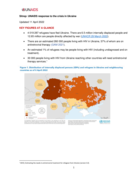
As the war in Ukraine enters its fifth year, the humanitarian crisis continues to deepen, with profound consequences for access to essential services, including health care. Modern warfare tactics, including the widespread use of drones and repeated attacks on critical infrastructure, are increasing
...
39th African Union (AU) Summit, Addis Ababa, Ethiopia, February 2026
National HIV Policies
recommended
Here you can download different national policies from Africa, Asia and Latin America

СТАНДАРТ МЕДИЧНОЇ ДОПОМОГИ.
These clinical guidelines, released by the Ukraine Ministry of Health in 2025, include the latest recommendations for HIV services, including oral PrEP and injectable cabotegravir (CAB) for PrEP.
This report provides an overview of the latest tuberculosis (TB) epidemiological situation and is published jointly by the WHO Regional Office for Europe and the European Centre for Disease Prevention and Control. In 2023, 38 993 cases of TB were reported in 29 European Union and European Economic A
...
The standards of care for HIV define the expected or desired quality of prevention, treatment, and care for people at risk of HIV acquisition or living with HIV.
The standards are based on a scientific rationale, as well as the responsibilities of each stakeholder, to ensure that people receive app
...
Tuberculosis (TB) remains a serious public health threat in South Africa and is the
leading cause of death in people living with HIV (PWH). Pre-hospital and early in-
hospital mortality is of particular concern in PWH. Significant progress has been made
to date, but a monumental effort is require
...

A toolkit for health facilities. This toolkit highlights successful differentiated-care approaches implemented in a number of settings and countries in sub-Saharan Africa. The toolkit will be further updated as more experience is gained with these and similar
approaches

This is the 2025 draft Malawi Guidelines for Syndromic Management of Sexually Transmitted Infections which is yet to be approved by the SMT.

National Policy
April 2025 – MARCH 2026

The Private Sector Engagement Strategy on HIV, STIs and TB is a is a guide that is both comprehensive
and focused, and it is to be used by businesses and corporations to actively participate in the HIV, STIs
and TB and Noncommunicable diseases (NCDs) response. The goal of this strategy is to devel
...

Objective To assess the effectiveness of a community-based tuberculosis and leprosy intervention in which village health teams and health workers conduct door-to-door tuberculosis screening, targeted screenings and contact tracing.

UNAIDS leads the world's most extensive data collection on HIV epidemiology, programme coverage and finance and publishes the most authoritative and up-to-date information on the HIV epidemic.

Malawi is a landlocked country with a surface area of 118,484 km2. Administratively, the country is divided into three regions, namely the Northern, Central and Southern regions. The country has 28 districts, which are further divided into traditional authorities (TA) ruled by chiefs. The TAs are su
...

20 YEARS OF STRATEGIC HIV AND PUBLIC HEALTH DATA . beThe completion of the 6th South African National HIV Prevalence, Incidence and Behaviour Survey (SABSSM) report, coincides with the celebration of 30 years of democracy in South Africa; and marks 20 years of conducting nationally representative ho
...

AIDS 2024, 38:1579–1588. Treatment interruptions are a barrier to successful antiretroviral therapy (ART). 'Fresh start messages', which leverage significant days on the calendar (e.g., new year, public holiday) in order to prompt action, have the potential to encourage people with HIV (PWH) to re
...
