
Filter
12
Featured
2
Language
Document type
3
3
3
2
1
Countries
1
1
Authors & Publishers
Publication Years
Category
1

National HIV Curriculum Module 2 Lesson 8

WHO guideline on HIV service delivery
recommended
Updated guidance on the integration of diabetes, hypertension and mental health services, and interventions to support adherence to antiretroviral therapy. The guideline offers practical implementation guidance for countries and key stakeholders as well as outlining key research gaps. As life expec
...
IAPAC provides guidance to clinicians and allied health professionals through normative guidance that encapsulates evidence-based approaches to optimizing the prevention, care, treatment, and support services delivered to people living with HIV

This technical brief describes promising models that demonstrate how FBOs could contribute to expanded access to improved HIV and other services for men. These models incorporate a range of WHO-recommended interventions and highlights operational considerations and key success factors. By capitalizi
...

Most people with unsuppressed HIV in a large population study in Uganda were already diagnosed but not in clinical care, suggesting that re-engaging people with HIV and ensuring that they are receiving antiretroviral treatment could have a substantial impact on HIV transmission.
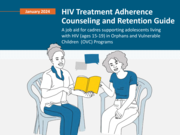
A job aid for cadres supporting adolescents living with HIV (ages 15-19) in Orphans and Vulnerable
Children (OVC) Programs
The HIV care continuum is a public health model that outlines the steps or stages that people with HIV go through from diagnosis to achieving and maintaining viral suppression (a very low or undetectable amount of HIV in the body).
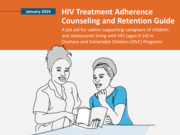
A job aid for cadres supporting caregivers of children and adolescents living with HIV (ages 0-14) in Orphans and Vulnerable Children (OVC) Programs
Successful retention and re-engagement in HIV care depends largely on the ability of the provider to involve and motivate patients to attend ongoing care
Implementation tools developed by the Boston University School of Social Work Center for Innovation in Social Work and Health under the HRSA HAB Special Projects of National Significance initiative.
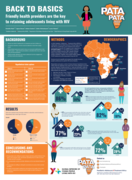
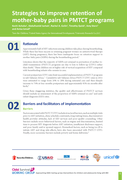
The majority of MBPs not retained in prevention of mother-to-child transmission (PMTCT) programs are due to loss to follow-up (LTFU).
