
Filter
142
Featured
5
10
Language
Document type
69
22
21
13
4
4
4
3
1
1
Countries
36
3
1
1
1
1
1
1
1
1
1
1
1
1
Authors & Publishers
Publication Years
Category
15
6
2
1
Ending the neglect to attain the Sustainable Development Goals: a road map for neglected tropical diseases 2021–2030 (“the road map”) sets explicit targets for the elimination of onchocerciasis by 2030, including eliminating the need for mass drug administration (MDA) of ivermectin in at least
...

La fascioliasis es una enfermedad parasitaria que afecta a las personas y a una gran variedad de animales, esencialmente herbívoros. En América Latina y el Caribe está causada por el trematodo Fasciola hepatica. La fascioliasis está clasificada por la Organización Mundial de la Salud (OMS) dent
...

Progrès dans la notification des données sur l’envenimation par morsure de serpent: défis et opportunités. Englisch/Francais. WEEKLY EPIDEMIOLOGICAL RECORD, NOS. 51/52, 20 DECEMBER 2024, pp. 770-775

WHO promotes the inclusion of foodborne trematodiases among the targets of preventive chemotherapy interventions. With the aim of providing access to quality medicines, WHO has negotiated with Novartis Pharma AG whereby Novartis donates triclabendazole for the treatment of fascioliasis and paragonim
...

Foodborne trematodiases are caused by parasitic trematode worms. People become infected by eating raw or undercooked fish, crustaceans and vegetables that contain the larval worms.

Mycetoma is a chronic, progressively destructive morbid inflammatory disease usually of the foot but any part of the body can be affected. Infection is most probably acquired by traumatic inoculation of certain fungi or bacteria into the subcutaneous tissue. Mycetoma was described in the modern l
...
Website last accessed on 28.02.2023
Website: Taeniasis/Cysticercose
General information from WHO/OMS
Languages: english, french, arabic, espanol, russian
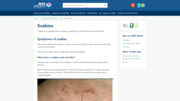
Scabies is a contagious skin condition caused by tiny mites that burrow into the skin.
The main symptom of scabies is intense itching that's worse at night. It also causes a skin rash on areas where the mites have burrowed.

Scabies is caused by Sarcoptes scabiei, a mite which lays its eggs under the surface of your skin and reproduces. When the eggs hatch, mites crawl out onto your skin and make new burrows.
The mites can be difficult to identify and may be confused with pubic lice as both conditions cause itching in
...

Human scabies is caused by an infestation of the skin by the human itch mite (Sarcoptes scabiei var. hominis). The microscopic scabies mite burrows into the upper layer of the skin where it lives and lays its eggs.
Scabies is found worldwide and affects people of all races and social classes. Scabi
...

As part of its 2019–2030 global strategy for the prevention and control of snakebite envenoming, WHO is launching a new Snakebite Information and Data Platform. This is the result of collaboration between the Departments of Control of Neglected Tropical Diseases (WHO/NTD) and Data Delivery for Imp
...

Website last accessed on 18.03.2023
Website last accessed on 09.04.2023
L’échinococcose humaine est une maladie parasitaire causée par des ténias du genre Echinococcus. Plus d’un million de personnes sont touchées par l’échinococcose.
Website last accessed on 09.04.2023
Human echinococcosis is a parasitic disease caused by tapeworms of the genus Echinococcus. More than one million people are affected by echinococcosis.
Website last accessed on 09.04.2023
La equinococosis humana es una enfermedad parasitaria causada por tenias del género Echinococcus. La equinococosis afecta a más de un millón de personas.
Website last accessed on 09.04.2023
Эхинококкоз человека - это паразитарное заболевание, вызываемое ленточными червями рода Echinococcus. Эхинококкозом болеют более миллиона человек
...
Website last accessed on 09.04.2023
Human echinococcosis is a parasitic disease caused by tapeworms of the genus Echinococcus. More than one million people are affected by echinococcosis.
Website last accessed on 14.04.2023
Food-borne trematode infections are zoonotic, and their pathogens can be transmitted to humans only after the completion of a complex life cycle, some stages of which take place in the body of an intermediate animal host. The first intermediate hosts of all tr
...
Website last accessed on 14.04.2023
Les trématodes d'origine alimentaire sont des zoonoses et leurs agents pathogènes ne peuvent être transmis à l'homme qu'après avoir accompli un cycle de vie complexe, dont certaines étapes se déroulent dans un hôte animal intermédiaire. Les premiers h
...
Website last accessed ob 14.04.2023
Los trematodos transmitidos por los alimentos son zoonosis y sus patógenos sólo pueden transmitirse al ser humano tras completar un complejo ciclo vital, algunas de cuyas etapas tienen lugar en un hospedador animal intermediario. El primer hospedador interme
...
