
Filter
106
Featured
5
2
Language
Document type
58
10
9
9
5
4
4
2
2
1
1
1
Countries
10
4
4
3
2
2
2
2
2
2
1
1
1
1
1
1
1
1
Authors & Publishers
Publication Years
Category
16
2
2
2
2
2
Amid food and climate crises, investing in sustainable food cold chains crucial
- More than 3 billion people can’t afford a healthy diet
- Lack of effective refrigeration directly results in the loss of 526 million tons of food production, or 12 percent of the global total
- Developing countrie
...

This report presents a WHO–PREZODE collaboration to develop and validate standardized indicators that assess the risk of zoonotic disease emergence by modeling pathogen circulation in animals and the risk of animal to human zoonotic spillover. The proposed indicators are intended to be actionable,
...
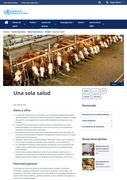
El enfoque de «Una sola salud» es un planteamiento integral y unificador destinado a equilibrar y optimizar la salud de las personas, los animales y los ecosistemas. Para ello, se basa en los vínculos estrechos e interdependientes que existen entre estos ámbitos y permite establecer nuevos méto
...
Global Animal Disease Information System - interactive Platform
Through the Emergency Prevention System (EMPRES), FAO assists countries to prevent and control the world’s most serious livestock and zoonotic diseases, while also surveying for newly emerging pathogens. Member countries are supported with early warning, and technical guidance for risk management
...

Public health challenges over the past decade have highlighted the importance of approaching health through a holistic lens of human, animal, and environmental sectors, recognizing the need for a collaborative response against shared threats. Zoonotic diseases, transmitted between humans and animals
...
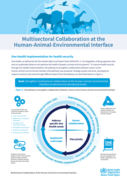
The pathway to strengthen multisectoral collaboration at the human-animal-environmental interface (HAI) aims to improve health security through One Health implementation. It outlines strategic guides and tools developed to support Member States through different steps of the HAI pathway.
The health of humans, animals and environment is vitally interlinked. A majority of emerging and endemic
human diseases have their origins in animals, be they transmitted directly, through food or the environment.
The World Health Organization (WHO), the World Organisation for Animal Health (WOAH,
...
The One Health (OH) High-Level Expert Panel (OHHLEP) of the Quadripartite Organizations defined OH as an integrated, unifying approach that aims to sustainably balance and optimize the health of people, animals and ecosystems.”
It recognizes the health of humans, domestic and wild animals, plan
...

The world faces global health risks that need to be effectively addressed in integrated, participatory effort

Mpox continues to affect people around the world. A new framework released today by WHO will guide health authorities, communities and other stakeholders in preventing and controlling mpox outbreaks, eliminating human-to-human transmission of the disease, and reducing spillover of the virus from ani
...

For thousands of years, humans have been using wildlife for commercial and subsistence purposes. Wildlife trade takes place at local, national and international levels, with different forms of wildlife, such as live animals, partly processed products and finished products. Wildlife is a vital source
...
he Global Early Warning and Prevention System (GLEWS) identifies and monitors disease events, develops epidemiological intelligence for identification and mitigation of risks against emerging, endemic and epidemic diseases, and threats to environmental health and food security. The Tripartite (FAO,
...
Issue Brief 31: Antimicrobial resistance (AMR) can occur when viruses, bacteria, parasites and fungi change over time. There is no longer a response to medicines, and the infection treatment gets really difficult which increases the risk of a disesase spread, which can lead to severe health problems
...

The Food and Agriculture Organization of the United Nations (FAO) launched a new Framework for Environmental and Social Management (FESM) to ensure that both people and the environment are protected from any potential impacts of FAO programmes and projects.
“This Framework ensures that our proj
...

The Quadripartite organizations have developed the One Health Priority Research Agenda for AMR report, this is a joint initiative to assist in directing and catalysing scientific interest and financial investments for the priority research agenda across sectors for countries and funding bodies. The
...

Antimicrobial resistance (AMR) is a global human, animal, plant and environment health threat that needs to be addressed by every country. The impacts of AMR are wide-ranging in terms of human health, animal health, food security and safety, environmental effects on ecosystems and biodiversity, and
...

The guide to implementing the One Health Joint Plan of Action (OH JPA) at national level provides practical guidance on how countries can adopt and adapt the OH JPA to strengthen and support national One Health action.
Building on the OH JPA theory of change, this guide describes three pathways a
...

Brucellosis is widespread in both humans and livestock in many developing countries. The authors have performed a series of epidemiological studies on brucellosis in agro-pastoral areas in Tanzania since 2015, with the aim of the disease control. Previously, the potential of a community-based brucel
...
