
Filter
47
Featured
25
Language
Document type
22
11
5
3
2
2
1
1
Countries
4
3
3
1
1
1
1
1
1
1
1
1
1
1
Authors & Publishers
Publication Years
Category
11
5
4
2
First published in 2020, this toolkit is intended for clinicians working in acute care, managing adult and paediatric patients with acute respiratory infection, including severe pneumonia, acute respiratory distress syndrome, sepsis and septic shock. The main objective is to provide key tools for us
...
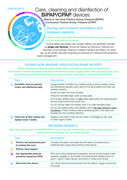
Bilevel or two-level Positive Airway Pressure (BiPAP).
Continuous Positive Airway Pressure (CPAP)
During non-invasive ventilation and between patients
Always read and follow the instructions and recommendations of the manufacturer`s manual
Consumables associated with oxygen delivery are genera
...

During ventilation and between patients
Always read and follow the instructions and recommendations of the manufacturer`s manual
Consumables associated with oxygen delivery are generally intended as single use devices, and should be treated as infectious material and disposed of accordingly. Dispo
...

During monitoring and between patients
Always read and follow the instructions and recommendations of the manufacturer`s manual
The device must be cleaned and disinfected after each individual use and, at minimum weekly, prior to use on another patient.

During non-invasive ventilation and between patients
Always read and follow the instructions and recommendations of the manufacturer`s manual
Consumables associated with oxygen delivery are generally intended as single use devices, should be treated as infectious material and disposed of according
...

Consumables associated with oxygen delivery are generally intended as single use devices. They should be treated as infectious1 material and disposed of accordingly. Disposal of patient interface, tubing, water bag and water chamber, for example, should be done as per facility standard operating pro
...
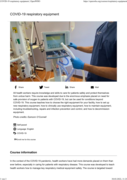
COVID-19 respiratory equipment
recommended
All health workers require knowledge and skills to care for patients safely and protect themselves from undue harm. This course was developed due to the enormous emphasis placed on need for safe provision of oxygen to patients with COVID-19, but can be used for conditions beyond COVID-19. This cours
...
For patients on HFNO with persistent hypoxaemia or respiratory distress:
• Check the equipment: inspect the exterior of the machine, the tubing (circuit), the prong for any sign of mechanical damage, confirm it fits and the filters are in place. Ensure the settings are appropriate and flow is max
...
WHO recommends prompt recognition of progressive acute hypoxaemic respiratory failure when a patient with respiratory distress is failing to respond to standard oxygen therapy and adequate preparation to provide advanced oxygen/ventilatory support.
Hypoxaemic respiratory failure in ARDS commonly re
...
Management of critical COVID-19: Acute hypoxaemic respiratory failure and COVID-19: Recognize ARDS
recommended
WHO recommends prompt recognition of progressive acute hypoxaemic respiratory failure when a patient with respiratory distress is failing to respond to standard oxygen therapy and adequate preparation to provide advanced oxygen/ventilatory support.
Hypoxaemic respiratory failure in ARDS commonly
...
For patients on NIPPV or HFNO with persistent hypoxaemia or respiratory distress:
• Check the equipment: inspect the exterior of the machine, the tubing (circuit), the mask for any sign of mechanical damage, confirm it fits securely without leak (if CPAP/BiPAP) and the filters are in place. Ensur
...
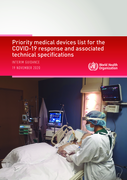
Priority medical devices list for the COVID-19 response and associated technical specifications
recommended
23 February 2021
This document describes the medical devices required for the clinical management of COVID-19, selected and prioritized according to the latest available evidence and interim guidelines. This includes: oxygen therapy, pulse oximeters, patient monitors, thermometers, infusion and suc
...
23 February 2021
This document describes the medical devices required for the clinical management of COVID-19, selected and prioritized according to the latest available evidence and interim guidelines. This includes: oxygen therapy, pulse oximeters, patient monitors, thermometers, infusion and suc
...
23 February 2021
This document describes the medical devices required for the clinical management of COVID-19, selected and prioritized according to the latest available evidence and interim guidelines. This includes: oxygen therapy, pulse oximeters, patient monitors, thermometers, infusion and suc
...
27 May 2021
This is a document to support the use of pulse oximeter for assessment of suspected and confirmed cases of Covid-19 in the community.
It is a well-known fact that Covid-19 can present as “happy hypoxia” with minimum symptoms of severe respiratory distress despite significant low ox
...
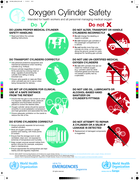
This poster is intended for health workers and other personnel on the safety and mitigation measures that need to be adhered to when dealing with medical oxygen. Medical oxygen, either in liquid or gas form, is an oxidizing agent that can result in a fire or explosion if not handled properly.
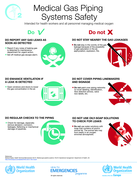
This poster is intended for health workers and other personnel on the safety and mitigation measures that need to be adhered to when dealing with medical oxygen. Medical oxygen, either in liquid or gas form, is an oxidizing agent that can result in a fire or explosion if not handled properly.
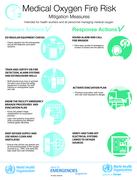
This poster is intended for health workers and other personnel on the safety and mitigation measures that need to be adhered to when dealing with medical oxygen. Medical oxygen, either in liquid or gas form, is an oxidizing agent that can result in a fire or explosion if not handled properly.

Medical oxygen is an essential medicine in the treatment of COVID-19. How is it used? Why is there a shortage in some countries and what are WHO, partners and Governments doing about it? WHO’s Dr Janet Diaz explains in Science in 5.

Background paper 7
The Independent Panel for Pandemic Preparedness and Response
May 2021
