
Filter
100
Featured
13
9
Language
Document type
84
5
4
3
2
1
1
Countries
1
1
1
Authors & Publishers
Publication Years
Category
26
1

Strengthening rehabilitation in health emergency preparedness, response, and resilience: policy brief outlines the evidence for rehabilitation in emergencies and the need for greater preparedness of rehabilitation services. It shows how existing guidelines support the integration of rehabilitation i
...
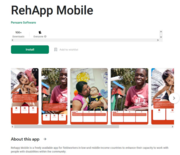
The RehApp is specifically designed for fieldworkers in low-and middle-income countries and aims to enhance their capacity to work with people with disabilities within the community: assess their abilities and inabilities, design rehabilitation interventions, provide care and support and refer appro
...
Global Report on assistive technology
recommended
The report notes that the number of people in need of one or more assistive products is likely to rise to 3.5 billion by 2050, due to populations ageing and the prevalence of noncommunicable diseases rising across the world. The report also highlights the vast gap in access between low- and high-inc
...
The Rehabilitation Competency Framework (RCF) is a model that communicates
the expected or aspired performance of the rehabilitation workforce across
professions, specializations and settings to enable quality care and service
delivery.
El Marco de Competencias para la Rehabilitación (MCR) es un modelo que
comunica el desempeño que se espera o al que se aspira del personal de
rehabilitación en todas las profesiones, especializaciones y entornos para hacer
posible una atención y una prestación de servicios de calidad. Incluy
...
Le Cadre de compétences en réadaptation (CCR) est un modèle qui présente les
performances attendues ou souhaitées pour les effectifs de réadaptation dans les
différentes professions, spécialisations et les différents contextes afin d’offrir des soins
et une prestation de services de qu
...
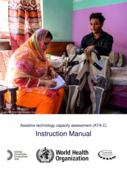
The assistive technology capacity assessment (ATA-C) is a system-level tool to evaluate a country’s capacity to finance, regulate, procure and provide assistive technology. It can be used for awareness raising, policy and programme design, and ongoing monitoring and evaluation. This manual provide
...
The WHO Guidelines on physical activity and sedentary behaviour provide evidence-based public health recommendations for children, adolescents, adults and older adults on the amount of physical activity (frequency, intensity and duration) required to offer significant health benefits and mitigate he
...
The Lancet. 1 December 2020. doi: 10.1016/S0140-6736(20)32340-0.
To our knowledge, this is the first study to produce a global estimate of the need for rehabilitation services and to show that at least one in every three people in the world needs rehabilitation at some point in the course of their
...

Community-based rehabilitation (CBR) matrix
recommended
Accessed online March 2018
Public health, innovation, intellectual property and trade

Rehabilitation in health systems provides recommendations for Member States and other relevant stakeholders to strengthen and expand the availability of quality rehabilitation services. Currently, there is a significant unmet need for rehabilitation services and it is frequently undervalued in the h
...
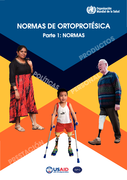

WHO, in partnership with the International Society for Prosthetics and Orthotics (ISPO) and the United States Agency for International Development (USAID), has published global standards for prosthetics and orthotics. Its aim is to ensure that prosthetics and orthotics services are people-centred an
...
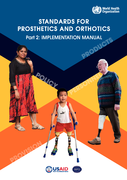
WHO, in partnership with the International Society for Prosthetics and Orthotics (ISPO) and the United States Agency for International Development (USAID), has published global standards for prosthetics and orthotics. Its aim is to ensure that prosthetics and orthotics services are people-centred an
...
With the health and demographic trends that characterise the 21st century, health systems face new challenges; people are living longer and with higher levels of disability. Strengthening health systems to provide rehabilitation services helps ensure people not only live longer but live well.
Systematic Review Summary 4
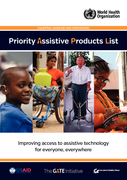
Improving access to assistive technology for everyone, everywhere.
The first WHO Priority Assistive Products List was launched in May 2016. The List includes hearing aids, wheelchairs, communication aids, spectacles, artificial limbs, pill organizers, memory aids and other essential items for many
...
