
Filter
394
Text search:
laboratory-confirmed
Featured
60
109
Language
Document type
171
85
55
22
21
17
14
5
2
1
1
Countries
27
16
14
14
14
13
12
12
10
8
7
7
6
6
6
6
5
5
4
4
4
3
3
3
3
3
3
3
3
3
3
2
2
2
2
2
2
2
2
2
2
2
2
2
2
2
2
1
1
1
1
1
1
1
1
1
1
1
1
1
1
1
1
1
1
1
1
1
1
1
1
1
1
1
1
1
Authors & Publishers
Publication Years
Category
137
49
13
12
11
8
3
Toolboxes
89
42
32
29
25
23
21
11
9
5
4
4
4
4
3
2
1
1
Laboratory diagnosis of Buruli ulcer
recommended
A manual for health care providers.
This manual provides expert guidance on the laboratory techniques and procedures used in the diagnosis of Buruli ulcer, a disease caused by Mycobacterium ulcerans. Aimed at laboratory technicians and scientists working on this disease, the manual details the exac
...
Interim Recommendation published 19 September 2014. These recommendations reflect current understanding of Ebola virus disease (EVD) and are intended for national laboratory staff performing diagnostic testing to detect Ebola virus.
The purpose of this document is to provide interim guidance to laboratories and stakeholders involved in laboratory testing of patients who meet the definition of suspected case of pneumonia associated with a novel coronavirus identified in Wuhan, China.
19 March 2020

Laboratory testing for the monkeypox virus
recommended
Any individual that meets the suspected case definition of monkeypox should be offered testing in appropriately equipped laboratories by staff trained in the relevant technical and safety procedures. Confirmation of monkeypox virus infection is based on nucleic acid amplification testing (NAAT), usi
...
July 2016
Expert opinion of the European Tuberculosis Laboratory Initiative core group members for the WHO European Region.
Copenhagen, Denmark, 24–25 August 2017

Accessed Febr. 6, 2020
WHO has developed this manual in order to strengthen the laboratory diagnosis and virological surveillance of influenza infection.

Many critical questions remain about the effectiveness of COVID-19 vaccines in real-world settings. These questions can only be answered in post-introduction vaccine effectiveness studies.This guidance document outlines an approach to leverage existing surveillance systems for Severe Acute Respirato
...

African Journal of Laboratory Medicine | Vol 7, No 2 | a796 | 06 December 2018

This is a case-ascertained prospective investigation of all identified health care contacts working in a health care facility in which a laboratory confirmed 2019-nCoV infected patient (see 2.2 Stud
...

Household transmission investigation protocol for 2019-novel coronavirus (2019-nCoV) infection
recommended
The household transmission investigation is a case-ascertained prospective study of all identified household contacts of a laboratory confirmed 2019-nCoV infection (see 2.2 Study population). It is
...
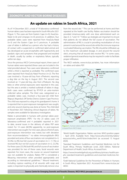
As of 14 December 2021, a total of 19 laboratory-confirmed human rabies cases has been reported in South Africa for 2021. The cases are from Eastern Cape, KwaZuluNatal and Limpopo provinces. In addi
...
The overall objective of this implementation plan is to define the strategy for implementation of the Xpert MTB/RIF test for rapid detection of TB and rifampicin (RIF) resistance in Tanzania, within the context of the National Tuberculosis and Leprosy Programme (NTLP) strategic plan and other nation
...
The Lancet DOI: 10.1016/S2468-2667(20)30101-8
WHO declared COVID-19 to be a pandemic on March 11, 2020. The pandemic eventually reached Yemen, with the first laboratory confirmed case announced on
...
