
Filter
2605
Text search:
demographic
factors
Featured
145
836
Language
2550
42
41
21
14
11
7
6
2
2
1
1
1
1
1
1
1
1
1
1
Document type
1576
583
189
100
92
25
18
17
3
1
1
Countries
119
118
109
97
81
78
77
72
70
69
67
63
58
55
54
52
50
44
39
36
30
30
29
27
27
26
24
24
21
20
18
16
16
14
14
13
13
13
12
12
11
11
10
10
9
9
9
9
8
8
8
7
7
7
7
6
6
6
6
6
5
5
5
5
4
4
4
4
4
4
4
3
3
3
3
3
3
3
3
3
2
2
2
2
2
2
2
2
2
2
2
2
2
1
1
1
1
1
1
1
1
1
1
1
1
1
1
1
1
1
1
1
1
1
1
1
1
1
1
1
1
1
1
Authors & Publishers
238
84
73
54
52
49
47
45
26
26
20
19
19
18
18
16
15
14
12
12
12
11
11
11
11
11
10
10
10
10
10
10
10
9
9
8
8
8
8
8
8
7
7
7
7
6
6
6
6
6
6
6
6
6
6
6
6
6
6
6
5
5
5
5
5
5
5
5
5
5
5
5
4
4
4
4
4
4
4
4
4
4
4
4
4
4
4
4
4
4
4
4
4
3
3
3
3
3
3
3
3
3
3
3
3
3
3
3
3
3
3
3
3
3
3
3
3
3
3
3
3
3
3
3
3
3
3
3
3
3
3
3
3
3
3
3
3
3
3
3
3
3
3
3
3
3
3
3
3
3
3
3
3
3
3
3
3
3
3
3
3
3
3
2
2
2
2
2
2
2
2
2
2
2
2
2
2
2
2
2
2
2
2
2
2
2
2
2
2
2
2
2
2
2
2
2
2
2
2
2
2
2
2
2
2
2
2
2
2
2
2
2
2
2
2
2
2
2
2
2
2
2
2
2
2
2
2
2
2
2
2
2
2
2
2
2
2
2
2
2
2
2
2
2
2
2
2
2
2
2
2
2
2
2
2
2
2
2
2
2
2
2
2
2
2
2
2
2
2
2
2
2
2
2
2
2
2
2
2
2
2
2
2
2
2
2
2
2
2
2
2
2
2
2
2
2
2
2
2
2
2
2
2
2
2
2
2
2
2
2
2
2
2
2
2
2
2
2
2
2
2
2
2
2
2
2
2
2
2
2
2
1
1
1
1
1
1
1
1
1
1
1
1
1
1
1
1
1
1
1
1
1
1
1
1
1
1
1
1
1
1
1
1
1
1
1
1
1
1
1
1
1
1
1
1
1
1
1
1
1
1
1
1
1
1
1
1
1
1
1
1
1
1
1
1
1
1
1
1
1
1
1
1
1
1
1
1
1
1
1
1
1
1
1
1
1
1
1
1
1
1
1
1
1
1
1
1
1
1
1
1
1
1
1
1
1
1
1
1
1
1
1
1
1
1
1
1
1
1
1
1
1
1
1
1
1
1
1
1
1
1
1
1
1
1
1
1
1
1
1
1
1
1
1
1
1
1
1
1
1
1
1
1
1
1
1
1
1
1
1
1
1
1
1
1
1
1
1
1
1
1
1
1
1
1
1
1
1
1
1
1
1
1
1
1
1
1
1
1
1
1
1
1
1
1
1
1
1
1
1
1
1
1
1
1
1
1
1
1
1
1
1
1
1
1
1
1
1
1
1
1
1
1
1
1
1
1
1
1
1
1
1
1
1
1
1
1
1
1
1
1
1
1
1
1
1
1
1
1
1
1
1
1
1
1
1
1
1
1
1
1
1
1
1
1
1
1
1
1
1
1
1
1
1
1
1
1
1
1
1
1
1
1
1
1
1
1
1
1
1
1
1
1
1
1
1
1
1
1
1
1
1
1
1
1
1
1
1
1
1
1
1
1
1
1
1
1
1
1
1
1
1
1
1
1
1
1
1
1
1
1
1
1
1
1
1
1
1
1
1
1
1
1
1
1
1
1
1
1
1
1
1
1
1
1
1
1
1
1
1
1
1
1
1
1
1
1
1
1
1
1
1
1
1
1
1
1
1
1
1
1
1
1
1
1
1
1
1
1
1
1
1
1
1
1
1
1
1
1
1
1
1
1
1
1
1
1
1
1
1
1
1
1
1
1
1
1
1
1
1
1
1
1
1
1
1
1
1
1
1
1
1
1
1
1
1
1
1
1
1
1
1
1
1
1
1
1
1
1
1
1
1
1
1
1
1
1
1
1
1
1
1
1
1
1
1
1
1
1
1
1
1
1
1
1
1
1
1
1
1
1
1
1
1
1
1
1
1
1
1
1
1
1
1
1
1
1
1
1
1
1
1
1
1
1
1
1
1
1
1
1
1
1
1
1
1
1
1
1
1
1
1
1
1
1
1
1
1
1
1
1
1
1
1
1
1
1
1
1
1
1
1
1
1
1
1
1
1
1
1
1
1
1
1
1
1
1
1
1
1
1
1
1
1
1
1
1
1
1
1
1
1
1
1
1
1
1
1
1
1
1
1
1
1
1
1
1
1
1
1
1
1
1
1
1
1
1
1
1
1
1
1
1
1
1
1
1
1
1
1
1
1
1
1
1
1
1
1
1
1
1
1
1
1
1
1
1
1
1
1
1
1
1
1
1
1
1
1
1
1
1
1
1
1
1
1
1
1
1
1
1
1
1
1
1
1
1
1
1
1
1
1
1
1
1
1
1
1
1
1
1
1
1
1
1
1
1
1
1
1
1
1
1
1
1
1
1
1
1
1
1
1
1
1
1
1
1
1
1
1
1
1
1
1
1
1
1
1
1
1
1
1
1
1
1
1
1
1
1
1
1
1
1
1
1
1
1
1
1
1
1
1
1
1
1
1
1
1
1
1
1
1
1
1
1
1
1
1
1
1
1
1
1
1
1
1
1
1
1
1
1
1
1
1
1
1
1
1
1
1
1
1
1
1
1
1
1
1
1
1
1
1
1
1
1
1
1
1
1
1
1
1
1
1
1
1
1
1
1
1
1
1
1
1
1
1
1
1
1
1
1
1
1
1
1
1
1
1
1
1
1
1
1
1
1
1
1
1
1
1
1
1
1
1
1
1
1
1
1
1
1
1
1
1
1
1
1
1
1
1
1
1
1
1
1
1
1
1
1
1
1
1
1
1
1
1
1
1
1
1
1
1
1
1
1
1
1
1
1
1
1
1
1
1
1
1
1
1
1
1
1
1
1
1
1
1
1
1
1
1
1
1
1
1
1
1
1
1
1
1
1
1
1
1
1
1
1
1
1
1
1
1
1
1
1
1
1
1
1
1
1
1
1
1
1
1
1
1
1
1
1
1
1
1
1
1
1
1
1
1
1
1
1
1
1
1
1
1
1
1
1
1
1
1
1
1
1
1
1
1
1
1
1
1
1
1
1
1
1
1
1
1
1
1
1
1
1
1
1
1
1
1
1
1
1
1
1
1
1
1
1
1
1
1
1
1
1
1
1
1
1
1
1
1
1
1
1
1
1
1
1
1
1
1
1
1
1
1
1
1
1
1
1
1
1
1
1
1
1
1
1
1
1
1
1
1
1
1
1
1
1
1
1
1
1
1
1
1
1
1
1
1
1
1
1
1
1
1
1
1
1
1
1
1
1
1
1
1
1
1
1
1
1
1
1
1
1
1
1
1
1
1
1
1
1
1
1
1
1
1
1
1
1
1
1
1
1
1
1
1
1
1
1
1
1
1
1
1
1
1
1
1
1
1
1
1
1
1
1
1
1
1
1
1
1
1
1
1
1
1
1
1
1
1
1
1
1
1
1
1
1
1
1
1
1
1
1
1
1
1
1
1
1
1
1
1
1
1
1
1
1
1
1
1
1
1
1
1
1
1
1
1
1
1
1
1
1
1
1
1
1
1
1
1
1
1
1
1
1
1
1
1
1
1
1
1
1
1
1
1
1
1
1
1
1
1
1
1
1
1
1
1
1
1
1
1
1
1
1
1
1
1
1
1
1
1
1
1
1
1
1
1
1
1
1
1
1
1
1
1
1
1
1
1
1
1
1
1
1
1
1
1
1
1
1
1
1
1
1
1
1
1
1
1
1
1
1
1
1
1
1
1
1
1
1
1
1
1
1
1
1
1
1
1
1
1
1
1
1
1
1
1
1
1
1
1
1
1
1
1
1
1
1
1
1
1
1
1
1
1
1
1
1
1
1
1
1
1
1
1
1
1
1
1
1
1
1
1
1
1
1
1
1
1
1
1
1
1
1
1
1
1
1
1
1
1
1
1
1
1
1
1
1
1
1
1
1
1
1
1
1
1
1
1
1
1
1
1
1
1
1
1
1
1
1
1
1
1
1
1
1
1
1
1
1
1
1
1
1
1
1
1
1
1
1
1
1
1
1
1
1
1
1
1
1
1
1
1
1
1
1
1
1
1
1
1
1
1
1
1
1
1
1
1
1
1
1
1
1
1
1
1
1
1
1
1
1
1
1
1
1
1
1
1
1
1
1
1
1
1
1
1
1
1
1
1
1
1
1
1
1
1
1
1
1
1
1
1
1
1
1
1
1
1
1
1
1
1
1
1
1
1
1
1
1
1
1
1
1
1
1
1
1
1
1
1
1
1
1
1
1
1
1
1
1
1
1
1
1
1
1
1
1
1
1
1
1
1
1
1
1
1
1
1
1
1
1
1
1
1
1
1
1
1
1
1
1
1
1
1
1
1
1
1
1
1
1
1
1
1
1
1
1
1
1
1
1
1
1
1
1
1
1
1
1
1
1
1
1
1
1
1
1
1
1
1
1
1
1
1
1
1
1
1
1
1
1
1
1
1
1
1
1
1
1
1
1
1
1
1
1
1
1
1
1
1
1
1
1
1
1
1
1
1
1
1
1
1
1
1
1
1
1
1
1
1
1
1
1
1
1
1
1
1
1
1
1
1
1
1
1
1
1
1
1
1
1
1
1
1
1
1
1
1
1
1
1
1
1
1
1
1
1
1
1
1
1
1
1
1
1
1
1
1
1
1
1
1
1
1
1
1
1
1
1
1
1
1
1
1
1
1
1
1
1
1
1
1
1
1
1
1
1
1
1
1
1
1
1
1
1
1
1
1
1
1
1
1
1
1
1
1
1
1
1
1
1
1
1
1
1
1
1
1
1
1
1
1
1
1
1
1
1
1
1
1
1
1
1
1
1
1
1
1
1
1
1
1
1
1
1
1
1
1
1
1
1
1
1
1
1
1
1
1
1
1
1
1
1
1
1
1
1
1
1
1
1
1
1
1
1
1
1
1
1
1
1
1
1
1
1
1
1
1
1
1
1
1
1
1
1
1
1
1
1
1
1
1
1
1
1
1
1
1
1
1
1
1
1
1
1
1
1
1
1
1
1
1
1
1
1
1
1
1
1
1
1
1
1
1
1
1
1
1
1
1
1
1
1
1
1
1
1
1
1
1
1
1
1
1
1
1
1
1
1
1
1
1
1
1
1
1
1
1
1
1
1
1
1
1
1
1
1
1
1
1
1
1
1
1
1
1
1
1
1
1
1
1
1
1
1
1
1
1
1
1
1
1
1
1
1
1
1
1
1
1
1
1
1
1
1
1
1
1
1
1
1
1
1
1
1
1
1
1
1
1
1
1
1
1
1
1
1
1
1
1
1
1
1
1
1
1
1
1
1
1
1
1
1
1
1
1
1
1
1
1
1
1
1
1
1
1
1
1
1
1
1
1
1
1
1
1
1
1
1
1
1
1
1
1
1
1
1
1
1
1
1
1
1
1
1
1
1
1
1
1
1
1
1
1
1
1
1
1
1
1
1
1
1
1
1
1
1
1
1
1
1
1
1
1
1
1
1
1
1
1
1
1
1
1
1
1
1
1
1
1
1
1
1
1
1
1
1
1
1
1
1
1
1
1
1
1
1
1
1
1
1
1
1
1
1
1
1
1
1
1
1
1
1
1
1
1
1
1
1
1
1
1
1
1
1
1
1
1
1
1
1
1
1
1
1
1
1
1
1
1
1
1
1
1
1
1
1
1
1
1
1
1
1
1
1
1
1
1
1
1
1
1
1
1
1
1
1
1
1
1
1
1
1
1
1
1
1
1
1
1
1
1
1
1
1
1
1
1
1
1
1
1
1
1
1
1
1
1
1
1
1
1
1
1
1
1
1
1
1
1
1
1
Publication Years
650
1734
214
6
1
Category
1386
172
139
134
101
25
11
Toolboxes
188
119
114
96
91
62
61
59
59
55
46
46
42
39
39
28
28
24
21
15
14
9
5
5
4
DHS Working Papers No. 110 | Zimbabwe Working Papers No. 11

Factors Associated with Stunting in Children under Age 2 in the Cambodia and Kenya 2014 Demographic and Health Surveys
Grace A. K. Ettyang & Caroline J. Sawe
United States Agency for International Development (USAID)
(2016)
C2
DHS WORKING PAPERS 2016 No. 126 | DEMOGRAPHIC AND HEALTH SURVEYS


To better adapt current case management practices and address excess mortality in otherwise treatable
cases will require better knowledge of the demographic characteristics of the patients and comorbidities
which can make severe dehydration harder
...
to tolerate physiologically. With this in mind, a scoping review
was undertaken, to explore the literature and summarise the existing evidence on cholera mortality and
reported risk factors.
more
Disability and Related Factors among Road Traffic Accident Victims in Benin: Study from Five Public and Faith-Based Hospitals in Urban and Suburban Areas
Yolaine Glèlè-Ahanhanzo, Alphonse Kpozèhouen, Noël Moussiliou Paraïso, Patrick Makoutodé, Chabi O. Alphonse Biaou, Eric Remacle, Edgard-Marius Ouendo, Alain Levêque
Scientific Research Publishing
(2018)
C2
Open Journal of Epidemiology, 2018, 8, 226-241
Abstract
Introduction: Road traffic accidents (RTAs) are a major public health issue
in developing countries, where roads tend to be built haphazardly and accidents
take a heavy toll on victims—including leaving them disabled. This
study seeks
...
to identify those factors that cause RTA victims to become disabled
as a result of their injuries. Methods: This retrospective community-
based study looked at RTA victims treated in five public and faith-based
hospitals in Benin. Disability was evaluated using the Washington Group on
Disabilities Statistics questionnaire. The independent variables were related to
the victim’s socio-demographic traits, the circumstances of the accident, and
post-crash response mechanisms. The proportions were compared using the
chi-squared test, with a threshold of 5%. Results: The prevalence of disability
among road traffic accident victims is 9.59% (CI 95%: 6.86% - 13.20%). The
occurrence of disability is associated with age (p = 0.002), occupational group
(p = 0.0077), the mode of transport used to transfer the victim (p < 0.001)
and the location of the injuries (p = 0.0035). The study also found that people
fail to make sufficient use of post-crash response mechanisms. Conclusion:
Public policy-makers should therefore focus on stepping up interventions to
get more people using both protective equipment and post-crash response services.
more

Non-communicable diseases (NCDs) are of increasing concern for society and national governments, as well as globally due to their high mortality rate. The main risk factors of NCDs can be classified into the categories of self-management, genetic
...
factors, environmental factors, factors of medical conditions, and socio-demographic factors.
more

Background: Data on burden of peripheral artery disease (PAD) and its attributable risk factors are valuable for policymaking. We aimed to estimate the burden and risk factors for PAD from 1990 to 2
...
019.
Methods: We extracted the data on prevalence, incidence, death, years lived with disability (YLDs), and years of life lost (YLLs) from the Global Burden of Disease Study 2019 to measure PAD burden. Moreover, the attributable burden to PAD risk factors was also estimated.
Results: Globally, in 2019, 113,443,017 people lived with PAD and 10,504,092 new cases occurred, resulting in 74,063 deaths, 500,893 YLDs, and 1,035,487 YLLs. The absolute numbers of PAD prevalent and incident cases significantly increased between 1990 and 2019, contrasting with the decline trends in age-standardized prevalence and incidence rates. However, no statistically significant changes were detected in the global age-standardized death or YLL rates. The burden of PAD and its temporal trends varied significantly by location, gender, age group, and social-demographic status. Among all potentially modifiable risk factors, age-standardized PAD deaths worldwide were primarily attributable to high fasting plasma glucose, followed by high systolic blood pressure, tobacco, kidney dysfunction, diet high in sodium, and lead exposure.
Conclusion: PAD remained a serious public health problem worldwide. More strategies aimed at implementing cost-effective interventions and addressing modifiable risk factors should be carried out, especially in regions with high or increasing burden.
more
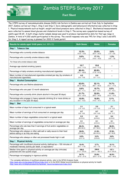
The STEPS survey of noncommunicable disease (NCD) risk factors in Zambia was carried out from July to September 2017. Zambia carried out Step 1, Step 2 and Step 3. Socio demographic and behavioural
...
information was collected in Step 1. Physical measurements such as height, weight and blood pressure were collected in Step 2. Biochemical measurements were collected to assess blood glucose and cholesterol levels in Step 3. The survey was a population-based survey of adults aged 18-69. A multi-stage cluster sample design was used to produce representative data for that age range in Zambia. A total of 4,302 adults participated in the survey. The overall response rate was 74% for Step 1 and 2 and 65% for Step 3. A repeat survey is planned for 2022 if funds permit.
more
This study is a theory-driven analysis of the socio-demographic determinants of maternal care seeking in Kenya. Specifically, it examines predisposing, enabling, and need factors potentially associa
...
ted with use of antenatal care (ANC), health facility delivery, and timely postnatal care (PNC).This study uses data from the 2014 Kenya Demographic and Health Survey (KDHS) conducted among women age 15-49 with a live birth in the five years preceding the survey. It includes data from all 47 counties of Kenya, grouped contiguously into 12regions.We apply Andersen’s Behavioral Model of Health Services Use to examine socio-demographic predictors of health service use.We estimate logistic regression models for adequate use of ANC (defined as attending at least four ANC visits, starting in the first three months of pregnancy), delivery in a health facility, and PNC within 48 hours of delivery.
more
We combine data on Chinese development projects with data from Demographic and Health Surveys to study the impact of Chinese aid on household welfare in sub-Saharan Africa. We use a novel methodology to test the effect of Chinese aid on three import
...
ant development outcomes: education, health, and nutrition. For each outcome, we use difference-in-difference estimations to compare household areas near Chinese project sites to control areas located farther away, before and after receiving Chinese aid. This empirical strategy rules out many confounding factors that can bias measuring the impact of Chinese aid on our outcome variables. First, we find that Chinese projects significantly improve education and child mortality in treatment areas, but do not significantly affect nutrition. Second, social sector projects have a larger effect on outcomes than economic projects. Third, we do not find significant effects for projects that ended more than five years before the post-treatment survey wave. Our results are robust to a host of robustness checks.
more

troke, a major Non-Communicable Disease (NCD), is responsible for 3.5% of disabilityadjusted life year (DALY) in India.Apart from risk factors like hypertension, diabetes, heart diseases and positive family history, other lifestyle related
...
factors such as unhealthy diet, obesity, lack of physical activity, stress and tobacco use account for its occurrence. Changes in lifestyles, behavioural patterns, demographic profile (aging population), socio-cultural and technological advancements are leading to sharp increases in the prevalence of stroke. The disease by and large can be prevented by making simple changes in the way people live their lives or simply by changing our lifestyle.
more
DHS Further Analysis Reports No. 111
This study is a theory-driven analysis of the socio-demographic determinants of maternal care seeking in Kenya. Specifically, it examines predisposing, enabling, and need ... factors potentially associated with use of antenatal care (ANC), health facility delivery, and timely postnatal care (PNC).
This study uses data from the 2014 Kenya Demographic and Health Survey (KDHS) conducted among women age 15-49 with a live birth in the five years preceding the survey. It includes data from all 47 counties of Kenya, grouped contiguously into 12 regions. We apply Andersen’s Behavioral Model of Health Services Use to examine socio-demographic predictors of health service use. We estimate logistic regression models for adequate use of ANC (defined as attending at least four ANC visits, starting in the first three months of pregnancy), delivery in a health facility, and PNC within 48 hours of delivery. more
This study is a theory-driven analysis of the socio-demographic determinants of maternal care seeking in Kenya. Specifically, it examines predisposing, enabling, and need ... factors potentially associated with use of antenatal care (ANC), health facility delivery, and timely postnatal care (PNC).
This study uses data from the 2014 Kenya Demographic and Health Survey (KDHS) conducted among women age 15-49 with a live birth in the five years preceding the survey. It includes data from all 47 counties of Kenya, grouped contiguously into 12 regions. We apply Andersen’s Behavioral Model of Health Services Use to examine socio-demographic predictors of health service use. We estimate logistic regression models for adequate use of ANC (defined as attending at least four ANC visits, starting in the first three months of pregnancy), delivery in a health facility, and PNC within 48 hours of delivery. more

Access to Services and Barriers faced by People with Disabilities: A Quantitative Survey
Nathan Grills, Lawrence Singh, Hira Pant, Jubin Varghese, GVS Murthy, Monsurul Hoq, Manjula Marella
Disability, CBR & Inclusive Development Journal (DCIDJ)
(2017)
CC
In low- and middle-income middle-income countries, reliable and disaggregated disability data on prevalence, participation and barriers are often unavailable. This study aimed to estimate disability prevalence, determine associated socio-demographic
...
factors and compare access in the community between people with and without disability in Dehradun district of Uttarakhand, India, using the Rapid Assessment of Disability survey.
more

Considerable energy has been expended over the last two decades in developing methods for identifying the presence of asthma among participants in population studies. The objective of this endeavour has commonly been to enable epidemiological research on risk
...
factors for asthma, with the ultimate aim of preventing the disease. However, there are other reasons for measuring the prevalence of asthma in populations, including the desire to assess the burden of disease attributable to asthma, to track changes over time, and to compare the prevalence among population groups defined by geographical, demographic or social factors. Two major international collaborative studies arising from this work have made major contributions to our knowledge about asthma
more
For the 24th consecutive year, PAHO has published the report Health Situation in the Americas: Core Indicators featuring the latest information on key indicators for the Region of the Americas. This 2018 edition includes data on the 82 core indicators for the countries, territories, and sub regions
...
of the Americas, grouped into the following categories: demographic-socioeconomic, health status, risk factors, service coverage, and health systems. Information is also presented on 22 indicators of the Sustainable Development Goals (SDGs).
more

An estimated 1.3 billion people globally experience significant disability. This figure has grown over the last decade and will continue to rise due to demographic and epidemiological changes. In 2022, the World Health Organization launched the Glob
...
al report on health equity for persons with disabilities. This report demonstrated that many persons with disabilities are still being left behind. Experiencing persistent health inequities, persons with disabilities die earlier, they have poorer health and functioning, and they are more affected by health emergencies than the general population. These differences are largely associated with unjust factors both inside and beyond the health sector and are avoidable. The Global Report called upon Member States to take actions to make health sector more inclusive for persons with disabilities through the primary health care approach. This will be essential for countries to make health coverage truly universal and to progress towards other health-related targets in the sustainable development goals.
more
Follow-up and tracing of tuberculosis patients who fail to attend their scheduled appointments in Cotonou, Benin: a retrospective cohort study
Serge Ade1, Arnaud Trébucq, Anthony D. Harries, Gabriel Ade, Gildas Agodokpessi, Prudence Wachinou, Dissou Affolabi, Sévérin Anagonou
BMC Health Services Research
(2016)
C2
Ade et al. BMC Health Services Research (2016) 16:5
Background: In the “Centre National Hospitalier de Pneumo-Phtisiologie” of Cotonou, Benin, little is known about
the characteristics of patients who have not attended their scheduled appointment, the results of tracing and the
possible b
...
enefits on improving treatment outcomes. This study aimed to determine the contribution of tracing
activities for those who missed scheduled appointments towards a successful treatment outcome.
Methods: A retrospective cohort study was carried out among all smear-positive pulmonary tuberculosis patients
treated between January and September 2013. Data on demographic and diagnostic characteristics and treatment
outcomes were accessed from tuberculosis registers and treatment cards. Information on those who missed their
scheduled appointments was collected from the tracing tuberculosis register. A univariate analysis was performed
to explore factors associated with missing a scheduled appointment
more

Journal of Biosocial Science / Volume 34 / Issue 04 / October 2002, pp 525 - 539
DOI: DOI:10.1017/S0021932002005254, Published online: 24 September 2002
This paper examines determinants of one aspect of sexual behaviour – coital frequency – among 2188 married women in the Central African Re
...
public using a secondary analysis of data from the Demographic and Health Survey of 1994–95. Female genital cutting (or circumcision) is practised in the Central African Republic and self-reported circumcision status was included in the questionnaire enabling it to be examined as a possible determinant of coital frequency. Multiple logistic regression was used to find a subset of factors independently associated with coital frequency.
Decreased coital frequency was found in those who had longer duration of marriage, those who were not the most recent wife in a polygamous marriage and those who had more surviving children. Coital frequency was higher in more educated women and those not contracepting because they wanted to get pregnant. After adjusting for confounders no association between
female genital cutting and coital frequency was found. The extent to which women can control coital frequency in this culture is not known and fertility desires may override any negative effects of circumcision on sexual pleasure.
It was therefore not possible to draw conclusions about how female genital cutting affects a woman’s desire for sexual intercourse and consequently there is a need to develop research methods further to investigate this question.
more
The National AIDS Control Council (NACC) continues to strengthen partnerships with all stakeholders in the response to HIV and AIDS in Kenya. While recognizing that there is no single preventive approach to reverse the spread of HIV, the faith sector comprising of Faith Communities (FCs) a
...
nd Faith-Based Organizations (FBOs) have demonstrated sustained motivation and moral authority with resources and outreach capability to significantly reduce new HIV infections. In addition, they have the power to influence policy changes to address societal, cultural and structural factors that impede individuals’ capacity to prevent HIV infection. According to Kenya Demographic Health Survey (2014), over 97% of the Kenya population was reported to ascribe to religious affiliation.
more
