
Filter
64
Text search:
decommissioning
Featured
13
24
Language
Document type
30
13
10
7
2
2
Countries
10
9
5
4
4
3
3
3
3
2
2
2
1
1
1
1
1
1
1
1
1
1
Authors & Publishers
Publication Years
Category
27
13
3
2
2
1
Toolboxes
12
6
4
4
3
2
2
2
2
2
1
1
1
1
In light of the decline in new Ebola cases, strategies are now needed to scale down the activities and bed capacities in Ebola care facilities. These facilities include Ebola treatment units, community care centres, Ebola treatment centres and isolation centres. The Governments of Guinea, Liberia an
...
These guidelines provide guidance of the procedures to be followed to decommission and dispose healthcare equipment at health facilities to ensure proper and safe healthcare equipment management.
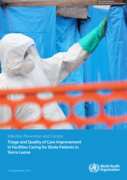
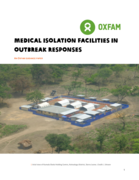
This technical briefing paper details the construction and setup of medical isolation facilities in support of infectious disease outbreak responses.
Program for Early Recovery and Resilience Building from EVD Outbreak in Liberia
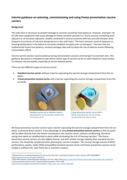
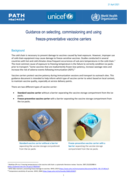
Interim Guidance, published 11 January 2021.
The cold chain is necessary to prevent damage to vaccines caused by heat exposure. However, improper use of cold chain equipment may cause damage to freeze-sensitive vaccines (i.e. those vaccines containing alum adjuvant or oil-emulsion adjuvant). Studie
...
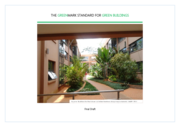
The Government recognizes the critical role of the built environment in addressing climate change and environmental degradation. To this end, it has identified and empowered the Kenya Building Research Centre to champion and coordinate the government’s green building agenda in relation to climate
...
Links to the Humanitarian Charter and international law
excreta disposal in emergencies
As part of a wider organisational undertaking to better capture and communicate the effectiveness of its work, Oxfam developed an evaluative method to assess the quality of targeted humanitarian responses. This method uses a global humanitarian indicator tool which is intended to enable Oxfam GB to
...
The report will describe how the Ebola Response MPTF, which has attracted contributions from 38 Member States, one business and many individuals, has offered a transparent and strategic tool to support the Ebola response. As of 31 January 2015, the Fund had total pledges amounting to US$142 million,
...
Decontaminating the Ebola Facilities in Sierra Leone
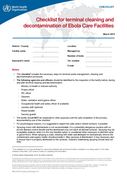
A terminal cleaning and decontamination checklist for Ebola care facilities should include thorough cleaning and disinfection of all surfaces, removal and proper disposal of contaminated items, and disinfection of the entire area, including hard-to-reach places, using appropriate methods and product
...
This Roadmap is structured around a results-based framework of outcomes, outputs and deliveraebles, to ensure that WHO maintains appropriate levels of organizational readiness, supports country-level capacity building and preparedness, deploys efficiently and effectively to respond to outbreaks and
...
