Filter
934
Text search:
water
reuse
Featured
Recommendations
162
New Publications
203
Language
Document type
Guidelines
245
No document type
235
Studies & Reports
201
Manuals
135
Strategic & Response Plan
62
Training Material
34
Fact sheets
10
Infographics
5
Brochures
2
Situation Updates
2
Resource Platforms
2
Videos
1
Countries / Regions
Global
74
India
43
Liberia
17
Sierra Leone
15
Nigeria
15
Kenya
14
Ethiopia
13
Ghana
11
Rwanda
11
Uganda
10
South Africa
10
Latin America and the Carribbean
10
Western and Central Europe
10
Africa
10
Syria
9
Tanzania
9
Myanmar / Burma
9
South Sudan
8
Bangladesh
8
South–East Asia Region
8
Nepal
7
Ukraine
7
Haiti
6
Eastern Europe and Central Asia
6
Guinea
5
Congo, Democratic Republic of
5
Jordan
5
Afghanistan
5
Malawi
5
Sudan
5
Yemen
5
Western Pacific Region
5
Somalia
4
Lebanon
4
Zambia
4
Philippines
3
Iraq
3
Egypt
3
Cambodia
3
Middle East and North Africa
3
Asia
3
Iran
3
Burkina Faso
2
Saudi Arabia
2
Cameroon
2
Zimbabwe
2
Pakistan
2
Turkey
2
Thailand
2
Namibia
2
Botswana
2
West and Central Africa
2
Djibouti
2
Senegal
1
Mali
1
Côte d’Ivoire / Ivory Coast
1
Morocco
1
USA
1
Germany
1
China
1
Singapore
1
Eswatini/ Swaziland
1
North Macedonia
1
Greece
1
Libya
1
Sri Lanka
1
East and Southern Africa
1
Palestine
1
Albania
1
Laos
1
Timor Leste/ East Timor
1
Russia
1
Qatar
1
Georgia
1
Vietnam
1
Denmark
1
Tunisia
1
Authors & Publishers
Publication Years
Category
Countries
211
Key Resources
144
Clinical Guidelines
98
Public Health
84
Women & Child Health
62
Capacity Building
39
Pharmacy & Technologies
30
Toolboxes
COVID-19
102
Planetary Health
96
Caregiver
77
AMR
59
NTDs
54
Ebola & Marburg
46
2.0 Rapid Response
37
Mental Health
32
Pharmacy
31
Conflict
29
Rapid Response
29
Global Health Education
29
NCDs
22
Malaria
22
HIV
20
Natural Hazards
18
Disability
15
TB
13
Cholera
9
Refugee
9
Specific Hazards
8
Zika
4
Health Financing Toolbox
4
Polio
3
Social Ethics
2
1 February 2021 to 31 January 2022
The World Health Organization (WHO) and the global community of countries, partners, donors, technical experts, scientists and field implementation teams continue to work towards the ultimate goal of a world free of the burden of neglected tropical diseases (NTDs).
The One Health approach can help achieve progress and promotes synergies on national and global priorities by generating synergies at the human-animal-environmental interface. While evidence is still scare, it is likely that the approach is highly cost-effective and improves effectiveness of core pu
...
This report summarizes the latest scientific knowledge on the links between exposure to air pollution and adverse health effects in children. It is intended to inform and motivate individual and collective action by health care professionals to prevent damage to children’s health from exposure to
...
2018 monitoring report: current status and strategic priorities
The report sets out the status of women’s, children’s and adolescents’ health, and on health systems and social and environmental determinants. Regional dashboards on 16 key indicators highlight where progress is being made o ...
Ebola disease and Marburg disease outbreaks continue to occur in Africa, with increased frequency. In addition to resulting in high mortality and morbidity, the outbreaks generate fear and mistrust about the response activities within the communities affected.
Infection prevention and control (IP
...
Technology landscape
This document is to support local authorities, leaders and policy-makers in cities and other urban settlements in identifying effective approaches and implementing recommended actions that enhance the prevention, preparedness and readiness for COVID-19 in urban settings, to ensure a robust response
...
The mhGAP community toolkit: field test version is an integral part of WHO's Mental Health Gap Action Programme (mhGAP), and aims at scaling up services for people with mental health conditions to achieve universal health coverage.
The toolkit provides guidance for programme managers on how to i
...
Diabetes mellitus, commonly known as diabetes, is a group of metabolic disorders characterized by the presence of hyperglycaemia in the absence of treatment. The heterogeneous aetiopathology includes defects in insulin secretion, insulin action, or both. The long-term specific complications of diabe
...
The primary audience for this guidance is persons
working directly in vector-borne disease prevention
and control, including programme managers,
researchers and field workers. A brief technical
background is provided for the benefit of persons
without expertise in vector-borne diseases; readers
...
his document, a first of its kind, clearly sets out the standards for rehabilitation and provides guidance on building or strengthening the capacity of EMTs in this area.The importance of early rehabilitation for functional outcomes is well documented. Rehabilitation needs can pe
...
The Infection prevention and control in the context of coronavirus disease 2019 (COVID-19): a living guideline consolidates technical guidance developed and published during the COVID-19 pandemic into evidence-informed recommendations for infection prevention and control (IPC). This living guideline
...
Ahead of World Malaria Day, the WHO Global Malaria Programme published a new operational strategy outlining its priorities and key activities up to 2030 to help change the trajectory of malaria trends, with a view to achieving the global malaria targets. The strategy outlines 4 strategic objectives
...
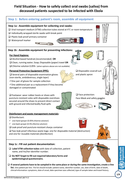
Steps on how to safely collect oral swabs (saliva) from deceased patients suspected to be infected with Ebola: before entering patient’s room, how to put on and remove personal protective equipment (PPE), how to collect oral swab from deceased patient and how to prepare VTM collection tube for tra
...
The WHO COVID-19 Clinical management: living guidance contains the Organization’s most up-to-date recommendations for the clinical management of people with COVID-19. Providing guidance that is comprehensive and holistic for the optimal care of COVID-19 patients throughout their entire illness is
...
Infectious disease outbreaks and epidemics are increasing in frequency, scale and impact. Health care facilities can amplify the transmission of emerging infectious diseases or multidrug-resistant organisms (MDRO) within their settings and communities. Therefore, evidence-based infection prevention
...