
Filter
1123
Text search:
Mediterranean
Featured
143
212
Language
Document type
347
340
177
78
62
42
22
22
17
11
1
1
1
1
1
Countries
109
42
33
29
26
12
12
11
11
10
9
9
8
8
7
7
7
7
7
7
7
7
7
7
6
6
6
5
5
5
5
5
5
4
4
4
4
4
4
4
4
4
4
3
3
3
3
3
3
2
2
2
2
2
2
2
2
1
1
1
1
1
1
1
1
1
1
1
1
1
1
1
1
1
1
1
1
1
1
1
1
1
1
1
Authors & Publishers
Publication Years
Category
160
131
122
83
77
31
21
Toolboxes
133
103
86
69
63
59
47
46
44
44
34
33
29
29
25
22
19
18
17
16
14
14
10
5
2
1
Mosquito-borne diseases are expanding their range, and re-emerging in areas where they had subsided for decades. The extent to which climate change influences the transmission suitability and population at risk of mosquito-borne diseases across different altitudes and population densities has not be
...

Front. Public Health, 04 June 2021 | https://doi.org/10.3389/fpubh.2021.618234
Schistosomiasis is an acute and chronic parasitic disease caused by blood flukes (trematode
worms) of the genus Schistosoma. At least 249 million people required preventive treatment in
2012. Preventive treatment, which should be repeated over a number of years, will reduce and
prevent morbidity.
...
Onchocerciasis – or “river blindness” – is a parasitic disease caused by the filarial worm
Onchocerca volvulus. It is transmitted through the bites of infected blackflies (Simulium spp.) that
breed in fast-flowing rivers and streams, mostly in remote villages located near fertile land wher
...

Nearly 260 000 people died in parts of Somalia between October 2010 and April 2012, including
133 000 children under five during the famine and food crisis in Somalia making it the worst famine in history.
A study commissioned and funded by the Food and Agriculture Organization of the United Natio
...
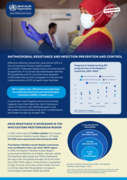
Effective infection prevention and control (IPC) is the cornerstone of every health system. As of 2023, 17 Member States have a functioning IPC programme; 19 countries have developed national IPC guidelines; and 13 countries have adopted multimodel intervention strategies to improve th
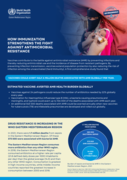
Vaccines contribute to the battle against antimicrobial resistance (AMR) by preventing infections and thereby reducing antimicrobial use and the incidence of disease from resistant pathogens. By preventing infection transmission, vaccines extend population protection by also reducing the risk of inf
...
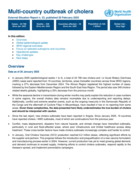
Multi-country outbreak of cholera External Situation Report # 23, published 20 February 2025

The “Declaration for Accelerated Malaria Mortality Reduction in Africa” is a statement signed by African health ministers reaffirming their commitment to reducing malaria-related mortality. It pledges strengthened leadership, increased domestic financing for malaria control programs, and the imp
...
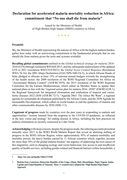
Issued by the Ministers of Health of High Burden High Impact (HBHI) countries in Africa. Yaounde Declaration.
Ministers committed to strengthening their health systems, stepping up domestic resources, enhancing multisectoral action and ensuring a robust accountability mechanism,” notes Dr Daniel
...
The WHO handbook “Epidemiological Data Analysis for the Early Warning Alert and Response Network (EWARN) in Humanitarian Emergencies” explains how to collect, analyse, interpret, and share health data during crises such as conflicts or natural disasters. It is a practical guide for health and su
...
The document provides a standardized protocol for evaluating the Early Warning Alert and Response Network (EWARN), a surveillance system used during humanitarian emergencies when regular national health surveillance may be disrupted. The purpose of EWARN is to detect outbreaks of communicable diseas
...
Training module on malaria control
Case Management; Guide for Tutors
Dengue is a mosquito-borne viral disease that has rapidly spread to all regions of WHO in recent years. Dengue virus is transmitted by female mosquitoes mainly of the species Aedes aegypti and, to a lesser extent, Ae. albopictus. These mosquitoes are also vectors of chikungunya, yellow fever and Zik
...
Training module
Why a 4°C warmer world must be avoided

This Manual covers all important aspects of echinococcosis, including parasite biology and life-cycles, geographic distribution and prevalence, epidemiology, clinical presentation in humans and animals, diagnosis and treatment, as well as control and prevention using newly developed tools and method
...
