
Filter
3283
Text search:
World
Health
Organization
(India)
Featured
Recommendations
292
New Publications
750
Language
Document type
No document type
1713
Studies & Reports
685
Guidelines
405
Manuals
195
Strategic & Response Plan
85
Training Material
69
Fact sheets
67
Situation Updates
21
Infographics
17
Resource Platforms
15
Videos
3
Brochures
2
Online Courses
2
App
1
Countries / Regions
India
372
Global
216
Nepal
87
Bangladesh
56
South–East Asia Region
56
Asia
50
Kenya
44
Myanmar / Burma
42
Ethiopia
35
South Africa
33
Latin America and the Carribbean
33
Nigeria
32
Africa
31
Indonesia
28
Syria
25
Uganda
24
Russia
23
Philippines
21
Malawi
21
Zambia
19
Tanzania
19
Western and Central Europe
19
Pakistan
17
Sierra Leone
16
Ukraine
16
Liberia
15
Rwanda
15
Namibia
15
Eastern Europe
15
Zimbabwe
14
Cambodia
14
Mozambique
14
China
13
Haiti
12
Thailand
12
Ghana
11
Middle East and North Africa
11
Afghanistan
10
Brazil
10
South Sudan
9
Colombia
9
Senegal
8
Congo, Democratic Republic of
8
Somalia
8
Sri Lanka
8
Yemen
8
Venezuela
8
Vietnam
7
East and Southern Africa
6
West and Central Africa
6
Guinea
5
Burkina Faso
5
Western Pacific Region
5
Eastern Europe and Central Asia
5
USA
4
Cameroon
4
Benin
4
Botswana
4
Lesotho
4
Mexico
4
Chile
4
Tajikistan
4
Iran
4
Iraq
3
Jordan
3
Germany
3
Lebanon
3
Turkey
3
Sudan
3
Central African Republic
3
Argentina
3
Angola
3
Laos
3
Timor Leste/ East Timor
3
Moldova
3
Georgia
3
Portugal
3
Mali
2
Guinea-Bissau
2
Morocco
2
Egypt
2
Peru
2
North Macedonia
2
Serbia
2
Bhutan
2
Palestine
2
Albania
2
Kyrgyzstan
2
North America
2
Bosnia and Herzegovina
2
Côte d’Ivoire / Ivory Coast
1
Saudi Arabia
1
Niger
1
Malaysia
1
Eswatini/ Swaziland
1
Hungary
1
Honduras
1
Ecuador
1
Bolivia
1
Greece
1
Libya
1
Madagascar
1
Other region
1
Poland
1
North Korea
1
Italy
1
Armenia
1
Mongolia
1
Canada
1
Qatar
1
Estonia
1
Romania
1
Kazakhstan
1
Turkmenistan
1
Jamaica
1
Japan
1
Maldives
1
Mauritius
1
Tunisia
1
Norway
1
Authors & Publishers
Publication Years
Category
Countries
896
Clinical Guidelines
372
Public Health
232
Women & Child Health
217
Key Resources
173
Capacity Building
68
Pharmacy & Technologies
40
Annual Report MEDBOX
1
Toolboxes
Mental Health
322
HIV
284
TB
246
COVID-19
236
Disability
177
Planetary Health
138
NTDs
129
Caregiver
102
AMR
94
NCDs
84
Global Health Education
83
Health Financing Toolbox
57
Pharmacy
53
Malaria
49
Rapid Response
43
Natural Hazards
42
Conflict
38
Refugee
38
Polio
29
Cholera
25
Ebola & Marburg
24
Specific Hazards
19
2.0 Rapid Response
19
Zika
16
Social Ethics
7
Typhoon
2
South Sudan
1

The Malaria Ministerial Conference, co-hosted by WHO and the Government of Cameroon on 6 March 2024, brought together more than 400 stakeholders, including Ministers of Health and senior representatives from the African countries hardest hit by mala
...

Access to NCD medicines: emergent issues during the COVID-19 pandemic and key structural factors
recommended
The coronavirus disease (COVID-19) pandemic exacerbated pre-existing inequalities in the treatment and care of noncommunicable diseases (NCDs). This report examines the effect of the COVID-19 pandemic on access to NCD medicines, and the policies and strategies implemented by countries and
...
Obesity and diet-related noncommunicable diseases (NCDs) have been steadily increasing globally, and with them, a pressing need to implement effective responses to address the contributing factors. Among the available evidence-based policy options that enable healthier choices and improved diets is
...

This document is an output of a WHO cross-programme initiative aiming to improve the prevention, diagnosis and management of anaemia and thereby accelerate reduction in its prevalence. It comes at an important time, midway through the era of the Sustainable Development Goals, when progress in reduci
...
The report aims to capture lessons from the COVID-19 pandemic and to highlight the opportunity for more ambitious global action: expanding sustainable access to vaccines for all towards the Immunization Agenda 2030 and pandemic prevention, preparedness and response efforts. The report is organized i
...
More than 700 000 people lose their life to suicide every year. A core foundation of suicide prevention is the timely registration and regular monitoring of suicide and self-harm. Surveillance data can be used to show important progress towards reaching global targets, such as reducing the suicide r
...

Developmental disabilities are common. Yet, children with developmental disabilities have been neglected in health systems planning and policy provisions for health and continue to experience stigma
...
The purpose of the Participant’s Workbook is to develop the skills and knowledge of personnel involved in wheelchair service delivery. The Participant’s Workbook contains exercises which will help to test and develop participants’ knowledge and skills. The Participant’s Workbook contains mat
...

The WHO continuously reviews available data on SARS-CoV-2 variants of concern. For this version, the global epidemiological
situation of the COVID-19 pandemic as of 21 January 2022 – at a time when the Omicron VOC had been identified in 171
countries across all six WHO Regions and was rapidly re
...

Safe drinking-water management must consider drinking-water quality, acceptability and quantity in the context of public health protection. In this manual, the term “safety” encompasses these three elements. Although the principles in this manua
...
Les modules de formation et d’orientation QualityRights ont été élaborés pour renforcer les connaissances, les compétences et la compréhension des principales parties prenantes sur la manière de promouvoir les droits des personnes en situation de handicap psychosocial, intellectuel ou cogni
...

The WHO Global Antimicrobial Resistance and Use Surveillance System (GLASS) was launched in 2015 to foster AMR surveillance and inform strategies to contain AMR. The system started with surveillance of AMR in bacteria causing common human infections and has expanded its scope to include surveillance
...
Energy use in the home is a vital and ubiquitous feature of human society. Energy
is used for a wide variety of purposes, including cooking, space heating, light-
ing, small-scale income generation, various household tasks, and entertainment.

The ninth WHO report on the global tobacco epidemic tracks the progress made by countries in tobacco control since 2008 and, marks 15 years since the introduction of the MPOWER technical package which is designed to help countries implement the demand-reduction measures of the WHO Framework Conventi
...
This document sets out the criteria and procedures to be followed by countries in verifying the interruption of yaws transmission. It is intended for use by international verification teams, national yaws eradication programmes and WHO technical staff involved in the eradication of yaws.

WHO TRS N°1012.
Key updates include: (i) surveillance strategies, including cross-sectoral linking of systems and suitable diagnostics; (ii) the latest recommendations on human and animal immunization; (iii) palliative care in lowresource settings; (iv) risk assessment to guide management of bite
...

National action plans on antimicrobial resistance (AMR) often overlook the critical intersection of gender, despite evidence that exposure and susceptibility to infection, health-seeking behaviours, as well as antimicrobial prescribing and use patte
...
The technical note by the Global Task Force on Cholera Control (GTFCC) discusses the use of Oral Cholera Vaccines (OCVs) for international workers and travelers in cholera-affected areas. It reviews the effectiveness of WHO-prequalified vaccines (Dukoral®, Shanchol™, and Euvichol®), emphasizing
...
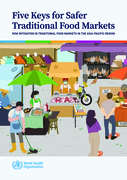
Traditional food markets play important economic, cultural, and social role and are sources of livelihood for millions of people in urban and rural areas. The manual Five keys for safer traditional food markets: risk mitigation in traditional food markets in the Asia-Pacific Region aims to support a
...
