
Filter
956
Text search:
eastern
mediterranean
Featured
129
179
Language
Document type
304
276
150
70
59
32
20
16
16
8
1
1
1
1
1
Countries
95
37
29
25
25
12
10
10
9
9
9
8
7
7
7
7
6
6
6
6
6
5
5
5
5
5
5
4
4
4
4
4
4
4
4
4
3
3
3
3
3
3
3
3
2
2
2
2
2
2
2
2
2
2
1
1
1
1
1
1
1
1
1
1
1
1
1
1
1
1
1
1
1
1
Authors & Publishers
Publication Years
Category
139
114
112
72
67
26
21
Toolboxes
120
84
68
51
45
45
43
40
39
35
32
31
28
24
20
20
19
17
16
16
14
10
8
4
2
1
This guidance note identifies strategic action for policy-makers and managers at the national, subnational and facility level to address these different challenges.
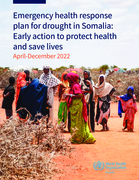
Nearly 260 000 people died in parts of Somalia between October 2010 and April 2012, including
133 000 children under five during the famine and food crisis in Somalia making it the worst famine in history.
A study commissioned and funded by the Food and Agriculture Organization of the United Natio
...
The WHO handbook “Epidemiological Data Analysis for the Early Warning Alert and Response Network (EWARN) in Humanitarian Emergencies” explains how to collect, analyse, interpret, and share health data during crises such as conflicts or natural disasters. It is a practical guide for health and su
...

Progress report and road map. Countries included in this report: Algeria, Afghanistan, Bahrain, Djibouti, Egypt, the Islamic Republic of Iran, Iraq, Jordan, Kuwait, Lebanon, Libya, Morocco, Oman, Pakistan, Qatar, State of Palestine, Saudi Arabia, Somalia, Sudan, the Syrian Arab Republic, Tunisia, Un
...
WHO practical guidelines. 2nd edition
Euro Surveill. 2016;21(12):pii=30174. DOI: http://dx.doi.org/10.2807/1560-7917.ES.2016.21.12.30174
SCOPING QUESTION: Which psychosocial interventions are effective in the management of cannabis dependence?
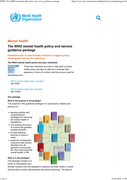
Checklists and 13 user-friendly modules to support policy development and service planning. You can download the different modules directly from the website:
https://www.who.int/mental_health/policy/essentialpackage1/en/
The purpose of the guidance package is to assist policy-makers and planner
...
This guide covers psychological first aid which involves humane, supportive and practical help to fellow human beings suffering serious crisis events. It is written for people in a position to help others who have experienced an extremely distressing event. It gives a framework for supporting people
...

Geneva, 19–24 MAY 2014
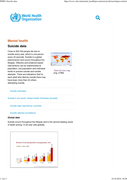
Close to 800 000 people die due to suicide every year, which is one person every 40 seconds. Suicide is a global phenomenon and occurs throughout the lifespan. Effective and evidence-based interventions can be implemented at population, sub-population and individual levels to prevent suicide and sui
...
The Global Status Report on Preventing Violence Against Children 2020 - Russian
Цель доклада состоит в том, чтобы документально установить в какой степени государства выполняют следующие виды деятеÐ
...
Mosquito-borne diseases are expanding their range, and re-emerging in areas where they had subsided for decades. The extent to which climate change influences the transmission suitability and population at risk of mosquito-borne diseases across different altitudes and population densities has not be
...
Schistosomiasis is an acute and chronic parasitic disease caused by blood flukes (trematode
worms) of the genus Schistosoma. At least 249 million people required preventive treatment in
2012. Preventive treatment, which should be repeated over a number of years, will reduce and
prevent morbidity.
...
Onchocerciasis – or “river blindness” – is a parasitic disease caused by the filarial worm
Onchocerca volvulus. It is transmitted through the bites of infected blackflies (Simulium spp.) that
breed in fast-flowing rivers and streams, mostly in remote villages located near fertile land wher
...
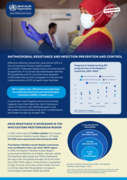
Effective infection prevention and control (IPC) is the cornerstone of every health system. As of 2023, 17 Member States have a functioning IPC programme; 19 countries have developed national IPC guidelines; and 13 countries have adopted multimodel intervention strategies to improve th
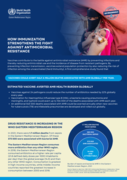
Vaccines contribute to the battle against antimicrobial resistance (AMR) by preventing infections and thereby reducing antimicrobial use and the incidence of disease from resistant pathogens. By preventing infection transmission, vaccines extend population protection by also reducing the risk of inf
...
