
Filter
455
Text search:
World
Health
Organization
(South-East-Asia)
Featured
Recommendations
59
New Publications
124
Language
Document type
No document type
222
Studies & Reports
94
Guidelines
66
Manuals
30
Strategic & Response Plan
17
Training Material
8
Fact sheets
6
Resource Platforms
5
Situation Updates
3
Infographics
3
Online Courses
1
Countries / Regions
Global
40
South–East Asia Region
34
India
18
Asia
15
Myanmar / Burma
13
Bangladesh
10
Nepal
6
Western and Central Europe
6
Philippines
5
Cambodia
5
Syria
4
Kenya
4
Indonesia
4
Latin America and the Carribbean
4
Nigeria
3
Congo, Democratic Republic of
3
Thailand
3
South Africa
3
Middle East and North Africa
3
Western Pacific Region
3
Uganda
2
Tanzania
2
China
2
Rwanda
2
East and Southern Africa
2
West and Central Africa
2
Eastern Europe and Central Asia
2
Africa
2
Russia
2
Ethiopia
1
Cameroon
1
South Sudan
1
Egypt
1
Malaysia
1
Malawi
1
Sudan
1
Benin
1
Eswatini/ Swaziland
1
Brazil
1
Serbia
1
Yemen
1
Other region
1
Venezuela
1
Eastern Europe
1
Timor Leste/ East Timor
1
Tajikistan
1
Kazakhstan
1
Vietnam
1
Japan
1
Authors & Publishers
Publication Years
Category
Countries
85
Clinical Guidelines
68
Women & Child Health
44
Public Health
41
Key Resources
30
Capacity Building
13
Pharmacy & Technologies
8
Toolboxes
HIV
45
Mental Health
34
TB
32
NTDs
30
Planetary Health
27
COVID-19
23
AMR
20
Caregiver
20
Rapid Response
15
Global Health Education
15
Disability
11
Zika
9
NCDs
9
Conflict
7
Pharmacy
7
Ebola & Marburg
6
Natural Hazards
6
2.0 Rapid Response
6
Refugee
5
Polio
4
Malaria
4
Specific Hazards
3
Cholera
2
Typhoon
1


The content of these guidelines goes beyond the technicalities of medical needs with additional insights into community empowerment, possible access to welfare and economic opportunities and similar issues. If these are adequately explored, the health
...
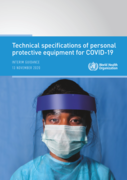
The document "Priority medical devices list for the COVID-19 response and associated technical specifications" complements this guideline.
This document provides interim guidance on the quality, performance characteristics and related standards of personal protective equipment (PPE) to be used i
...
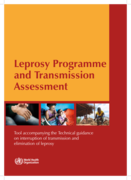
The Leprosy Programme and Transmission Assessment (LPTA) is an activity that is carried out by internal teams towards the end of Phase 1 (see Leprosy Elimination Framework in the Annex) when a subnational jurisdiction (typically second-tier) reaches the milestone for interruption of transmission, i.
...

The strategic priorities of the CCS 2014–2018 are:
(1) Strengthening the health system.
(2) Enhancing the achievement of communicable disease control targets.
(3) Controlling the growth of the noncommunicable disease burden.
(4 ...
(1) Strengthening the health system.
(2) Enhancing the achievement of communicable disease control targets.
(3) Controlling the growth of the noncommunicable disease burden.
(4 ...
All personnel performing SARS-CoV-2 antigen rapid diagnostic tests (Ag-RDT) need to understand how to safely perform testing, ensure quality testing and interpret results. This course is developed to provide theoretical knowledge on SARS-CoV-2 Ag-RDT testing. The learning package consists of 10 modu
...

This guide covers psychological first aid which involves humane, supportive and practical help to fellow human beings suffering serious crisis events. It is written for people in a position to help others who have experienced an extremely distressing event. It gives a framework for supporting people
...
The Guidelines for the Diagnosis, Treatment and Prevention of Leprosy provide state-of-the-art knowledge and evidence on leprosy diagnosis, treatment and prevention based on a public health approach in endemic countries. The target audience of this
...
Lymphatic filariasis, commonly known as elephantiasis, is a neglected tropical disease. Infection occurs when filarial parasites are transmitted to humans through mosquitoes. When a mosquito with infective stage larvae bites a person, the parasites are deposited on the person’s skin from where the
...
Close to 800 000 people die due to suicide every year, which is one person every 40 seconds. Suicide is a global phenomenon and occurs throughout the lifespan. Effective and evidence-based interventions can be implemented at population, sub-population and individual levels to prevent suicide and sui
...
The report focuses on antibacterial resistance (ABR) in common bacterial pathogens. There is a major gap in knowledge about the magnitude of this problem. Antimicrobial resistance (AMR) threatens the effective revention and treatment of an ever-increasing range of infections caused by bacteria, para
...
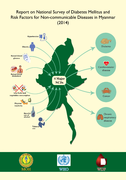
The Ministry of Health conducted STEPS surveys on adult risk factors surveillance in Myanmar in 2003, 2009 and 2014. Amongst these three surveys, the 2014 one is the most comprehensive, providing an analysis of all States and Regions within Myanmar
...
Updated recommendations on treatment of adolescents and children with chronic HCV infection
recommended
The new treatment recommendations that extend the 2018 treat all recommendation for adults with chronic HCV infection to include adolescents and children down to 3 years, and to align the existing recommended pangenotypic direct-acting antiviral (DAA) regimens (SOF/DCV, SOF/VEL and G/P) for adults,
...
