
Filter
663
Text search:
Neglected
Tropical
Diseases
(NTDs)
Featured
53
74
Language
Document type
197
105
95
72
51
33
31
30
16
14
7
4
4
2
2
Countries
164
18
13
11
9
9
8
8
8
7
7
7
7
6
6
4
4
4
4
4
4
3
3
3
3
3
3
3
3
2
2
2
2
2
2
2
2
2
2
2
1
1
1
1
1
1
1
1
1
1
1
1
1
1
1
1
1
1
1
1
1
1
1
1
1
1
1
1
Authors & Publishers
Publication Years
Category
115
65
28
19
13
8
2
1
Toolboxes
470
17
13
11
7
6
5
5
4
3
3
3
1
1
1
1
1
1

In 1997, the Fiftieth World Health Assembly adopted resolution WHA50.29 on the elimination of
lymphatic filariasis as a public health problem. Preliminary guidance from WHO printed in 2011 referred to “verification” as the official process by which the achievements of the Global Programme to El
...

ICTC’s 2022-2030 strategic plan spans the critical period running to the end of 2030, the year by which we are striving to achieve the elimination of trachoma as a public health problem. This strategic plan is in alignment with the NTD road map, Ending the neglect to attain the Sustainable Develop
...
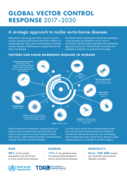
Mosquitoes, flies, bugs and other vectors transmit viruses, parasites and bacteria that infect millions of people globally. They cause many diseases, including malaria, dengue, leishmaniases, Chagas disease and Zika virus disease.
The World Health
...

The World Health Organization (WHO) convened a meeting of the Technical Advisory Group on Buruli ulcer at its headquarters in Geneva, Switzerland on 25 to 27 March 2019

Guia de treinamento para profissionais de saúde da linha de frente
Versão oficial em português da obra original em Inglês
Recognizing neglected tropical
...

It is Zika virus (ZIKV) that most often causes these neurological effects it appears to be the only arbovirus than can cause congenital malformations such as microcephaly. In any case, more scientific tests are needed to establish the causal relationship between the virus and this malformation (7-10
...

Dickson and Daniel discuss lymphatic filariasis caused by the helminths Wuchereria bancrofti and Brugia malayai.

The Pharmaceutical Forum of the Americas (PFA) has previously published guidelines and organised campaigns for community pharmacists on the prevention, detection and control of arbovirus infections in 2018 with a grant from the FIP Foundation for Pharmacy Education and Research. Building on that exp
...
MEDBOX Issue Brief no.35: The first issue brief on the NTD Toolbox contains general strategies, roadmaps, key treatment guidelines, reports, and training material on Buruli ulcer, Chagas, and Leishmaniasis.
Issue Brief NTDs Part 3 : Schistosomiasis
recommended
In this subsequent part of the issue brief on the NTD Toolbox you will learn about general strategies, roadmaps, key treatment guidelines, reports, and training material on Schistosomiasis
Schistosomiasis is one of the 17 ‘neglected tropical diseases’ as classified by the World Health Organization.
In order to better understand
...

Onchocerca volvulus transmitted by repeated bites of infected blackflies (Simulium spp.). These blackflies breed along fast-flowing rivers and streams, close to remote villages located near fertile land where people rely on agriculture.
There is a need to reinforce skills of national and district
...
Ending the neglect to attain the Sustainable Development Goals: a road map for neglected tropical diseases 2021–2030 (“the road map”) sets ex
...
Human African trypanosomiasis (HAT) is a lethal neglected tropical disease (NTD) transmitted by the bite of infected tsetse flies. The disease is also known as “sleeping sickness”. During the 20
...
The World Health Organization (WHO) met with Kenya’s Ministry of Health on 25 November 2024 to discuss preliminary results from the first-ever real-world assessment of the WHO Skin NTDs App, powered by two artificial intelligence (AI)-based algori
...
Noma (cancrum oris) is a serious gangrenous disease of the mouth and face, mainly affecting children aged 2 to 6 years in sub-Saharan Africa.
Despite substantial knowledge gaps, it is reported to be linked with malnutrition, poor oral hygiene, immunosuppression, and living in extreme poverty situ
...

Leishmaniasis is a vector-borne tropical/subtropical disease caused by an intracellular parasite transmitted to humans by sand fly bite. It is endemic in Asia, Africa, the Americas, and the Mediterranean region. Worldwide reports include 1.5–2 mil
...
Human African Trypanosomiasis (HAT, sleeping sickness) and Animal African Trypanosomiasis (AAT) are neglected tropical diseases generally caused by
...
Health communication has proven to play a crucial role in addressing diseases such as dengue, Zika and chikungunya, for which there are no definitive or easily accessible vaccines. In this context, this discipline becomes a fundamental tool to promo
...
