
Filter
690
Text search:
Latin
America
and
the
Caribbean
Featured
46
123
Language
Document type
262
242
63
41
31
16
12
11
7
3
1
Countries
158
84
29
16
14
11
5
5
5
5
5
4
4
4
4
4
4
3
3
3
3
3
3
3
3
3
3
3
2
2
2
2
2
2
2
2
2
2
2
2
2
2
2
2
1
1
1
1
1
1
1
1
1
1
1
1
1
1
1
1
1
1
1
1
1
1
1
1
1
Authors & Publishers
Publication Years
Category
204
60
56
56
37
6
4
Toolboxes
103
87
53
32
30
27
27
26
22
18
17
15
15
14
14
13
13
8
6
4
3
3
3
3
1

This third regional report discusses gaps and challenges in reducing the harmful use of alcohol and how countries can reverse current trends in a c
...
This new edition highlights once again the importance of collecting disaggregated data to conduct gender-based analysis in order to determine, address, reduce, and eliminate
...

The document is structured into five sections. The first presents the key experiences and challe
...

Tuberculosis continues to represent a severe public health problem in the Region of the Americas, even more so in the case of indigenous peoples, w
...
The International Forum of Indigenous Women (IIWF) has prepared this report in order to have a
document for analysis and systematization of the im
...
PLoS Negl Trop Dis 15(8): e0009697. Chagas disease (CD), caused by the parasite Trypanosoma cruzi, affects ~6–7 million people worldwide. Significant limitations still exist in our understanding of CD. Harnessing individual participant data (IPD)
...
Throughout the Americas, populations are aging and the Region is undergoing a rapid demographic transition.
...
Effective surveillance and monitoring of noncommunicable diseases (NCDs) and their risk factors are essential for informing evidence-based public health policies, addressing health inequities,
...
This document focuses on making recommendations for the diagnosis and treatment of Chagas disease, an infection caused by Trypanosoma cruzi, the pr
...
The proposed roadmap includes components and recommended actions to eliminate these neglected infectious diseases from the Americas.
This research report offers community perceptions of COVID-19 from migrants, refugees, host communities and indigenous populations in nine countries in the Americas: Argentina, Brazil, Bolivia, Colo
...
As of 21 May 2020, 4.8 million confirmed cases of Coronavirus disease 2019 (COVID-19) have been reported globally. In South America, COVID-19 was first detected on 26 February 2020, when Brazil confirmed a case in São Paulo.
Crisis Group’s Watch List identifies ten countries or regions at risk of deadly conflict or escalation thereof in 2021. In these places, early action, driven or supported by the EU and its member
...
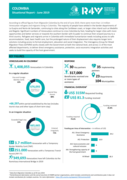
According to official figures from Migración Colombia by the end of June 2019, there were more than 1.4 million Venezuelan refugees and migrants living in Colombia.
...

Taenia saginata is a zoonotic tapeworm that is of economic importance in countries where cattle are kept. The parasite is transmitted from human tapeworm carriers (taeniosis) to bovines (cysticercosis) by excretion of eggs or proglottids containing
...
The Resolution Population and Individual Approaches to the Prevention and Management of Diabetes
...
Obesity and diabetes are affecting the peoples of the Americas at high and increasing rates. Nat
...

The COVID-19 HEalth caRe wOrkErs Study (HEROES): Regional Report from the Americas is a multicenter prospective cohort study to assess the impact o
...

The objective of Health in the Americas: Overview of the Region of the Americas in
...
