Filter
1502
Text search:
Physical
Trauma
Featured
181
341
Language
Document type
894
196
192
103
38
36
17
13
8
3
1
Countries
76
53
50
44
36
29
27
24
24
23
22
19
17
15
15
14
12
12
12
11
11
11
11
11
11
10
9
8
8
8
7
7
7
7
7
7
6
6
6
5
5
4
4
4
4
4
4
3
3
3
3
3
3
3
3
3
2
2
2
2
2
2
2
2
2
2
2
2
1
1
1
1
1
1
1
1
1
1
1
1
1
1
1
1
1
1
1
1
1
1
1
1
1
1
Authors & Publishers
Publication Years
Category
470
131
112
105
54
39
2
1
Toolboxes
391
112
82
72
71
47
42
35
34
25
21
18
16
15
13
10
9
5
5
4
2
2
2
1
1
Group psychological help for adults impaired by distress in communities exposed to adversity
With this manual, the World Health Organization (WHO) is responding to requests from colleagues around the world for a group version of the manual Problem Management Plus (PM+), which was developed for adul
...
Available in English, Russian and Ukrainian from the website
https://reliefweb.int/report/ukraine/ocha-ukraine-situation-report-22-october-2021-enruuk
The recommendation in this document thus supersedes the previous WHO recommendation for the prevention of PPH as published in the 2012 guideline, WHO recommendations for the prevention and treatment of postpartum haemorrhage.
Sepsis contributes significantly to preventable mortality and is the final common pathway to death for severe infectious diseases; it can also arise as a complication of injuries and non-communicable diseases.
Expert Consensus Report for Emergency Centres in
Western Cape

The Guidelines on promotive and preventive mental health interventions for adolescents - Helping Adolescents thrive (HAT), provide evidence-informed recommendations on psychosocial interventions to promote mental health, prevent mental disorders, and reduce self-harm and other risk behaviours among
...
There is no secret to our procedure: the daily scanning of the literature helps us to stay afloat in the never-ending waves of new publications about SARS-CoV-2 and COVID-19. Many papers discussed in the Top 10 will eventually make it into subsequent editions of COVID Reference.
A framework for planning, developing and implementing solutions with and for young people.
The guidance presented in this document is intended for digital health intervention designers, developers, implementers, researchers and funders. Newcomers to digital health can use it as a start-to-finish pr
...
The recommendation in this document thus supersedes the previous WHO recommendation for the prevention of PPH as published in the 2012 guideline
The recommendation in this document thus supersedes the previous WHO recommendation for the prevention of PPH as published in the 2012 guideline, WHO recommendations for the prevention and treatment of postpartum haemorrhage.
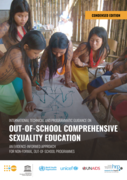
An evidence-informed approach for non-formal, out-of-school CSE programmes that aims to reach young people from left-behind populations
This guidance is intended to assist anyone designing and/or implementing CSE in out-of-school settings, especially in low- and middle-income countries. This includ
...


Every year, nearly 250 million people move across borders temporarily or permanently for a job opportunity, studying, to flee a crisis back home, or for other reasons. Another 750 million move for similar reasons within the borders of their countries. With the understanding that human mobility affec
...
WHO labour care guide: user’s manual
recommended
The WHO Labour Care Guide is a tool that aims to support good-quality, evidence-based, respectful care during labour and childbirth, irrespective of the setting or level of health care. This manual has been developed to help skilled health personnel to successfully use the WHO Labour Care Guide. The
...
Increasing the Odds: A Series to Understanding Gambling Disorders. Vol.7
All editions of Increasing the Odd sare available as a free download at https://www.icrg.org/resources/monographs
Guidelines on the management of chronic pain in children, developing and implementing national and local policies for pain management and protocols in children, implementing national and local regulations for pain management in children, pain management and protocols
English Analysis on World about Disaster Management and Protection and Human Rights; published on 12 Jan 2021 by IFRC

In fragile, conflict-affected and vulnerable settings, delivery of quality health services faces significant challenges, including disruption of a routine health service organization and delivery systems, increased health needs, complex and unpredictable resourcing issues, and vulnerability to multi
...