
Filter
1910
Text search:
humanitarian
practice
Featured
213
530
Language
Document type
963
348
258
144
95
38
33
15
9
3
1
1
1
Countries / Regions
133
71
59
56
48
40
34
34
33
33
33
32
30
26
22
21
20
19
15
15
14
13
13
13
13
12
12
12
12
12
11
11
10
9
9
8
8
8
7
7
7
7
6
6
6
6
6
6
6
6
5
5
5
5
5
5
5
5
4
4
4
4
4
3
3
3
3
3
3
3
2
2
2
2
2
2
2
2
2
2
2
2
2
1
1
1
1
1
1
1
1
1
1
1
1
1
1
1
1
1
1
1
1
1
1
1
1
1
Authors & Publishers
Publication Years
Category
455
356
171
107
92
43
7
3
Toolboxes
213
178
171
123
116
77
71
66
58
49
37
37
35
32
22
22
20
19
13
13
13
12
7
6
6
4
1

At the end of 2023, WHO convened our first-ever annual WHO Stakeholder Review Conference for Prevention and Response to Sexual Misconduct. Aimed at joint learning and frank discussion on challenges faced in the achieving zero tolerance for all forms of sexual misconduct by aid workers, the Conferenc
...
Since February 24th, 2022, the beginning of Russia’s aggression against Ukraine, more than 80,000 women were expected to give birth. Therefore, understanding the impact of war on the perinatal health of women is an important requisite to improve perinatal care. This narrative synthesis has two mai
...
Healthy Settings, a key component of Malawi’s Health Sector Strategic Plan (HSSP) 2011–2016, is the World Health Organization’s (WHO) holistic community-led approach to achieving health improvement by addressing social determinants of health, an approach which is central to the current WHO fra
...
Evidence- and rights-based national policies, guidelines and legislation play a key role in improving sexual, reproductive, maternal, newborn, child and adolescent health (SRMNCAH), framing the enabling environment for equitable provision and accessibility of quality services. The SRMNCAH policy sur
...
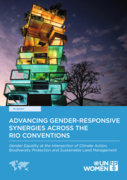
This brief highlights the urgency of addressing gender inequalities across the Rio Conventions, provides examples of where progress has been made, and identifies clear entry points for addressing gender equality considerations across the Conventions. It makes recommendations for actions to accelerat
...
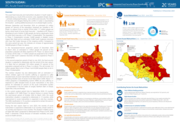
The acute food insecurity and malnutrition situation in South Sudan is deteriorating as a result of the economic crisis, repeated climatic shocks – primarily widespread flooding – and conflict and insecurity. The inflow of returnees and refugees fleeing the conflict in Sudan is exacerbating the
...
Climate change is one of the biggest crises of our time. Climate threats range from higher temperatures, heavy rainfalls and floods, erratic precipitation, droughts, desertification, and land degradation. This has negative implications on the quality and quantity of natural resources, such as land a
...

Namibia recorded its first COVID-19 case on 14 March 2020, with cumulative cases reaching 15,773 and 118 deaths by 10 December 2020. Namibia has done relatively well to contain the outbreak.
However, positivity rates have shown a consistent increase above 5 percent in quarter 4 of 2020, necessitati
...

The COVID-19 pandemic exposed critical gaps in the global response to health crises, particularly in the financing of pandemic prevention, preparedness, response, recovery, and reconstruction. This chapter presents a comprehensive framework for pandemic financing that spans the entire pandemic cycle
...

This document is for public health specialists, health emergency responders, clinicians, health facility managers, health and care workers and IPC practitioners including but not limited to those working in primary care clinics, sexual health clinics, emergency departments, dental practices, infecti
...

Growing emergencies and displacements across the world demand increasingly complex interventions and responses. The World Health Organization (WHO) has developed Malaria control in emergencies: a field manual to provide technical guidance to help partners respond effectively to malaria in emergency
...

Early Adolescent Skills for Emotions (EASE) is an evidence-based group psychological intervention to help 10–15-year-olds affected by internalizing problems (e.g. stress and symptoms of anxiety, depression) in communities exposed to adversity. Published by the World Health Organization (WHO) and U
...
This report synthesizes the state of knowledge on the interlinkages between environmental degradation climate change conflict and mobility in the East and Horn of Africa, focusing on Burundi, Djibouti, Ethiopia, Kenya, Somalia, South Sudan, Tanzania, and Uganda.

Drawing on the World Health Organization’s package of NCD best buys, the report demonstrates how these evidence-based measures can help countries reduce premature deaths, strengthen health systems, and advance progress towards the Sustainable Development Goals. It provides policymakers, donors, ad
...

WHO guideline on balanced national controlled medicines policies to ensure medical access and safety
Access to medicines is essential for attainment of universal health coverage, which is central to achievement of the health-related Sustainable Development Goals. Controlled medicines include those such as opioids, benzodiazepines, barbiturates, amphetamines and others with identified or emergent cl
...

On Global Handwashing Day, WHO and UNICEF have released the first-ever global Guidelines on Hand Hygiene in Community Settings to support governments and practitioners in promoting effective hand hygiene outside health care – across households, public spaces and institutions. Framing hand hygiene
...

These Frequently Asked Questions (FAQs) have been developed by the Infant Feeding in Emergencies (IFE) Core Group Infectious Disease Working Group based on the most recent recommendations, collective knowledge and evidence on cholera. The FAQs also draw on infant and young child feeding (IYCF) recom
...

Ces questions fréquemment posées (FAQs) ont été élaborées par le Groupe de travail sur les maladies infectieuses du Groupe l'alimentation central sur des nourrissons en situation d'urgence (IFE) en se basant sur les recommandations les plus récentes, les connaissances collectives et les donnÃ
...
Technology and digital tools are transforming everyday life, opening new opportunities for women and girls—but they are also being weaponized to harass, threaten, and silence them online. Technology-facilitated violence against women and girls (TF VAWG) is now a defining challenge for gender equal
...

The UNICEF Gender Equality Action Plan, 2026–2029 provides the road map
for the organization’s key commitments to advancing gender equality and the
empowerment of all girls and women, anchored in the UNICEF Strategic Plan,
2026–2029.
