
Filter
2448
Text search:
National
Institute
of
Mental
Health
Featured
219
491
Language
2263
111
83
67
37
23
20
16
9
6
5
5
4
4
3
3
3
2
2
2
2
2
2
2
2
2
1
1
1
1
1
1
1
1
1
1
1
1
1
1
1
1
1
1
1
1
Document type
1372
460
271
157
71
53
24
17
11
5
4
1
Countries / Regions
143
115
65
64
60
53
50
48
43
35
31
31
27
27
27
26
25
24
24
24
23
22
21
20
20
18
15
14
14
14
14
12
11
10
10
9
9
9
9
8
8
8
8
8
8
8
7
7
6
6
6
6
6
6
6
6
6
6
5
5
5
5
4
4
4
4
4
4
4
4
3
3
3
3
3
3
3
3
3
3
2
2
2
2
2
2
2
2
2
2
2
2
2
2
2
2
2
2
2
2
2
1
1
1
1
1
1
1
1
1
1
1
1
1
1
1
1
1
1
1
1
1
Authors & Publishers
304
115
102
75
60
55
43
42
24
23
21
18
17
17
16
16
14
14
13
13
13
13
12
12
12
11
10
10
10
10
9
8
8
8
8
7
7
7
6
6
6
6
6
5
5
5
5
5
5
5
5
5
5
5
5
5
5
5
5
5
5
5
5
4
4
4
4
4
4
4
4
4
4
4
4
4
4
4
4
4
4
4
4
4
4
4
4
4
4
4
4
4
4
4
4
4
4
4
4
3
3
3
3
3
3
3
3
3
3
3
3
3
3
3
3
3
3
3
3
3
3
3
3
3
3
3
3
3
3
3
3
3
3
3
3
3
3
3
3
3
3
3
3
3
3
3
3
3
3
3
3
3
2
2
2
2
2
2
2
2
2
2
2
2
2
2
2
2
2
2
2
2
2
2
2
2
2
2
2
2
2
2
2
2
2
2
2
2
2
2
2
2
2
2
2
2
2
2
2
2
2
2
2
2
2
2
2
2
2
2
2
2
2
2
2
2
2
2
2
2
2
2
2
2
2
2
2
2
2
2
2
2
2
2
2
2
2
2
2
2
2
2
2
2
2
2
2
2
2
2
2
2
2
2
2
2
2
2
2
2
2
2
2
2
2
2
2
2
2
2
2
2
2
2
2
2
2
2
2
2
2
2
2
2
2
2
2
2
2
2
2
2
2
2
2
2
2
2
2
2
2
2
1
1
1
1
1
1
1
1
1
1
1
1
1
1
1
1
1
1
1
1
1
1
1
1
1
1
1
1
1
1
1
1
1
1
1
1
1
1
1
1
1
1
1
1
1
1
1
1
1
1
1
1
1
1
1
1
1
1
1
1
1
1
1
1
1
1
1
1
1
1
1
1
1
1
1
1
1
1
1
1
1
1
1
1
1
1
1
1
1
1
1
1
1
1
1
1
1
1
1
1
1
1
1
1
1
1
1
1
1
1
1
1
1
1
1
1
1
1
1
1
1
1
1
1
1
1
1
1
1
1
1
1
1
1
1
1
1
1
1
1
1
1
1
1
1
1
1
1
1
1
1
1
1
1
1
1
1
1
1
1
1
1
1
1
1
1
1
1
1
1
1
1
1
1
1
1
1
1
1
1
1
1
1
1
1
1
1
1
1
1
1
1
1
1
1
1
1
1
1
1
1
1
1
1
1
1
1
1
1
1
1
1
1
1
1
1
1
1
1
1
1
1
1
1
1
1
1
1
1
1
1
1
1
1
1
1
1
1
1
1
1
1
1
1
1
1
1
1
1
1
1
1
1
1
1
1
1
1
1
1
1
1
1
1
1
1
1
1
1
1
1
1
1
1
1
1
1
1
1
1
1
1
1
1
1
1
1
1
1
1
1
1
1
1
1
1
1
1
1
1
1
1
1
1
1
1
1
1
1
1
1
1
1
1
1
1
1
1
1
1
1
1
1
1
1
1
1
1
1
1
1
1
1
1
1
1
1
1
1
1
1
1
1
1
1
1
1
1
1
1
1
1
1
1
1
1
1
1
1
1
1
1
1
1
1
1
1
1
1
1
1
1
1
1
1
1
1
1
1
1
1
1
1
1
1
1
1
1
1
1
1
1
1
1
1
1
1
1
1
1
1
1
1
1
1
1
1
1
1
1
1
1
1
1
1
1
1
1
1
1
1
1
1
1
1
1
1
1
1
1
1
1
1
1
1
1
1
1
1
1
1
1
1
1
1
1
1
1
1
1
1
1
1
1
1
1
1
1
1
1
1
1
1
1
1
1
1
1
1
1
1
1
1
1
1
1
1
1
1
1
1
1
1
1
1
1
1
1
1
1
1
1
1
1
1
1
1
1
1
1
1
1
1
1
1
1
1
1
1
1
1
1
1
1
1
1
1
1
1
1
1
1
1
1
1
1
1
1
1
1
1
1
1
1
1
1
1
1
1
1
1
1
1
1
1
1
1
1
1
1
1
1
1
1
1
1
1
1
1
1
1
1
1
1
1
1
1
1
1
1
1
1
1
1
1
1
1
1
1
1
1
1
1
1
1
1
1
1
1
1
1
1
1
1
1
1
1
1
1
1
1
1
1
1
1
1
1
1
1
1
1
1
1
1
1
1
1
1
1
1
1
1
1
1
1
1
1
1
1
1
1
1
1
1
1
1
1
1
1
1
1
1
1
1
1
1
1
1
1
1
1
1
1
1
1
1
1
1
1
1
1
1
1
1
1
1
1
1
1
1
1
1
1
1
1
1
1
1
1
1
1
1
1
1
1
1
1
1
1
1
1
1
1
1
1
1
1
1
1
1
1
1
1
1
1
1
1
1
1
1
1
1
1
1
1
1
1
1
1
1
1
1
1
1
1
1
1
1
1
1
1
1
1
1
1
1
1
1
1
1
1
1
1
1
1
1
1
1
1
1
1
1
1
1
1
1
1
1
1
1
1
1
1
1
1
1
1
1
1
1
1
1
1
1
1
1
1
1
1
1
1
1
1
1
1
1
1
1
1
1
1
1
1
1
1
1
1
1
1
1
1
1
1
1
1
1
1
1
1
1
1
1
1
1
1
1
1
1
1
1
1
1
1
1
1
1
1
1
1
1
1
1
1
1
1
1
1
1
1
1
1
1
1
1
1
1
1
1
1
1
1
1
1
1
1
1
1
1
1
1
1
1
1
1
1
1
1
1
1
1
1
1
1
1
1
1
1
1
1
1
1
1
1
1
1
1
1
1
1
1
1
1
1
1
1
1
1
1
1
1
1
1
1
1
1
1
1
1
1
1
1
1
1
1
1
1
1
1
1
1
1
1
1
1
1
1
1
1
1
1
1
1
1
1
1
1
1
1
1
1
1
1
1
1
1
1
1
1
1
1
1
1
1
1
1
1
1
1
1
1
1
1
1
1
1
1
1
1
1
1
1
1
1
1
1
1
1
1
1
1
1
1
1
1
1
1
1
1
1
1
1
1
1
1
1
1
1
1
1
1
1
1
1
1
1
1
1
1
1
1
1
1
1
1
1
1
1
1
1
1
1
1
1
1
1
1
1
1
1
1
1
1
1
1
1
1
1
1
1
1
1
1
1
1
1
1
1
1
1
1
1
1
1
1
1
1
1
1
1
1
1
1
1
1
1
1
1
1
1
1
1
1
1
1
1
1
1
1
1
1
1
1
1
1
1
1
1
1
1
1
1
1
1
1
1
1
1
1
1
1
1
1
1
1
1
1
1
1
1
1
1
1
1
1
1
1
1
1
1
1
1
1
1
1
1
1
1
1
1
1
1
1
1
1
1
1
1
1
1
1
1
1
1
1
1
1
1
1
1
1
1
1
1
1
1
1
1
1
1
1
1
1
1
1
1
1
1
1
1
1
1
1
1
1
1
1
1
1
1
1
1
1
1
1
1
1
1
1
1
1
1
1
1
1
1
1
1
1
1
1
1
1
1
1
1
1
1
1
1
1
1
1
1
1
1
1
1
1
1
1
1
1
1
1
1
1
1
1
1
1
1
1
1
1
1
1
1
1
1
1
1
1
1
1
1
1
1
1
1
1
1
1
1
1
1
1
1
1
1
1
1
1
1
1
1
1
1
1
1
1
1
1
1
1
1
1
1
1
1
1
1
1
1
1
1
1
1
1
1
1
1
1
1
1
1
1
1
1
1
1
1
1
1
1
1
1
1
1
1
1
1
1
1
1
1
1
1
1
1
1
1
1
1
1
1
1
1
1
1
1
1
1
1
1
1
1
1
1
1
1
1
1
1
1
1
1
1
1
1
1
1
1
1
1
1
1
1
1
1
1
1
1
1
1
1
1
1
1
1
1
1
1
1
1
1
1
1
1
1
1
1
1
1
1
1
1
1
1
1
1
1
1
1
1
1
1
1
1
1
1
1
1
1
1
1
1
1
1
1
1
1
1
1
1
1
1
1
1
1
1
1
1
1
1
1
1
1
1
1
1
1
1
1
1
1
1
1
1
1
1
1
1
1
1
1
1
1
1
1
1
1
1
1
1
1
1
1
1
1
1
1
1
1
1
1
1
1
1
1
1
1
1
1
1
1
1
1
1
1
1
1
1
1
1
1
1
1
1
1
1
1
1
1
1
1
1
1
1
1
1
1
1
1
1
1
1
1
1
1
1
1
1
1
1
1
1
1
1
1
1
1
1
1
1
1
1
1
1
1
1
1
1
1
1
1
1
1
1
1
1
1
1
1
1
1
1
1
1
1
1
1
1
1
1
1
1
1
1
1
1
1
1
1
1
1
1
1
1
1
1
1
1
1
1
1
1
1
1
1
1
1
1
1
1
1
1
1
1
1
1
1
1
1
1
1
1
1
1
1
1
1
1
1
1
1
1
1
1
1
1
1
1
1
1
1
1
1
1
1
1
1
1
1
1
1
1
1
1
1
1
1
1
1
1
1
1
1
1
1
1
1
1
1
1
1
1
1
1
1
1
1
1
1
1
1
1
1
1
1
1
1
1
1
1
1
1
1
1
1
1
1
1
1
1
1
1
1
1
1
1
1
1
1
1
1
1
1
1
1
1
1
1
1
1
1
1
1
1
1
1
1
1
1
1
1
1
1
1
1
1
1
1
1
1
1
1
1
1
1
1
1
1
1
1
1
1
1
1
1
1
1
1
1
1
1
1
1
1
1
1
1
1
1
1
1
1
1
1
1
1
1
1
1
1
1
1
1
1
1
1
1
1
1
1
1
1
1
1
1
1
1
1
1
1
1
1
1
1
1
1
1
1
1
1
1
1
1
1
1
1
1
1
1
1
1
1
1
1
1
1
1
1
1
1
1
1
1
1
1
1
1
1
1
1
1
1
1
1
1
1
1
1
1
1
1
1
1
1
1
1
1
1
1
1
1
1
1
1
1
1
1
1
1
1
1
1
1
1
1
1
1
1
1
1
1
1
1
1
1
1
1
1
1
1
1
1
1
1
1
1
1
1
1
1
1
1
1
1
1
1
1
1
1
1
1
1
1
1
1
1
1
1
1
1
1
1
1
1
1
1
1
1
1
1
1
1
1
1
1
1
1
1
1
1
1
1
1
1
1
1
1
1
1
1
1
1
1
1
1
1
1
1
1
1
1
1
1
1
1
1
1
1
1
1
1
1
1
1
1
1
1
1
1
1
1
1
1
1
1
1
1
1
1
1
1
1
1
1
1
1
1
1
1
1
1
1
1
1
1
1
1
1
1
1
1
1
1
1
1
1
1
1
1
1
1
1
1
1
1
1
1
1
1
1
1
1
1
1
1
1
1
1
1
1
1
1
1
1
1
1
1
1
1
1
1
1
1
1
1
1
1
1
1
1
1
1
1
1
1
1
1
1
1
1
1
1
1
1
1
1
1
1
1
1
1
1
1
1
1
1
1
1
1
1
1
1
1
1
1
1
1
1
1
1
1
1
1
1
1
1
1
1
Publication Years
731
1478
224
15
Category
814
163
128
126
97
31
9
1
Toolboxes
568
201
181
120
112
74
66
64
58
57
49
47
31
24
23
21
19
16
14
11
11
6
6
4
3
1
1

Environmental Health Management After Natural Disaster
recommended
Ruth Newman, Richard Hansen, John Quigley and Don Schramm
Pan American Health Organization
(2003)
C_WHO
Natural disasters often increase morbidity and mortality rates. Taking appropriate measures to maintain environmental health helps to reduce or eliminate the risks of preventable disease and death.
...
Such measures contribute not only to the health of individuals in and near disaster-stricken areas, but they also contribute to decreasing the high costs of providing emergency health services in the aftermath of disaster.
This document is divided into several parts. The first section primarily addresses the effects of natural disasters on environmental health conditions and services. In the second section, environmental health measures are described that should be undertaken in each of three time frames: the predisaster, disaster, and postdisaster periods.
more
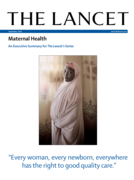
Each year, about 210 million women become pregnant and about 140 million newborn babies are delivered. The sheer scale of maternal health issues makes maternal well being and survival vital concerns
...
. A decade after The Lancet published a Series on maternal survival, a new Series of six papers brings our knowledge of maternal health, its epidemiology, successes, and current failings together, and at a crucial time within the sustainable development framework to 2030. The Series concludes with a call to action setting out five key targets which need to be met to ensure the progression of broader sustainable development goals (SDGs).
Open Access
more

ICF is WHO's framework for health and disability. It is the conceptual basis for the definition, measurement and policy formulations for health and disability. It is a universal classification
...
of disability and health for use in health and health related sectors. ICF therefore looks like a simple health classifiation, but it can be used for a number of purposes. The most important is as a planning and policy tool for decision-makers.
more
Climate change (CC) impacts on health outcomes, both direct and indirect, are sufficient to jeopardize achieving the World Bank Group’s visions and agendas in poverty reduction, population resilience, and
...
health, nutrition and population (HNP). In the last 5 years, the number of voices calling for stronger international action on climate change and health has increased, as have the scale and depth of activities. But current global efforts in climate and health are inadequately integrated. As a result, actions to address climate change, including World Bank Group (WBG) investment and lending, are missing opportunities to simultaneously promote better health outcomes and more resilient populations and health sectors. Accordingly, with the financial support of the Nordic Development Fund (NDF), the World Bank Group set out to develop an approach and a 4-year action plan, outlined in this paper, to integrate health-related climate considerations into selected WBG sector plans and investments.
more
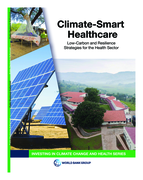
Climate change is damaging human health now and is projected to have a greater impact in the future. Low- and middle-income countries are seeing the worst effects as they are most vulnerable to climate shifts and least able to adapt given weak
...
health systems and poor infrastructure. Low-carbon approach can provide effective, cheaper care while at the same time being climate smart. Low-carbon healthcare can advance institutional strategies toward low-carbon development and health-strengthening imperatives and inspire other development institutions and investors working in this space. Low-carbon healthcare provides an approach for designing, building, operating, and investing in health systems and facilities that generate minimal amounts of greenhouse gases. It puts health systems on a climate-smart development path, aligning health development and delivery with global climate goals. This approach saves money by reducing energy and resource costs. It can improve the quality of care in a diversity of settings. By prompting ministries of health to tackle climate change mitigation and foster low-carbon healthcare, the development community can help governments strengthen local capacity and support better community health.
more
The environment in which young people live, learn and play significantly affects their decisions about whether to consume alcohol. Environmental factors are the main risk factors driving alcohol consumption and related harm among young people. Environments that normalize alcohol consumption – term
...
ed alcogenic environments – include contexts with unregulated advertising and marketing of alcoholic beverages, higher alcohol outlet density, products designed to facilitate affordability and low prices of alcoholic beverages. A recent body of research evidence has emerged related to the measurement, functional significance and consequences of living in alcogenic environments. This includes findings on the complex and bidirectional interactions among alcohol acceptability, availability and affordability and how they create and perpetuate alcogenic environments. Comprehensive and enforced alcohol control policies are effective at delaying the age of onset and lowering alcohol prevalence and frequency among young people. Evidence consistently confirms the effectiveness of designing and implementing alcohol control policies that regulate upstream the drivers of alcogenic environment, including alcohol availability, acceptability and affordability. These policies need to be multipronged and address the complex interactions between these drivers and the local alcohol culture
more
This publication makes the case for working with men and women, boys and girls, together in an intentional and mutually reinforcing way that challenges gender norms in the pursuit of improved health
...
and gender equality. In addition to providing a definition for the new concept of gender synchronization, this document provides examples of synchronized approaches that have worked first with women and girls, or first with men and boys, and describes interventions that have worked with both sexes from the start. It also provides examples of new and emerging programs that should be watched in the coming years for the knowledge they may contribute to the implementation of gender synchronization.
more

Over half a billion children are living in areas with extremely high levels of floods and nearly 160 million children live in areas of high or extremely high droughts. The World
...
Health Organisation (WHO) estimates that 26% of the annual 6.6 million deaths of children under five are linked to environment-related causes and conditions. Children are also disproportionately affected by pollution, not only in terms of death rates, but also in terms of cognitive and physical development. This report illustrates that environmental causes also have an impact on whether children are pushed to work and on the kind of work they engage in, the conditions of work, exposure to dangerous toxicants and the risk of exploitation. However, the report raises more questions than it answers as it is one of the first reports addressing the question, how environmental degradation and climate change affect the vulnerability of children towards exploitation.
more

The United Nations Children's Fund (UNICEF), the International Organization for Migration (IOM), Georgetown University, and the United Nations University have today launched new guidelines to provide the first-ever global policy framework that will help protect, include, and empower children on the
...
move in the context of climate change.
The Guiding Principles for Children on the Move in the Context of Climate Change provides a set of 9 principles that address the unique and layered vulnerabilities of children on the move both internally and across borders as a result of the adverse impacts of climate change. Currently, most child-related migration policies do not consider climate and environmental factors, while most climate change policies overlook the unique needs of children.
The guidelines note that climate change is intersecting with existing environmental, social, political, economic, and demographic conditions contributing to people’s decisions to move. In 2020 alone, nearly 10 million children were displaced in the aftermath of weather-related shocks. With around one billion children – nearly half of the world’s 2.2 billion children – living in 33 countries at high risk of the impacts of climate change, millions more children could be on the move in the coming years.
Developed in collaboration with young climate and migration activists, academics, experts, policymakers, practitioners, and UN agencies, the guiding principles are based on the globally ratified Convention on the Rights of the Child and are further informed by existing operational guidelines and frameworks.
Recommendations for safeguarding the rights and well-being of children regardless of their location or migration status.
The guiding principles provide national and local governments, international organizations and civil society groups with a foundation to build policies that protect children’s rights. The organizations and institutions are calling on governments, local and regional actors, international organizations, and civil society groups to embrace the guiding principles to help protect, include, and empower children on the move in the context of climate change.
more

The document, "Progress on the Prevention and Control of Non-Communicable Diseases," reports on global efforts to reduce the impact of NCDs, such as heart disease, cancer, diabetes, and chronic resp
...
iratory diseases, following the commitments made at high-level United Nations meetings. It highlights the inadequate progress in meeting the targets set under the Sustainable Development Goal 3.4 to reduce premature NCD mortality by one-third by 2030. Key challenges include insufficient funding, limited implementation of effective interventions, and political and economic barriers, especially in low-income countries. The report calls for strengthened international cooperation, policy reform, and innovative approaches to meet global health targets.
more
This monograph presents 12 reports of successful programs serving children with special needs in various nations. The program locations and the program report titles and authors are as follows: (1) Austria: "Integration Models for Elementary an
...
d Secondary Schools in Austria" (Volker Rutte); (2) China: "Integrated Education Project, Anhui Province" (Janet C. Holdsworth); (3) Ghana: "The Community-Based Rehabilitation Programme in Ghana" (Lawrence Ofori-Addo); (4) Guyana: "Involvement of Volunteers, Parents and Community Members with Children with Special Needs" (Brian O'Toole); (5) India: "Teacher Development Initiative To Meet Special Needs in the Classroom" (N. K. Jangira and Anupam Ahuja); (6) Jamaica: "Early Intervention and Education Initiatives in Rural Areas" (M. J. Thorburn); (7) Jordan: "The Role of Institutions in Community-based Rehabilitation and in Community-based Special Education" (Andrew L. de Carpentier); (8) Jordan: "The Resource Room at the Amman National School" (Hala T. Ibrahim); (9) Netherlands: "Individual Integration of Children with Down's Syndrome in Ordinary Schools" (Trijntje de Wit-Gosker); (10) Norway: "In Harmony We Learn" (Marna Moe); (11) International: "INITIATIVES for Deaf Education in the Third World" (Andrew L. de Carpentier); and (12) Sri Lanka: "The Integrated Education of Visually Impaired Children in Sri Lanka" (B. L. Rajapakse).
more

In 2019, the Task Force on Fiscal Policy for Health concluded that taxes on tobacco, alcohol, and sugar-sweetened beverages were a highly effective but greatly underused policy tool to reduce consumption, save lives, and raise domestic resources. Th
...
e Task Force estimated that if all countries increased their excise taxes to raise prices by 50 percent, over 50 million premature deaths could be averted worldwide over the next 50 years while
raising over USD 20 trillion of additional revenue. Since the Task Force first convened, the world has faced a “polycrisis,” including a global pandemic, an economic recession, and the outbreak of wars in Europe and the Middle East. Against this backdrop, the world has also experienced prolonged health and fiscal crises. Health systems, weakened by the COVID-19 pandemic, lack sufficient financing to rebuild and respond to the surging noncommunicable diseases epidemic caused by uncontrolled risk factors such as tobacco, alcohol, and sugar consumption. Opportunities to raise domestic resources are limited and debt burdens have squeezed budgets. The period from 2019 to 2027 risks becoming a “lost decade” for health and social policies, with 110 countries facing little prospect of any
ability to raise government revenues beyond current levels. In this paper, we describe the current health and fiscal crises and review the contribution that health taxes could make in turning around this dire situation. We conclude that taxes on tobacco, alcohol, and
sugar-sweetened beverages are an ideal policy solution—good for the budget and good for health. These taxes are relatively quick to implement, and, unlike other taxes, do not put economic growth at risk—a vital benefit in the current era.
more
The availability, prices and affordability of essential medicines in Malawi: A cross-sectional study
The Malawian government recently introduced cost-covering consultation fees for self-referral patients in tertiary public hospitals. Previously, patients received medicines free of charge in government-owned
...
health facilities, but must pay elsewhere. Before the government implements a payment policy in other areas of health care, it is important to investigate the prices, affordability and availability of essential medicines in Malawi.
more
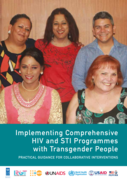
This publication offers practical advice on implementing HIV and STI programmes for transgender people, with a focus on transgender women, aligned with the 2011 Recommendations and the 2014 Key Populations Consolidated Guidelines. It contains examples of
...
good practice from around the world that may support efforts in planning programmes and services, and describes issues that should be considered and how to overcome challenges.
This tool describes how services can be designed and implemented to be acceptable and accessible to transgender women. To accomplish this, respectful and ongoing engagement with them is essential.
This tool gives particular attention to programmes run by transgender people themselves, in contexts where this is possible. more
This tool describes how services can be designed and implemented to be acceptable and accessible to transgender women. To accomplish this, respectful and ongoing engagement with them is essential.
This tool gives particular attention to programmes run by transgender people themselves, in contexts where this is possible. more
Crisis Emergency Risk Communication. Manual
recommended
The CERC manual provides an evidence-based framework and recommended practices for anyone who communicates on behalf of an organization responding to major emergencies such as natural disasters.
Cette ressource a été élaborée pour faciliter le développement de plans d’action nationaux stratégiques et bien coordonnés afin de contrer rapidement la désinformation sur les vaccins et d’encourager la demande de vaccination éclairée par l’écoute sociale.
Drug Facts - Methamphetamine
National Institute on Drug Abuse
(2018)
C2
Treating Opioid Addiction in Criminal Justice Settings
National Institute on Drug Abuse
(2017)
C2
Medication in Prison Associated with Reductions in Fatal Opioid Overdoses After Release
National Institute on Drug Abuse
(2018)
C2
Science Spotlight
February 14, 2018
