
Filter
1083
Text search:
enfermedades
transmisibles
Featured
61
91
Language
Document type
331
191
187
93
85
53
39
27
18
15
15
14
10
3
1
Countries
375
67
66
41
23
19
18
17
16
16
13
13
12
9
8
8
8
6
5
4
4
3
3
3
3
3
3
3
3
2
2
2
2
2
2
2
2
2
2
1
1
1
1
1
1
1
1
1
1
1
1
1
1
1
1
1
1
1
1
1
1
1
1
1
1
1
1
1
Authors & Publishers
Publication Years
Category
629
206
152
27
24
24
3
Toolboxes
550
79
46
44
42
23
20
12
10
10
10
10
8
6
6
5
5
5
4
3
3
2
1
In this document, recommendations are provided on designing and implementing
a cross-sectional serosurvey using school-based sampling to estimate age-specific
DENV seroprevalence to inform a country’s national dengue vaccination program.
The document includes recommendations for methods for
...
The objectives of pertussis surveillance are to:hmonitor disease burden and the impact of the pertussis vaccination programme, with a special focus on understanding the morbidity and mortality in children < 5 years of agehgenerate data to inform vaccine schedule and delivery strategy decisions to optimize the impact of
...
This updated step by step guide aims to assist the ministries of health (MoHs) in developing the national action plans for noma prevention and control, with a view to sustainably reducing the incidence of noma as a public health problem through programmes that are fully integrated with national heal
...
Este artículo analiza un grupo particularmente vulnerable a la pandemia de la COVID-2019: las personas privadas de libertad (PPLs). Con base en el análisis del Censo Carcelario de 2019, presentamos la situación actual de las PPLs y las condiciones de los establecimient
...
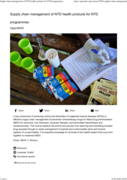
A key component of achieving control and elimination of neglected tropical diseases (NTDs) is effective supply chain management of preventive chemotherapy drugs for Mass Drug Administration (MDA) for trachoma, river blindness, lymphatic filariasis, soil-transmitted helminthiasis and schistosomiasis.
...
The Kigali Declaration on neglected tropical diseases (NTDs) is a high-level, political declaration which aims to mobilise political will and secure commitments to achieve the Sustainable Development Goal 3 (SDG3) target on NTDs and to deliver the targets set out in the World Health Organization’s
...
Contemporary data for causes of vision impairment and blindness form an important basis of recommendations in public health policies. Refreshment of the Global Vision Database with recently published data sources permitted modelling of cause of vision loss data from 1990 to 2015, further disaggregat
...
Chapter 6 contents
Malaria
Human African trypanosomiasis (sleeping sickness)
American trypanosomiasis (Chagas disease)
Leishmaniases
Intestinal protozoan infections (parasitic diarrhoea)
Flukes
Schistosomiases
Cestodes
Nematode infections
Filariasis
...

The sixteenth meeting of the Strategic and Technical Advisory Group for Neglected Tropical Diseases (STAG-NTD) was held as a hybrid meeting, 27–28 September 2022.
Dr Ren Minghui, Assistant Director-General, Universal Health Coverage/Communicable and Noncommunicable Diseases, welcomed participan
...

This guideline for the prevention and control of chikungunya fever
(CF) is intended for use by all peripheral health workers in the Region and
is based on the strategy outlined above. This document will focus mainly
on preventing, predicting and detecting outbreaks, and after detection,
investig
...
Progress towards achieving the Roadmap targets for control and elimination of the Neglected Tropical Diseases.
Through the USAID-funded Organized Network of Services for Everyone’s Health (ONSE) Activity, MSH is assisting Malawi’s National Malaria Control Program to provide high-quality malaria services at the facility and community levels in 10 districts, covering nearly a third of the country.
Our
...
Pathogen genomic surveillance has become a priority for public health systems in recent years. Genomic sequencing is increasingly being used to characterize pathogens and monitor important public health priorities (e.g. poliovirus, influenza virus, Mycobacterium tuberculosis and Vibrio cholerae, ant
...
Diphtherie gibt es auf der ganzen Welt. Früher starben bei Ausbrüchen dieser Infektionskrankheit viele Tausende Menschen, besonders Kinder. Weil die meisten Kinder in Europa geimpft sind, ist die Diphtherie hier seit den 1960er Jahren stark zurückgegangen. In Deutschland gab es lange Zeit nur noc
...

The key actions, activities, and approaches in this document are organized within each of the 5Cs (see Table 1 in the PDF) and those of the Strategic preparedness and response plan (SPRP) pillars as follows:
National action plan key activities, prioritized for the current context and the current
...

The Infection prevention and control in the context of coronavirus disease 2019 (COVID-19): a living guideline consolidates technical guidance developed and published during the COVID-19 pandemic into evidence-informed recommendations for infection prevention and control (IPC). This living guideline
...
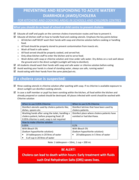
What you should do as head of school or child centre to prevent cholera:
Educate all staff and pupils on the common cholera transmission routes and how to prevent it.
Educate all kitchen staff on how to handle food and cooking utensils. Emphasis the key points below:
o All kitchen staff MUST wa
...
