Filter
1532
Text search:
Vector
Control
Featured
148
420
Language
Document type
601
345
237
120
111
35
34
14
12
10
3
3
3
3
1
Countries
117
57
53
31
30
27
25
21
20
19
18
18
18
18
17
15
15
15
15
15
14
14
14
13
12
11
10
10
10
10
9
9
9
9
8
8
8
7
6
6
6
6
6
5
5
5
5
5
5
5
4
4
4
4
4
4
3
3
3
3
3
3
3
3
3
3
3
3
3
3
3
3
2
2
2
2
2
2
2
2
2
2
2
2
2
2
2
2
1
1
1
1
1
1
1
1
1
1
1
1
1
1
1
1
1
1
1
1
1
1
1
1
1
1
1
1
1
1
Authors & Publishers
Publication Years
Category
521
132
105
101
23
22
22
Toolboxes
241
178
132
116
100
56
46
42
37
28
20
18
16
15
13
10
10
10
8
8
6
3
3
2
1
In areas of Mexico, Central America, and South America, where the Trypanosoma cruzi parasite is present in triatomine bugs, improved housing and spraying insecticide inside housing to eliminate the bugs has significantly decreased the spread of Chagas disease. Screening of blood donations for Chagas
...
El presente documento reúne un conjunto de recomendaciones formuladas por la Organización Mundial de la Salud (OMS) y la Organización Panamericana de la Salud (OPS) para ayudar, a los profesionales encargados de los programas de control de vector
...

The Declaration by African Youth to End Malaria in Africa by 2030 is a commitment from young people across Africa to eradicate malaria by the year 2030. In this document, they outline specific strategies and actions they pledge to undertake, emphasizing the importance of youth involvement in mala
...

The Malaria Ministerial Conference, co-hosted by WHO and the Government of Cameroon on 6 March 2024, brought together more than 400 stakeholders, including Ministers of Health and senior representatives from the African countries hardest hit by malaria, global health leaders, scientists, civil socie
...

The National Malaria Elimination Strategic Plan (NMESP) 2024–2028 of Ghana outlines the country’s roadmap to shift from malaria control to elimination. Despite major progress—like reducing malaria deaths from nearly 2,800 in 2012 to 151 in 202
...
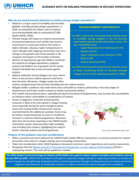
This UNHCR guidance note provides comprehensive recommendations for the prevention and control of malaria in refugee settings worldwide. Aligned with the WHO Global Technical Strategy for Malaria, it outlines strategies to ensure access to effective
...
The webpage describes how the Preparedness and Resilience for Emerging Threats (PRET) initiative is being implemented in the Americas to strengthen pandemic preparedness and response. It explains that PRET promotes a unified approach by grouping diseases according to how they spread (such as respira
...

Available in English, French an Spanish. The Malaria Threats Map is an interactive data platform which provides a geographic overview of the status of the 4 biological threats to malaria control and elimination
The WHO webpage describes the Preparedness and Resilience for Emerging Threats (PRET) initiative, which is a global approach to improve how countries prepare for and respond to future pandemics. Instead of focusing on individual diseases, PRET emphasizes a broader strategy that groups pathogens by h
...

The “Declaration for Accelerated Malaria Mortality Reduction in Africa” is a statement signed by African health ministers reaffirming their commitment to reducing malaria-related mortality. It pledges strengthened leadership, increased domestic financing for malaria
...
Planning for public health emergencies should ensure that capabilities developed during previous emergencies are maintained, incorporated, and put into practice when a new event of public health concern arises. Investments in pandemic preparedness lead to more rapid detection and a stronger response
...

communicable Disease Toolkit
2nd edition. WHO's recommendation has not changed: the standard WHO susceptibility tests should remain a primary method by which resistance is detected. However, it was considered necessary to update the existing resistance-monitoring procedures to also highlight the need for operationally meaningfu
...
As of October 2017, the global database comprised almost 30 000 records, including results from bioassays to measure phenotypic resistance, and biochemical and molecular tests for resistance mechanisms. The current report presents an overview of data on malaria
...
Dengue is a mosquito-borne viral disease that occurs mainly in the tropics and subtropics but has a high potential to spread to new areas. Dengue infections are climate sensitive, so it is important to better understand how changing climate factors affect the potential for geographic spread and futu
...
Leishmaniasis is a vector-borne disease with a wide variety of parasite species, reservoirs, and vectors involved in transmission. It is caused by different species of the protozoa Leishmania and is transmitted to animals and humans through a bite o
...
This guideline for the prevention and control of chikungunya fever
(CF) is intended for use by all peripheral health workers in the Region and
is based on the strategy outlined above. This document will focus mainly
on preventing, predicting and
...
2nd edition. Training module on malaria control