
Filter
2376
Text search:
National
Tuberculosis
Control
Programme
Featured
275
725
Language
2222
95
53
43
16
13
9
5
4
2
2
1
1
1
1
1
1
1
1
1
1
1
1
1
1
1
1
1
1
Document type
1372
408
305
125
104
24
16
11
5
2
1
1
Countries
170
98
76
73
67
60
57
54
53
48
48
46
45
42
39
37
36
36
35
28
24
21
19
19
18
17
17
15
14
13
12
12
10
10
9
9
9
8
8
8
7
7
7
7
6
6
6
5
5
5
5
4
4
4
4
4
4
4
4
4
4
3
3
3
3
3
3
3
2
2
2
2
2
2
2
2
2
2
2
2
1
1
1
1
1
1
1
1
1
1
1
1
1
1
1
1
1
1
1
1
1
1
1
1
1
1
1
1
1
1
1
1
1
1
1
Authors & Publishers
378
147
67
64
62
58
39
38
31
24
24
24
20
19
17
17
16
14
14
14
13
12
12
12
12
12
11
11
10
10
10
9
9
9
9
9
8
8
8
8
7
7
7
7
7
7
7
7
6
6
6
6
6
6
6
6
6
6
6
6
6
5
5
5
5
5
5
5
5
5
5
5
5
5
5
5
5
4
4
4
4
4
4
4
4
4
4
4
4
4
4
4
4
4
4
4
4
4
4
4
4
4
4
4
4
4
4
4
3
3
3
3
3
3
3
3
3
3
3
3
3
3
3
3
3
3
3
3
3
3
3
3
3
3
3
3
3
3
3
3
3
3
3
3
3
3
3
3
3
3
3
2
2
2
2
2
2
2
2
2
2
2
2
2
2
2
2
2
2
2
2
2
2
2
2
2
2
2
2
2
2
2
2
2
2
2
2
2
2
2
2
2
2
2
2
2
2
2
2
2
2
2
2
2
2
2
2
2
2
2
2
2
2
2
2
2
2
2
2
2
2
2
2
2
2
2
2
2
2
2
2
2
2
2
2
2
2
2
2
2
2
2
2
2
2
2
2
2
2
2
2
2
2
2
2
2
2
2
2
2
2
2
2
2
2
2
2
2
2
2
2
2
2
2
2
2
2
2
2
2
2
2
1
1
1
1
1
1
1
1
1
1
1
1
1
1
1
1
1
1
1
1
1
1
1
1
1
1
1
1
1
1
1
1
1
1
1
1
1
1
1
1
1
1
1
1
1
1
1
1
1
1
1
1
1
1
1
1
1
1
1
1
1
1
1
1
1
1
1
1
1
1
1
1
1
1
1
1
1
1
1
1
1
1
1
1
1
1
1
1
1
1
1
1
1
1
1
1
1
1
1
1
1
1
1
1
1
1
1
1
1
1
1
1
1
1
1
1
1
1
1
1
1
1
1
1
1
1
1
1
1
1
1
1
1
1
1
1
1
1
1
1
1
1
1
1
1
1
1
1
1
1
1
1
1
1
1
1
1
1
1
1
1
1
1
1
1
1
1
1
1
1
1
1
1
1
1
1
1
1
1
1
1
1
1
1
1
1
1
1
1
1
1
1
1
1
1
1
1
1
1
1
1
1
1
1
1
1
1
1
1
1
1
1
1
1
1
1
1
1
1
1
1
1
1
1
1
1
1
1
1
1
1
1
1
1
1
1
1
1
1
1
1
1
1
1
1
1
1
1
1
1
1
1
1
1
1
1
1
1
1
1
1
1
1
1
1
1
1
1
1
1
1
1
1
1
1
1
1
1
1
1
1
1
1
1
1
1
1
1
1
1
1
1
1
1
1
1
1
1
1
1
1
1
1
1
1
1
1
1
1
1
1
1
1
1
1
1
1
1
1
1
1
1
1
1
1
1
1
1
1
1
1
1
1
1
1
1
1
1
1
1
1
1
1
1
1
1
1
1
1
1
1
1
1
1
1
1
1
1
1
1
1
1
1
1
1
1
1
1
1
1
1
1
1
1
1
1
1
1
1
1
1
1
1
1
1
1
1
1
1
1
1
1
1
1
1
1
1
1
1
1
1
1
1
1
1
1
1
1
1
1
1
1
1
1
1
1
1
1
1
1
1
1
1
1
1
1
1
1
1
1
1
1
1
1
1
1
1
1
1
1
1
1
1
1
1
1
1
1
1
1
1
1
1
1
1
1
1
1
1
1
1
1
1
1
1
1
1
1
1
1
1
1
1
1
1
1
1
1
1
1
1
1
1
1
1
1
1
1
1
1
1
1
1
1
1
1
1
1
1
1
1
1
1
1
1
1
1
1
1
1
1
1
1
1
1
1
1
1
1
1
1
1
1
1
1
1
1
1
1
1
1
1
1
1
1
1
1
1
1
1
1
1
1
1
1
1
1
1
1
1
1
1
1
1
1
1
1
1
1
1
1
1
1
1
1
1
1
1
1
1
1
1
1
1
1
1
1
1
1
1
1
1
1
1
1
1
1
1
1
1
1
1
1
1
1
1
1
1
1
1
1
1
1
1
1
1
1
1
1
1
1
1
1
1
1
1
1
1
1
1
1
1
1
1
1
1
1
1
1
1
1
1
1
1
1
1
1
1
1
1
1
1
1
1
1
1
1
1
1
1
1
1
1
1
1
1
1
1
1
1
1
1
1
1
1
1
1
1
1
1
1
1
1
1
1
1
1
1
1
1
1
1
1
1
1
1
1
1
1
1
1
1
1
1
1
1
1
1
1
1
1
1
1
1
1
1
1
1
1
1
1
1
1
1
1
1
1
1
1
1
1
1
1
1
1
1
1
1
1
1
1
1
1
1
1
1
1
1
1
1
1
1
1
1
1
1
1
1
1
1
1
1
1
1
1
1
1
1
1
1
1
1
1
1
1
1
1
1
1
1
1
1
1
1
1
1
1
1
1
1
1
1
1
1
1
1
1
1
1
1
1
1
1
1
1
1
1
1
1
1
1
1
1
1
1
1
1
1
1
1
1
1
1
1
1
1
1
1
1
1
1
1
1
1
1
1
1
1
1
1
1
1
1
1
1
1
1
1
1
1
1
1
1
1
1
1
1
1
1
1
1
1
1
1
1
1
1
1
1
1
1
1
1
1
1
1
1
1
1
1
1
1
1
1
1
1
1
1
1
1
1
1
1
1
1
1
1
1
1
1
1
1
1
1
1
1
1
1
1
1
1
1
1
1
1
1
1
1
1
1
1
1
1
1
1
1
1
1
1
1
1
1
1
1
1
1
1
1
1
1
1
1
1
1
1
1
1
1
1
1
1
1
1
1
1
1
1
1
1
1
1
1
1
1
1
1
1
1
1
1
1
1
1
1
1
1
1
1
1
1
1
1
1
1
1
1
1
1
1
1
1
1
1
1
1
1
1
1
1
1
1
1
1
1
1
1
1
1
1
1
1
1
1
1
1
1
1
1
1
1
1
1
1
1
1
1
1
1
1
1
1
1
1
1
1
1
1
1
1
1
1
1
1
1
1
1
1
1
1
1
1
1
1
1
1
1
1
1
1
1
1
1
1
1
1
1
1
1
1
1
1
1
1
1
1
1
1
1
1
1
1
1
1
1
1
1
1
1
1
1
1
1
1
1
1
1
1
1
1
1
1
1
1
1
1
1
1
1
1
1
1
1
1
1
1
1
1
1
1
1
1
1
1
1
1
1
1
1
1
1
1
1
1
1
1
1
1
1
1
1
1
1
1
1
1
1
1
1
1
1
1
1
1
1
1
1
1
1
1
1
1
1
1
1
1
1
1
1
1
1
1
1
1
1
1
1
1
1
1
1
1
1
1
1
1
1
1
1
1
1
1
1
1
1
1
1
1
1
1
1
1
1
1
1
1
1
1
1
1
1
1
1
1
1
1
1
1
1
1
1
1
1
1
1
1
1
1
1
1
1
1
1
1
1
1
1
1
1
1
1
1
1
1
1
1
1
1
1
1
1
1
1
1
1
1
1
1
1
1
1
1
1
1
1
1
1
1
1
1
1
1
1
1
1
1
1
1
1
1
1
1
1
1
1
1
1
1
1
1
1
1
1
1
1
1
1
1
1
1
1
1
1
1
1
1
1
1
1
1
1
1
1
1
1
1
1
1
1
1
1
1
1
1
1
1
1
1
1
1
1
1
1
1
1
1
1
1
1
1
1
1
1
1
1
1
1
1
1
1
1
1
1
1
1
1
1
1
1
1
1
1
1
1
1
1
1
1
1
1
1
1
1
1
1
1
1
1
1
1
1
1
1
1
1
1
1
1
1
1
1
1
1
1
1
1
1
1
1
1
1
1
1
1
1
1
1
1
1
1
1
1
1
1
1
1
1
1
1
1
1
1
1
1
1
1
1
1
1
1
1
1
1
1
1
1
1
1
1
1
1
1
1
1
1
1
1
1
1
1
1
1
1
1
1
1
1
1
1
1
1
1
1
1
1
1
1
1
1
1
1
1
1
1
1
1
1
1
1
1
1
1
1
1
1
1
1
1
1
1
1
1
1
1
1
1
1
1
1
1
1
1
1
1
1
1
1
1
1
1
1
1
1
1
1
1
1
1
1
1
1
1
1
1
1
1
1
1
1
1
1
1
1
1
1
1
1
1
1
1
1
1
1
1
1
1
1
1
1
1
1
1
1
1
1
1
1
1
1
1
1
1
1
1
1
1
1
1
1
1
1
1
1
1
1
1
1
1
1
1
1
1
1
1
1
1
1
1
1
1
1
1
1
1
1
1
1
1
1
1
1
1
Publication Years
633
1492
238
13
Category
1082
180
148
94
82
39
26
Toolboxes
425
155
104
97
71
61
52
52
51
46
43
43
37
35
31
31
28
26
19
16
15
3
2
2
1
1
Whole-genome sequencing (WGS) provides a vast amount of information and the highest possible resolution for pathogen subtyping. The application of WGS for global surveillance can provide information on the early emergence and spread of AMR and further inform timely policy development on AMR
...
control. Sequencing data emanating from AMR surveillance may provide key information to guide the development of rapid diagnostic tools for better and more rapid characterization of AMR, and thus complement phenotypic methods. This document addresses the applications of WGS for AMR surveillance, including the benefits and limitations of current WGS technologies
more
This guide is available in English, French, Spanish, Russian, Arabic and Chinese
This guide consolidates COVID-19 guidance for human resources for health managers and policy-makers at national, subnational and facility levels to design, manage and
...
preserve the workforce necessary to manage the COVID-19 pandemic and maintain essential health services.
The guide identifies recommendations to protect, support and empower health workers at individual, management, organizational and system levels.
more
Refugee protection in the country is provided within the framework of these international and national refugee laws as well as the core international human rights treaties that have been ratified by the country. Continued insecurity within neighbour
...
ing states has resulted in sustained refugee movements, either directly as a result of internal conflict and human rights abuses or as a result of conflict related to competition for scare natural resources and drought related food insecurity.
more
Food and nutrition security in the Democratic Republic of the Congo is subject to the relentless impact of conflict, epidemics and climate events that have persisted in the country for decades, further compounded by the global COVID-19 pandemic. Lack of infrastructure and investment in agriculture,
...
health and human capital development combine to impede progress towards the achievement of Sustainable Development Goals 2 and 17. While there are several legal instruments and policies that promote food and nutrition security, poor coordination, weak national capacity and exponential population growth present serious obstacles to the achievement of zero hunger. Political instability and siloed sectoral responses to humanitarian and development needs have also affected results to date.
more

UNHCR’s Public Health Strategy 2021-2025 is based on the lessons learnt, and builds on the achievements, of the Global Strategy for Public Health 2014-2018.
Progress was made on policies favouring inclusion and integration into national systems3
...
with 92% of 48 operations surveyed reporting refugees having access to national primary health care facilities under the same conditions as nationals and 96% reporting refugees having access to all relevant vaccines under the same conditions as nationals. While many refugee hosting countries have policies that allow refugees to access national health services, many face partial access, prohibitive out-of-pocket expenditures and other barriers including distance to facilities, language and provider acceptance. Furthermore, more work is needed on strengthening these systems to be able to meet the needs of both host communities and refugees.
more

The 2021 COVID-19 Strategic Preparedness and Response Plan (SPRP) for AFR serves as a regional guide for a holistic public health response to COVID‑19 at regional, national and sub-national levels
...
. The 2021
SPRP:
1. Builds upon the lessons learnt from the implementation of the 2020 SPRP and outlines a regional preparedness, response and recovery strategy for COVID‑19.
2. Has been adapted to reflect the Regional context including COVID-19 vaccination. It also considers epidemiological changes and recommen-dations emerging from the evaluation report of the 2020 SPRP4.
3. Highlights to Member States strategic preparedness and response actions to be sustained at national and sub-national levels, as well as the critical inter-agency and partner support required.
4. provides the indicative resource requirements to reinforce WHO planned interventions in the African Region to enhance countries’ capacities to suppress transmission, save lives and mitigate the impact of the pandemic on people and health systems.
5. Provides a road map for mitigating potential resurgence in the Region as economies reopen and ensure country level continuity of other essential health services.
more

During the year 2022, COVID-19 continued to be a significant challenge in Eritrea as in many other countries across the world. As COVID-19 devastated communities around the world, WHO worked with the MoH to strengthen the National and Sub-
...
National health systems in order to meet community needs and mitigate the devastation during the pandemic and beyond.
One of the major achievements in the year 2022 was the beginning of the journey towards validation of
the elimination of mother to child transmission of HIV, syphilis, and hepatitis B. This is the culmination of years
of commitment and determination by the political leadership, national and international partnerships to
reduce the associated indices to levels that qualify for elimination.
more

In the last decade, Timor-Leste has made remarkable progress in strengthening its health system and improving the health status of its population. This has resulted in an increased life expectancy, and the achievement of Millennium Development Goals such as a reduction in infant and under-five morta
...
lity, an improvement in maternal and child health outcomes, and an increase in immunization coverage. Further, the country has successfully eliminated infectious diseases such as polio, measles, and maternal and neonatal tetanus. There is full political commitment to reducing the incidence of tuberculosis (TB) by 80% and the number of deaths due to TB by 90% by 2030. The country has made great progress in the context of the pandemic, having established numerous quarantine facilities/isolation centres; trained health-care workers; streamlined the procurement and supply of medicines, consumables, personal protective equipment and other equipment; and strengthened the capacity in critical care across secondary and tertiary health care, to better respond to future pandemics and other disaster situations.
more
Donor government disbursements to combat HIV in low- and middle-income countries totaled US$8 billion in 2018, little changed from the US$8.1 billion total in 2017 and from the levels of a decade ago, finds a new report from the Kaiser Family Foundation (KFF) and the Joint United Nations
...
Programme on HIV/AIDS (UNAIDS)
more
Diabetes mellitus, commonly known as diabetes, is a group of metabolic disorders characterized by the presence of hyperglycaemia in the absence of treatment. The heterogeneous aetiopathology includes defects in insulin secretion, insulin action, or both. The long-term specific complications of diabe
...
tes include retinopathy, nephropathy, and neuropathy. People with diabetes are also at increased risk of other diseases, including cardiac, peripheral arterial and cerebrovascular disease, cataracts, erectile dysfunction, and nonalcoholic fatty liver disease. They are also at an increased risk of some infectious diseases such as tuberculosis, and are likely to experience poorer outcomes.
more

In Sierra Leone, Health care delivery is organized around a three-tier system i) primary level constituting peripheral health units (community health centers, community health posts, and maternal and child health posts secondary level constituting district hospitals tertiary level comprising region
...
al and national referral hospitals [Figure 3].
more

Operational Guidance. This operational guidance provides a structured approach to support countries in sustaining priority services for HIV, viral hepatitis and sexually transmitted infections in the context of reduced external funding. The guidance is intended for
...
national governments, public health programmes, community-led organizations, civil society, technical partners and donors working to safeguard priority services, support phased adaptation, protect health outcomes and preserve hard-won gains.
more

Sustaining HIV Community-led Responses: Technical guidelines for costing and budgeting
UNAIDS
(2026)
Community-led responses (CLRs) are a vital pillar of the HIV response and central to achieving national and global targets, including the 30-80-60 commitments outlined in the 2021 Political Declaration on HIV and AIDS. These guidelines provide pract
...
ical, step-by-step methods for costing and budgeting community-led responses (CLRs), tailored to the unique features of CLRs. They are designed for use by community-led organizations (CLOs), their partners, national governments, policy-makers, donors, and researchers involved in planning, implementing, financing or evaluating CLRs that address HIV.
more
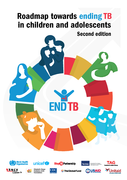
2nd edition. The 2018 Roadmap incorporates an additional critical population: adolescents. Despite making up 1 in 6 of the world’s people, adolescents have been largely overlooked as global momentum to address TB has grown. Spanning the ages of 10–19 years, adolescents are both at risk of TB and
...
represent an important population for TB control. They often present with infectious TB and frequently have multiple contacts in congregate settings, such as schools and other educational institutions. Nevertheless, few countries capture TB data in suitably age-disaggregated ways to allow full understanding of its impact in this group and even fewer provide the adolescent-friendly services our young people need to access diagnosis and care.
more
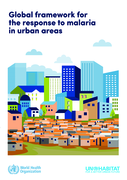
Cities are uniquely positioned to understand local needs and respond rapidly to changing conditions to safeguard health. These changes require strong city leadership to implement multisectoral, health-relevant policies and public services that engage communities. The response to malaria must be an i
...
ntegral part of such policies and processes.
This framework supports the control and elimination of malaria in urban environments. It provides guidance for city leaders, health programmes and urban planners as they respond to the challenges of rapid urbanization in a targeted way. For each urban context, the strategic use of data can inform effective, tailored responses and help build resilience against the threat of malaria and other vector-borne diseases.
more
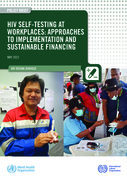
Countries are making progress toward the global goal of 95% of people living with HIV knowing their status by 2025. However, considerable gaps remain in achieving these goals globally. Men in high HIV burden settings and men from key populations in all settings are consistently less likely to know t
...
heir HIV status than women. Globally, 78% of men ages 15 years and older who are living with HIV are aware of their HIV status, compared with 86% of women with HIV of these ages.
Offering HIV testing services, including HIV self-testing, at formal and informal workplaces has emerged as an effective, acceptable and feasible approach for reaching men. A 2018 World Health Organization (WHO) and International Labour Organization (ILO) policy brief provides key guiding principles for HIVST implementation at workplaces. Building on the 2018 policy brief, this brief captures early experience with HIVST implementation at workplaces and discusses emerging approaches of sustainable financing that can be adapted for HIV self-testing at workplaces.
The primary audiences for this policy brief are ministries of health and labour, national HIV programmes, employers’ organizations, workers’ organizations (labour unions), enterprises, implementing partners, including civil society organizations, and health insurance agencies.
more

The 2024 edition reviews more than 50 health-related indicators from the Sustainable Development Goals and WHO’s Thirteenth General Programme of Work. It also highlights the findings from the Global health estimates 2021, notably the impact of the
...
COVID-19 pandemic on life expectancy and healthy life expectancy.
more
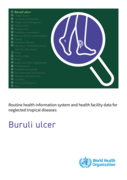
Buruli ulcer (BU) is a skin-related neglected tropical disease (skin NTD) caused by infection with
Mycobacterium ulcerans. BU is the third most common mycobacterial disease after tuberculosis and leprosy
in people who are not immunocompromised. Th
...
e infection manifests in non-ulcerative forms as nodules,
plaques and/or oedemas, which ulcerate within 4–6 weeks and display characteristic undermined edges and yellowish-white necrotic slough . Most lesions occur on the lower limbs.
more
This Clinic Supervisor’s Manual is helpful for focusing managers on the key elements of integrated primary health care as they simultaneously integrate new interventions for HIV/AIDS, tuberculosis, and malaria. This tool contains 12 sections. Sect
...
ion 1 explains how to use the manual. Section 2 helps the clinic supervisors organize their supervisory visit. The remainder of the sections focus on a number of key areas during a clinic supervision visit.
more
Implementation Research in Health – A Practical Guide
David H. Peters, Nhan T. Tran, Taghreed Adam
Alliance for Health Policy and Systems Research (AHPSR) and World Health Organization
(2013)
This guide is an attempt to redress the deficit in understanding of implementation research and to encourage programme personnel and implementers to take a greater interest in the subject, recognizing that implementation research is in fact an integ
...
ral part of programme planning and execution, rather than something that happens once programmes are up and running. Intended for newcomers to the field, those already conducting implementation research, and those with responsibility for implementing programmes, the guide provides an introduction to basic implementation research concepts and language, briefly outlines what it involves, and describes the many exciting opportunities that it presents
more
