
Filter
1340
Text search:
Government
of
Tanzania
Featured
Recommendations
99
New Publications
334
Language
Document type
No document type
772
Studies & Reports
327
Guidelines
101
Strategic & Response Plan
54
Manuals
47
Fact sheets
17
Training Material
10
Situation Updates
9
Infographics
3
Countries / Regions
Tanzania
146
Global
84
Kenya
76
Africa
66
Uganda
55
Zambia
41
Ethiopia
40
Malawi
40
Rwanda
37
South Africa
25
Nigeria
23
Congo, Democratic Republic of
23
East and Southern Africa
22
Liberia
19
Zimbabwe
15
Nepal
15
Sierra Leone
14
South Sudan
14
Mozambique
14
Ghana
13
Namibia
13
India
11
Bangladesh
11
West and Central Africa
10
Cameroon
9
Burkina Faso
8
Indonesia
8
Botswana
8
Madagascar
8
Lesotho
8
Myanmar / Burma
8
Senegal
7
Eswatini/ Swaziland
7
Guinea
6
Haiti
6
Syria
6
Burundi
6
Yemen
6
Middle East and North Africa
5
South–East Asia Region
5
Somalia
4
Pakistan
4
Afghanistan
4
Lebanon
4
China
4
Sudan
4
Central African Republic
4
Southern Africa
4
Mali
3
Philippines
3
Chad
3
Cambodia
3
Angola
3
Latin America and the Carribbean
3
Western and Central Europe
3
Asia
3
Russia
3
Vietnam
3
Côte d’Ivoire / Ivory Coast
2
Germany
2
Benin
2
Palestine
2
Niger
1
Togo
1
Iraq
1
Jordan
1
Thailand
1
Malaysia
1
Papua New Guinea
1
Vanuatu
1
Brazil
1
Colombia
1
Ecuador
1
Mexico
1
Sri Lanka
1
Eastern Europe and Central Asia
1
Solomon Islands
1
Venezuela
1
North Korea
1
Djibouti
1
Laos
1
Congo-Brazzaville
1
Iran
1
North America
1
Gabon
1
Japan
1
Mauritius
1
Authors & Publishers
Publication Years
Category
Countries
532
Women & Child Health
98
Public Health
85
Key Resources
69
Clinical Guidelines
66
Capacity Building
21
Pharmacy & Technologies
9
Annual Report MEDBOX
1
Toolboxes
HIV
149
Disability
82
TB
69
COVID-19
57
Planetary Health
56
Mental Health
54
NTDs
53
Caregiver
40
AMR
38
Global Health Education
32
Health Financing Toolbox
32
Refugee
30
Pharmacy
21
Ebola & Marburg
19
Rapid Response
19
Malaria
18
Conflict
15
NCDs
15
2.0 Rapid Response
14
Natural Hazards
13
Zika
8
Cholera
5
Social Ethics
5
Polio
3
Specific Hazards
3
South Sudan
1
Typhoon
1
WHO published the first COVID-19 Strategic Response and Preparedness Plan (SPRP) on 3 February, 2020. This report highlights the main points of progress that were made up to 30 June 2020 under the three objectives outlined in the SPRP: scaling up in
...
Human African trypanosomiasis (HAT) has been an alarming global public health issue. The disease affects mainly poor and marginalized people in low-resource settings and is caused by two subspecies of haemoflagellate parasite, Trypanosoma brucei and
...

Internationally, there is a growing concern over antimicro-bial resistance (AMR) which is currently estimated to ac-count for more than 700,000 deaths per year worldwide. If no appropriate measures are taken to halt its pro-gress, AMR will cost approximately 10 million lives andabout US$100 trillion
...
The 2019-2023 Strategy for UNU-IIGH, developed in
2018, built on UNU-IIGH’s strategic advantage and
position vis-à-vis the UN and global health ecosystem.
The Strategy set a goal to advance evidencebased policy on key issues related to sustainable
development and health and shifted the Instit
...

WASH and Health working together: a ‘how-to’ guide for neglected tropical disease programmes
recommended
2nd edition. This toolkit provides step-by-step guidance to NTD programme managers and partners on how to engage and work collaboratively with the WASH community to improve delivery of water, sanitation and hygiene services to underserved population
...

These guidelines group all recommendations on TB care and support in one document and are complemented by an operational handbook. The guidelines are to be used primarily by national TB programmes, or their equivalents in Ministries of Health,
...
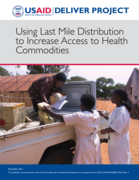
Last Mile delivery presents a unique challenge in making health commodities available in the developing world. This guide, designed for in-country practitioners and decisionmakers, uses a range of real world examples to support selection and design
...
This report presents, for the first time, a global assessment of the extent to which health care facilities provide essential water, sanitation and hygiene (WASH) services. Drawing on data from 54 low- and middle-income countries, the report conclud
...
In 2005, the World Health Organization (WHO) Member States adopted the revised International
Health Regulations (IHR) (2005). The Regulations provide a unique public health framework in the
form of obligations and reco
...
This guide is an introduction on how to integrate logistics management information systems (LMIS) with geographic information systems (GIS). It covers the value of integrating these two systems, the steps in assessing if it is currently viable to li
...
This guideline provides health policy-makers and decision-makers in health professional training institutions with advice on the rationale for health-care providers’ use of counselling skills to address sexual health concerns in a primary health c
...
This study was designed to examine the knowledge, attitude and beliefs about causes, manifestations and treatment of mental illness among adults in a rural community in
northern Nigeria.

Lessons learned from recent public health events such as the COVID-19 pandemic, Ebola virus disease, Zika virus disease outbreaks, and other public health threats, including earthquakes and floods, have highlighted the need for countries to continuously develop, strengthen, and maintain capacities r
...

Cities are uniquely positioned to understand local needs and respond rapidly to changing conditions to safeguard health. These changes require strong city leadership to implement multisectoral, health-relevant policies and public services that engage communities. The response to malaria must be an i
...

Nearly 800 women die every day from preventable maternal causes, and in 2022 alone, an estimated 2.3 million newborns died. For every maternal death, countless more women endure life-altering injuries, infections, and disabilities related to childbirth.
Maternal deaths are concentrated in the poo
...
Globally, in low-income countries, the average newborn mortality rate is 27 deaths per 1,000 births, the report says. In high-income countries, that rate is 3 deaths per 1,000. Newborns from the riskiest places to give birth are up to 50 times more likely to die than those from the safest places.
...
...

Front. Med., 27 November 2020 | https://doi.org/10.3389/fmed.2020.594728. The Checklist included eight actions for implementing rural pathways in LMICs: establishing community needs; policies and partners; exploring existing workers and scope; selecting health workers; education and training; workin
...
Cogent Medicine, 7:1, 1794272,
PUBLIC HEALTH & PRIMARY CARE | RESEARCH ARTICLE
Edutainment and infographics for
schistosomiasis health education in Ndumo area,
Kwazulu-Natal, South Africa
Tafadzwa Mindu1*, Muhubiri Kabuyaya1 and Moses J. Chimbari1
Educational interventions targeting communiti
...
The COVID-19 pandemic has created challenges for forcibly displaced persons and the humanitarian organizations working to support them. With restrictions on movement and limited access to refugees, asylum-seekers, internally displaced persons (IDPs) and stateless persons across the globe, UNHCR is s
...

Antimicrobials are medicines, including antibiotics, antivirals, antifungals, and antiparasitics, that are used to prevent and treat infections in humans, animals, and plants. Antimicrobial Resistance (AMR) arises when bacteria, viruses, fungi, and parasites no longer respond to these medicines, ren
...
