Filter
419
Text search:
skills
retention
Featured
Recommendations
31
New Publications
121
Language
Document type
No document type
261
Studies & Reports
60
Guidelines
34
Manuals
25
Strategic & Response Plan
24
Training Material
7
Fact sheets
5
Situation Updates
3
Countries / Regions
Kenya
23
South Africa
17
Uganda
16
India
15
Rwanda
13
Nepal
11
Malawi
11
Global
11
Ethiopia
9
Zambia
9
Nigeria
8
Sierra Leone
7
Ghana
7
Namibia
7
Liberia
6
South Sudan
6
Syria
6
Myanmar / Burma
6
Zimbabwe
5
Tanzania
4
Bangladesh
4
East and Southern Africa
4
Africa
4
Senegal
3
Eswatini/ Swaziland
3
Ukraine
3
Latin America and the Carribbean
3
Somalia
2
Pakistan
2
Indonesia
2
Botswana
2
Lesotho
2
West and Central Africa
2
Middle East and North Africa
2
South–East Asia Region
2
Western and Central Europe
2
Asia
2
Guinea
1
Congo, Democratic Republic of
1
USA
1
Cameroon
1
Afghanistan
1
Germany
1
Cambodia
1
Thailand
1
China
1
Singapore
1
Mozambique
1
Papua New Guinea
1
Brazil
1
North Macedonia
1
Serbia
1
Croatia
1
Sri Lanka
1
Yemen
1
Bhutan
1
Southern Africa
1
Timor Leste/ East Timor
1
Russia
1
Estonia
1
Iran
1
Kyrgyzstan
1
Georgia
1
Vietnam
1
Turkmenistan
1
Japan
1
United Kingdom
1
Portugal
1
Spain
1
Azerbaijan
1
Bosnia and Herzegovina
1
Authors & Publishers
Publication Years
Category
Countries
187
Women & Child Health
28
Public Health
26
Clinical Guidelines
24
Key Resources
22
Capacity Building
13
Pharmacy & Technologies
3
Toolboxes
HIV
61
Mental Health
30
Caregiver
28
Disability
23
Conflict
13
COVID-19
13
TB
9
Planetary Health
6
NCDs
6
Natural Hazards
4
Global Health Education
3
Cholera
2
Refugee
2
NTDs
2
Polio
1
Rapid Response
1
Specific Hazards
1
AMR
1
Social Ethics
1
Pharmacy
1
Malaria
1
2.0 Rapid Response
1
The Border Consortium (TBC) developed a comprehensive Training of Trainers Nutrition Curriculum which includes 12 Modules (6 Basic and 6 Advanced topics). The Manual provides trainers with standardized methods and content to deliver nutrition training.
Original file: 25 MB
Background paper for the Oslo Summit on Education for Development.
This paper covers the four topics of the Oslo Summit: investment in education, quality of learning, education in emergencies and girls’ education. Disability continues to be one of the primary causes of educational disadvantage a
...
Skin-related neglected tropical diseases, or “skin NTDs”, are historically neglected because active case detection, individual case management, significant resources and intensive effort are required to control, eliminate and eradicate them. Integrated control and management of skin NTDs offers
...
Evaluation report
January 2014
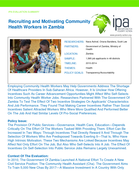
Qualitative study from Zambia on barriers to and facilitators of life-long learning
A systematic analysis for the Global Burden of Disease Study 2019. The Lancet Vol.399 Issue 10341 p.2129-2154
Human resources for health (HRH) include a range of occupations that aim to promote or improve human health. The UN Sustainable Development Goals (SDGs) and the WHO Health Workforce 2030 s
...
The State of the world’s nursing 2020 report provides the latest, most up-to-date evidence on and policy options for the global nursing workforce.
Policy Note #3: Myanmar Health Systems in Transition Policy Notes Series
A network of basic health facilities has been established in each of the 330 townships, covering both rural and urban areas. For the vast majority of Myanmar’s people, particularly the 70% who reside in rural areas, the ...
This report brings attention to achieving gender equality in the context of women, girls, and the HIV response. This six-month consultation in 2016 with adolescent women and young girls found that #WhatWomenWant is: collaboration and joint action by all to invest in women's HIV and Sexual and Reprod
...
Menstrual Hygiene Management
recommended
Operational Guidelines.
Guidelines for the development of educational programmes for MHM, including tips on the topics to address and methods to assess girls’ practices in a respectful way with practical tools
HOW ICAP IS BUILDING NURSING AND MIDWIFERY CAPACITY AND STRENGTHENING HEALTH SYSTEMS
WHO published and launched the third part of the Wheelchair Service Training Package (WSTP) series consisting of two sub-packages: the Wheelchair Service Training Package for Managers (WSTPm) and the Wheelchair Service Training Package for Stakeholders (WSTPs). WHO recognises that in order to develo
...