
Filter
1801
Text search:
livelihoods
Featured
133
545
Language
Document type
865
458
136
125
90
49
36
29
4
4
3
2
Countries
116
87
64
62
59
50
46
38
37
35
34
33
33
31
30
26
25
25
24
23
23
22
22
21
20
16
16
15
14
14
14
13
13
13
13
13
12
12
11
11
10
10
9
9
8
8
8
8
7
7
7
6
6
5
5
5
5
5
5
5
4
4
4
4
4
4
4
4
3
3
3
3
3
3
3
3
2
2
2
2
2
2
2
2
2
2
2
2
2
2
2
2
2
2
2
2
2
1
1
1
1
1
1
1
1
1
1
1
1
1
1
1
1
1
1
1
1
1
Authors & Publishers
Publication Years
Category
699
239
58
43
19
13
1
Toolboxes
251
202
164
104
101
91
85
65
48
45
31
24
21
21
18
18
12
9
7
6
6
4
4
3
3
2
1
For thousands of years, humans have been using wildlife for commercial and subsistence purposes. Wildlife trade takes place at local, national and international levels, with different forms of wildlife, such as live animals, partly processed products and finished products. Wildlife is a vital source
...
Climate change is one of the biggest crises of our time. Climate threats range from higher temperatures, heavy rainfalls and floods, erratic precipitation, droughts, desertification, and land degradation. This has negative implications on the quality and quantity of natural resources, such as land a
...
In 21st century capitalism, financial markets reign supreme. The elevation of investing, trading, and speculating as a way of making profit has shifted economic power towards institutional investors and enhanced the power of financial capital. Financialisation has introduced uncertainty in the commi
...
As the number of transboundary pest and animal and foodborne disease outbreaks rises, so does the number of people who are chronically hungry due to these and other factors. The correlation can be explained by the link between our health and that of the planet. We rely on land and sea for the produc
...
This report aims to support countries in the necessary transition toward healthier, more sustainable diets by integrating biodiversity in food-based interventions to support nutrition and health. It is intended to help guide decision-makers in the health, nutrition and other sectors, to:
Consider
...
Updated version June 2015
The One Health approach can help achieve progress and promotes synergies on national and global priorities by generating synergies at the human-animal-environmental interface. While evidence is still scare, it is likely that the approach is highly cost-effective and improves effectiveness of core pu
...
As the war in Ukraine pushes food, fuel and fertilizer prices toward record levels putting food security in many of the world’s poorest countries at risk, the UN’s International Fund for Agricultural Development (IFAD) today launched a Crisis Response Initiative to ensure that small-scale farmer
...

In 2016 CRS leveraged the robust infrastructure of its large, multi-sectoral orphans and vulnerable children (OVC) program in Nigeria by expanding the program's core mandate to include community childhood TB casefinding, with a focus on highly vulnerable children and their caregivers
Accessed November 2014
UNDP Africa Policy Note
This policy brief is targeted at national governments, donors and regional and international actors to support Ebola-affected countries to transition from emergency response to recovery.
The number of new Ebola infections in Sierra Leone is declining, despite the outbreak continuing to claim lives. New cases have dropped to around 9-12 per week, according to recent WHO figures. There were over 500 cases per week at the height of the crisis around late November 2014.
The impact on t
...
The building damage assessment, conducted between March 2010 and February 2011 by the Government of Haiti and the United Nations system, showed that more than 400,000 buildings were damaged or destroyed, of which approximately 218,000 could be occupied without repairs (green category), 105,000 were
...
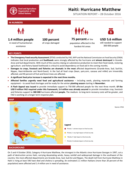
IN NUMBERS
1.4 million people in need of humanitarian assistance
100 percent of crops damaged
75 percent of the population affected in the hardest-hit areas
USD 5.6 million still needed to support 300 000 people
